Key Takeaways
- A true AI agent is autonomous. It plans, acts, and adapts without constant human input. Most tools marketed as "agents" are actually simpler AI tools or rule-based automations.
- AI agents excel at data-heavy, repetitive SEO tasks like content brief production, keyword clustering, and internal linking analysis, saving teams hours of manual work.
- Agents fail at tasks requiring strategic judgment, brand nuance, or human relationships. Human oversight is critical, especially for content that gets published.
- When building an AI-powered content pipeline, use agents for research and drafting but streamline publishing with a headless blog CMS like Wisp to eliminate engineering bottlenecks.
If you're a marketing director or CMO at a mid-market SaaS company, you've probably heard the phrase "AI agents for marketing" at least a dozen times in the last six months. It's in every vendor deck, every LinkedIn post, every conference keynote. And if you've actually tried to figure out what any of it means for your team, you've likely hit a wall of vague promises and underwhelming demos. This article isn't going to add to that noise. Instead, it's a grounded look at what AI agents actually are, where they genuinely help, and where the hype quietly outpaces the reality.
Let's start with a clear definition.
What Is an AI Agent? (The Real Definition)
An AI agent is not just a chatbot with extra steps. According to LiveRamp's breakdown, a true AI agent is an autonomous entity capable of planning, executing, and optimizing multi-step tasks without constant human instruction.
An agent perceives its environment, makes decisions, and takes actions, adapting based on the results. It loops until the goal is achieved.
That's what separates a real agent from everything else. It doesn't just answer a question and stop. It checks whether the answer worked, adjusts, and keeps going. Think of it as a junior team member with a very narrow but very reliable skill set, one who can work through a defined process without you holding their hand at every step.
The problem is that this definition has been stretched far beyond its original meaning.
AI Tools vs. Automation vs. Agents
This is the most important distinction in the article, and getting it wrong is costing marketing teams real money. Here's how to think about the three categories:
AI Tools
AI Tools are reactive. You give them a single input, they return a single output. ChatGPT answering a prompt is an AI tool. An image generator is an AI tool. A grammar checker is an AI tool. Powerful, yes. Autonomous, no. MindStudio puts it plainly: AI tools provide a single output to a specific input. They don't plan, they don't adapt, and they don't take action on your behalf.
AI Automation
AI Automation chains pre-defined steps together using rigid logic. Zapier is the canonical example. An email sequence that fires when someone fills out a form is automation. It follows a script.
It can handle structured, predictable workflows well, but the moment something falls outside the script, it breaks or stalls. It's not thinking, it's executing a checklist.
AI Agents
AI Agents plan a multi-step task, take real actions, evaluate the results, and adapt their next steps to hit a goal. A real agent tasked with "monitor keyword X and rewrite our blog introduction if we drop below position 5" would check the SERPs, pull the current content, assess what's changed in the competitive results, write a new introduction, and push an update, without you telling it what to do at each step. That's a fundamentally different capability from a tool or an automation.
Here's the uncomfortable truth: most products currently marketed as "AI agents" are either sophisticated AI tools or rule-based automations with the word "agent" bolted on for positioning purposes. As one marketing practitioner put it in a Reddit thread, "most 'AI agents' we tested were either glorified ChatGPT wrappers, or cool demos that didn't survive contact with real client work."
This isn't just a semantic complaint. Harvard Law researchers have a name for it: agent washing. It occurs when companies misrepresent simpler AI tools as agents, overstating their autonomy and business impact, creating real disclosure and compliance risks for organizations that act on those claims.
Where AI Agents Genuinely Deliver in Marketing
With a clear definition in hand, where do real AI agents actually earn their place in a marketing stack? The honest answer is: in data-intensive, repetitive tasks that require analysis and action within a well-defined system.
Relevance AI's library highlights several areas where agents are producing real results today. Automated campaign reporting is one of the strongest. An agent can aggregate performance data from Google Analytics, your CRM, and paid channels, synthesize it into a weekly summary, and flag anomalies that warrant attention. It won't tell you what your brand strategy should be, but it will save your team four hours every Monday morning.
Hyper-personalization at scale is another area with genuine traction. Agents can tailor messaging based on real-time signals like on-site behavior, purchase history, or campaign interaction patterns, adjusting which content a user sees without a human manually segmenting and scheduling every variation.
Dynamic media budget reallocation is an emerging use case worth watching. An agent can monitor campaign performance across channels, identify where conversion rates are shifting, and automatically rebalance spend toward higher-performing placements within pre-set guardrails. This is the kind of task that used to require a media buyer running daily checks and making manual adjustments.
Intelligent audience discovery is also a real application. Agents can analyze behavioral patterns from prior successful campaigns, surface new potential audience segments, and flag them for a strategist to evaluate, compressing what used to be days of analysis into hours.
Where AI Agents Still Fail in Marketing
This is the section most vendors won't write. But it's also the section that will save you from wasting budget and credibility.
The biggest gap is in what practitioners call "upstream judgment." As one marketer described it, the hard part is "studying competitors, spotting what's actually working in your space, adapting your messaging every week, deciding why something should be made." Agents see the visible 10% of the work but miss the upstream judgment that makes that 10% effective. They can execute a brief, but they can't decide whether the brief is pointed in the right direction.
Brand strategy is another ceiling. An agent can generate copy, but it cannot make the nuanced call about whether a particular piece of content fits your brand's positioning in a crowded market. Editorial judgment, tone decisions, and strategic trade-offs all require a human who understands the broader context.
Relationship-dependent tasks are firmly off the table. PR outreach, link building, sales conversations, and community management all require genuine human rapport. An agent can draft a cold email, but it cannot build the trust that makes a journalist respond or a potential partner say yes.
Real-world context is also a hard limit. An agent trained on web data knows facts, but it doesn't have the lived experience to understand local sentiment, cultural nuance in a campaign, or why a particular meme is landing differently in one market vs. another. That gap matters more than most people account for when designing agent workflows.
AI Agents for SEO: Where the Real Value Is
SEO is arguably the marketing function where AI agents have the most mature and defensible use cases right now. The work is data-heavy, the patterns are structured, and the feedback loops are measurable. Here's where agents are actually moving the needle.
Content brief production is the strongest current application. An agent can analyze the top 20 SERP results for a target keyword, extract the key themes, identify common questions from "People Also Ask," map the entities that appear across top-ranking pages, and assemble all of that into a structured brief, faster than any human researcher could. According to Search Engine Land's walkthrough, SEO teams who don't want to sacrifice quality for speed are already using this kind of agent-assisted research at scale.
The critical caveat: letting an agent write and publish content at scale without human review is a different story entirely. One practitioner was direct about the risk: "Most of them got killed by Google updates that aggressively penalized scaled AI content." Human-in-the-loop (HITL) review isn't optional for production content. It's the difference between a content pipeline and a liability.
Keyword research and topical clustering is another strong fit. An agent can ingest a seed keyword, pull related terms, group them by search intent, and map clusters to existing or planned content pillars. This used to take a strategist a full day. Done well, an agent can return a first-pass cluster map in under an hour, ready for human review and refinement.
Internal linking analysis is an underrated application. An agent can crawl a site, identify pages with weak internal link equity, and suggest contextually relevant anchor text and source pages based on semantic relationships between content. Search Engine Land highlights this as one of the more immediately actionable workflows for SEO teams adopting agents.
SERP monitoring and alerting. This moves beyond basic rank tracking. An agent can monitor a set of target keywords, detect unusual volatility, identify competitor movements in the top results, and generate a summary alert for the SEO team to review, before a ranking drop becomes a traffic problem. This kind of proactive analysis is where agents start to feel genuinely useful rather than just novel.
Together, these capabilities form the backbone of a modern ai content strategy, one where agents handle the data-gathering and pattern recognition so strategists can focus on the decisions that machines still can't make. For on-page optimization, built-in features like AI Related Posts can then improve internal linking automatically.
Building or Buying: How to Choose Your Path
Once you've decided that a specific workflow is a good fit for an AI agent, the next decision is whether to build it yourself or buy a platform. The right answer depends entirely on your situation.
Buying a Platform
Buying a platform makes sense when your needs map to common, well-defined marketing tasks (brief writing, reporting, keyword clustering), you want to move quickly without a long build cycle, and you don't have in-house technical resources to maintain a custom system. Platforms like Relevance AI are designed exactly for this use case. You configure agents rather than build them, which significantly reduces the time from idea to running workflow.
Building a Custom Agent
Building a custom agent makes sense when you have a proprietary workflow that gives you a competitive edge and you don't want a vendor replicating it for other customers. This is often the case for agencies managing multiple client blogs, where a multi-tenant CMS is essential for scaling operations securely. It also makes sense when off-the-shelf tools don't connect cleanly to your specific data stack, or when you have the technical talent to treat the agentic workflow as a long-term internal asset. Tools like n8n offer the flexibility to build highly specific workflows that no packaged platform would support out of the box.
One practical insight from teams that have gone through both paths: it's almost always better to start with a platform and then graduate to custom builds for your highest-value, most differentiated workflows. Trying to build everything custom from the start is one of the fastest ways to spend six months and end up with nothing deployable.
What Synscribe's AI Agent Stack Looks Like
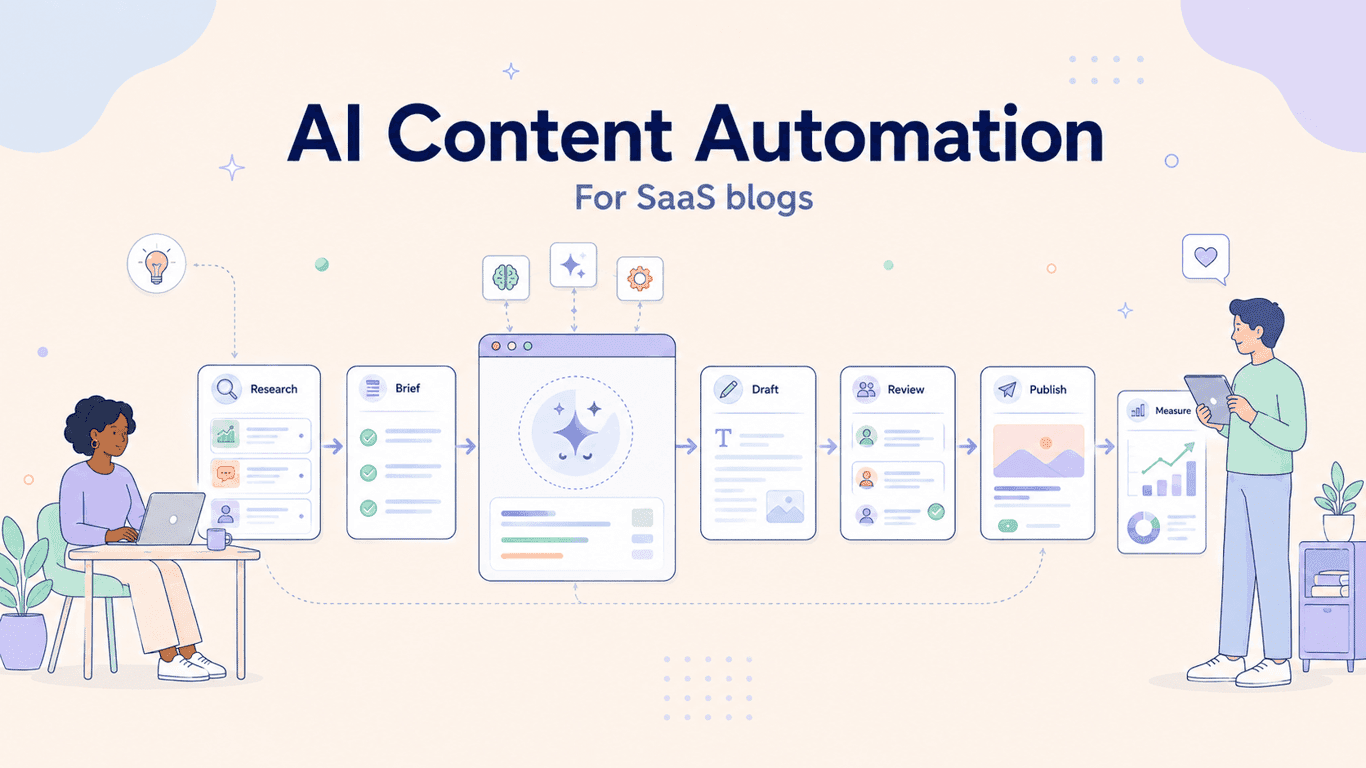
We're not going to claim we have a magic system. What we have is a structured process built around a human-in-the-loop (HITL) model, where agents handle the volume work and our strategists handle the judgment calls. Here's what that looks like in practice for a content production workflow.
- Strategist input. A human defines the target audience, the competitive context, and the primary keyword cluster. No agent decides what to build or why. That decision sits with the strategist.
- Research agent. An agent analyzes the top-ranking SERP results for the target keyword, extracts key themes, common questions, competitor content structures, and semantic entities. This typically covers 20 to 30 URLs and returns a structured research summary.
- Briefing agent. A second agent synthesizes the research into a comprehensive content brief. This includes a recommended outline, suggested internal linking targets, semantic keywords to include, and notes on gaps in existing competitor content.
- Human review. The strategist reviews the brief, challenges the structure where needed, and adds brand-specific direction, positioning context, and any insight that only comes from knowing the client's market. This step is not optional. It's where the brief goes from usable to actually good.
- Assisted drafting. An AI tool (not an agent) helps a writer produce the first draft against the approved brief. The writer is in control. The tool accelerates, it doesn't replace.
- Human editorial. The piece goes through standard human editing, fact-checking, and brand voice review before anything is published. The final step, publishing, is where a system with features like Custom Content Types can make the difference between a smooth handoff and another bottleneck.
The "stack" isn't really about tools. It's a workflow where each agent has a specific, delegated task with a clear handoff point to a human. That structure is what keeps quality consistent at scale. And it's also why practitioner feedback about agents needing to be "adaptive around workflows but still have actual marketers be in charge" resonates with us, because that's exactly how we've built it.
How to Evaluate AI Agents for Your Marketing Team
Before you buy into any agent platform or start a build project, run through these five questions.
1. What is the precise task? "Automate reporting" is too vague. "Aggregate Google Analytics traffic, HubSpot MQLs, and Stripe revenue by campaign into a weekly summary with flagged anomalies" is a task an agent can actually perform. Specificity is what separates a useful agent from a perpetual pilot project.
2. Does this task require judgment or execution? If the work involves nuanced strategic trade-offs, brand decisions, or interpretation of ambiguous signals, it's not a good agent task. If it involves processing structured data and taking a defined action based on clear criteria, it likely is. MindStudio's breakdown is useful here for setting expectations.
3. How stable is the workflow? Agents struggle with processes that change frequently. As practitioners have noted, you need to build agents around workflows that are stable enough to automate, but the moment your process shifts every week, the agent becomes a maintenance burden rather than a time saver.
4. What's the cost of a failure? If an agent produces a wrong output and no one reviews it before it goes live, what happens? For internal reporting, a mistake is recoverable. For published content or automated customer communications, the stakes are higher. Design your oversight accordingly.
5. Are you being agent-washed? When a vendor pitches you on their "AI agent," ask them to walk you through a real multi-step task the agent handles autonomously. Look for genuine planning, action-taking, result assessment, and adaptation. If what they're showing you is a chained automation with an AI step in the middle, that's not an agent. Harvard's research is worth keeping in mind when evaluating any vendor in this space.
Put AI Agents to Work the Right Way
AI agents are powerful—if you know what they’re actually for. A true agent plans and acts on its own, which is why most “agents” are really just smart tools. Use them for the heavy lifting in your SEO workflow, like generating content briefs or analyzing internal links, but always keep a human in charge of strategy and the final review.
Your next step? Don't try to automate everything. Identify one repetitive task in your content process—like initial SERP analysis for a new post—and see how an AI tool can assist your team this week.
Once those AI-assisted drafts are ready, a clunky CMS shouldn't be what slows you down. If you're tired of engineering bottlenecks getting in the way of publishing, Wisp's free plan offers a headless CMS designed to get content live faster. Try it for free and see if it’s the right fit for your team.
FAQs
What's the difference between an AI agent and an AI tool?
The key difference is autonomy. An AI agent can plan, act, and adapt through multi-step tasks to achieve a goal on its own. A regular AI tool, like a chatbot, only provides a single output for a single input and cannot act independently.
What marketing tasks are AI agents actually good for?
AI agents are best for data-intensive, repetitive marketing tasks. This includes automated campaign reporting, keyword clustering, and analyzing large datasets for audience discovery. They excel where clear rules and measurable outcomes exist.
How can AI agents help with SEO without penalties?
AI agents can safely help with SEO by handling research and analysis. Use them for tasks like content brief production, internal linking analysis, and SERP monitoring. Always have a human review and approve any content before it gets published.
When should I not use an AI agent for marketing?
You should not use an AI agent for marketing tasks that require strategic judgment, brand nuance, or human relationships. This includes setting brand strategy, making final editorial decisions, or conducting personal outreach like PR and link building.
Can an AI agent publish blog posts directly to my site?
No, you should not let an AI agent publish content directly without human review. A human-in-the-loop process is essential to ensure quality, accuracy, and brand alignment, and to avoid search engine penalties for scaled AI content.
Should my team build or buy AI agents?
Buying an AI agent platform is best when your needs are common, like brief writing, and you want to move quickly. Building your own makes sense for proprietary workflows that provide a competitive advantage and when you have in-house technical resources.
What is "agent washing" and how do I spot it?
"Agent washing" is when companies misrepresent simpler AI tools as autonomous agents. You can spot it by asking vendors for a demo of a real multi-step task. If the tool can't plan, act, and adapt without constant input, it's likely not a true agent.