 Are you a startup or small business looking for a powerful content management system without the enterprise-level price tag?
While Contentful leads the headless CMS market with impressive features that enable "78% increases in conversion rates" and "5-minute release cycles," its pricing structure and complexity can be overwhelming for smaller teams with simpler needs.
As developers frequently express on platforms like Reddit, there's a growing demand for "hassle-free setup and management" and frustration with the "limitations and reliance on third-party services" that often accompany larger platforms. Many teams simply want a "user-friendly content editing experience" that doesn't require constant developer intervention.
The good news? The market offers excellent budget-friendly Contentful alternatives tailored specifically for startups and SMBs. In this article, we'll explore eight cost-effective options, comparing their pricing models, free tiers, essential features, and implementation complexity.
Key Takeaways
Contentful is a leading headless CMS, but its enterprise pricing and complexity often make it a poor fit for startups and SMBs.
This article compares 8 budget-friendly alternatives based on cost, features, and ease of use, helping you find a tool that solves your specific problem efficiently.
When choosing, evaluate the total cost of ownership (including developer time), prioritize a user-friendly editing experience for your team, and ensure it fits your tech stack.
What Is a Headless CMS?
Before diving in, let's clarify what we mean by a "headless CMS."
Unlike traditional content management systems that handle both content creation and presentation, a headless CMS focuses solely on the back-end content management. It provides tools for modeling, creating, and organizing content, which is then delivered via an API to any front-end or "head" (like a website or app) that's managed separately.
This decoupled architecture gives you the flexibility to present your content across multiple platforms while maintaining a single content repository.
Why Look Beyond Contentful?
While Contentful offers a powerful suite of enterprise features—including a modular architecture, no-code tools for personalization, and 99.99% uptime—there are several compelling reasons for startups and SMBs to explore alternatives:
Cost: Contentful's subscription model can become expensive for high-traffic sites or as teams grow. The value proposition is geared toward enterprises where a "50% reduction in costs through improved efficiency" justifies the price tag.
Complexity: For teams that just need a blog or a simple content repository, a full Digital Experience Platform (DXP) is often unnecessary. User research shows a clear preference for simplicity and "quick and easy setup."
Niche Focus: General-purpose CMSs can't excel at everything. A specialized tool might solve a specific problem (e.g., adding a blog to a Next.js app) more efficiently.
8 Budget-Friendly Contentful Alternatives
Now, let's explore the best budget-friendly Contentful alternatives this 2026.
1. Wisp
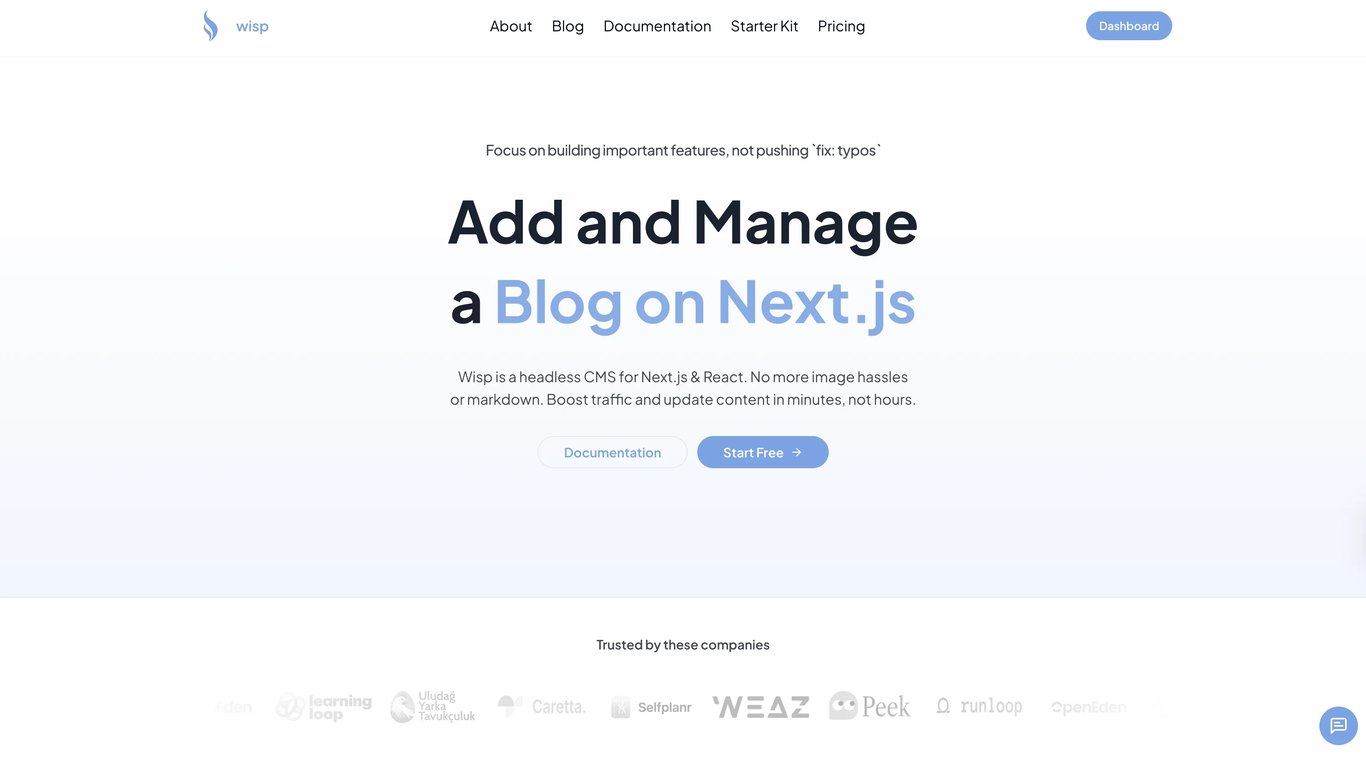
Overview: Wisp is a headless CMS built specifically for adding and managing high-performance blogs on Next.js and React sites. It's designed for teams who want to ship content fast without the engineering overhead of maintaining blog infrastructure. As one user noted, "Wisp took me literally 15 mins to setup."
Target Audience: Indie hackers, bootstrapped startups, and small teams managing one or many blogs.
Key Features:
Purpose-Built for Next.js/React: Solves the exact pain of adding a "blog layer" without the bloat of a general-purpose CMS.
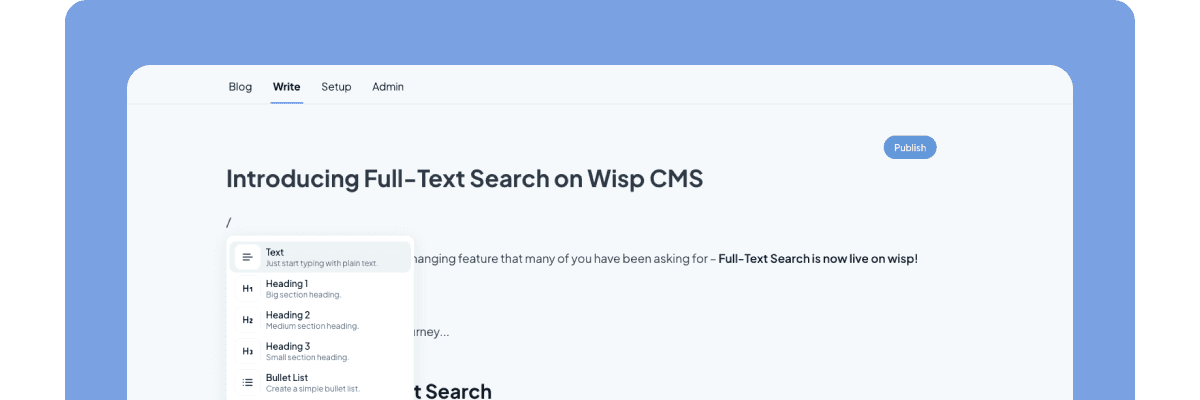
Distraction-Free Editor: A Medium/Notion-style editor that empowers non-developers to publish and format posts without writing Markdown. This directly addresses the common user pain of "dissatisfaction with the usability of the current rich text editor."
Integrated Media Handling: Images are automatically uploaded and served via a global CDN, supporting drag/drop and copy/paste. No need for a separate image pipeline.
Developer-Friendly Tooling: A clean Content API and a JavaScript SDK with TypeScript support for fast, type-safe integration.
Built-in SEO Guidance: Includes support for metadata, JSON-LD, and sitemaps to help with SEO optimization.
Multi-Tenancy: Manage multiple, separate blogs under a single account—perfect for agencies or founders with multiple projects.
Pricing & Free Tier:
Free Forever Plan: Includes core features and unlimited blogs/posts with Wisp attribution.
Pro Plan: Per-user pricing with no attribution and priority support.
Indie Hacker Pass: A lifetime option for solo creators.
Implementation & Maintenance:
Implementation: Extremely simple. Users grab a Blog ID and can integrate into an existing Next.js site or use the Next.js Blog Starter Kit for a working setup in under a few hours.
Maintenance: Minimal. Since Wisp is fully managed and purpose-built, there is no need to maintain servers, databases, or complex plugins.
2. Strapi
Overview: Strapi is a leading open-source, Node.js-based headless CMS known for its flexibility and extensive customization options.
Key Features:
User-friendly admin interface
Flexible content modeling and robust API capabilities
Hundreds of plugins available for extending functionality
Supports multiple databases and cloud providers
Pricing & Free Tier: The core software is free and open-source for self-hosting. Strapi Cloud offers managed hosting with paid tiers, but there is no free plan for cloud hosting.
Implementation & Maintenance:
Implementation: Requires technical knowledge for setup and deployment, especially the self-hosted version.
Maintenance: Self-hosting means you are responsible for server management, security, and updates, which adds to the long-term total cost of ownership.
3. Sanity
Overview: Sanity is a composable content cloud platform that offers real-time collaboration and a unique query language.
Key Features:
Real-time Collaboration: Multiple editors can work on content simultaneously
GROQ: A powerful, precise query language for fetching content
Custom Content Structures: Highly flexible for building complex data models
Pricing & Free Tier: Offers a generous free tier for individuals and small projects. The Team plan starts at $15/user/month.
Implementation & Maintenance:
Implementation: Relatively straightforward for developers, but there is a learning curve for the GROQ query language.
Maintenance: Fully managed SaaS, so maintenance is low. The main consideration is the potential for rising costs with increased usage and limited dedicated support on lower tiers.
4. Storyblok
Overview: Storyblok is a headless CMS that stands out with its real-time visual editor, allowing content creators to see changes as they make them.
Key Features:
Visual Editor: A unique feature that bridges the gap between headless flexibility and traditional CMS previews
Component-Based Approach: Content is built with reusable blocks, promoting consistency
Supports multi-language content and custom plugins
Pricing & Free Tier: A free plan is available for a single user. Paid plans start around €99/month, but per-seat pricing can get high on Business plans.
Implementation & Maintenance:
Implementation: The visual editor makes it intuitive for non-technical users, requiring minimal technical skills for content management.
Maintenance: Fully managed, so no infrastructure overhead.
5. Directus
Overview: Directus is an open-source, API-driven CMS that acts as a data platform, instantly turning any SQL database into a REST/GraphQL API and providing a beautiful admin interface.
Key Features:
Highly customizable admin interface
Supports multiple SQL databases (PostgreSQL, MySQL, etc.)
Granular role-based access control for user permissions
Pricing & Free Tier: Offers a free, open-source, self-hosted option. A managed cloud version is also available with tiered pricing.
Implementation & Maintenance:
Implementation: Best suited for developers, as setup and configuration require technical expertise.
Maintenance: Similar to Strapi, self-hosting requires server management. The cloud version abstracts this away for a monthly fee.
6. Prismic
Overview: Prismic is a SaaS-based headless CMS with a strong focus on a user-friendly content creation experience and flexible content modeling.
Key Features:
Writing Room: A collaborative interface for content teams
Custom Slices: A component-based approach to building pages
API-driven, designed for easy integration with modern front-ends
Pricing & Free Tier: A free community plan is available. Paid plans scale with features, users, and usage.
Implementation & Maintenance:
Implementation: Designed for ease of use, making it suitable for teams without deep technical skills.
Maintenance: Fully managed platform, so maintenance is handled by Prismic.
7. ButterCMS
Overview: ButterCMS is an API-first headless CMS known for its simplicity and built-in tools that cater to both developers and marketers.
Key Features:
Built-in SEO tools and a user-friendly dashboard
Simple, easy-to-integrate API
Supports multiple programming languages and frameworks
Pricing & Free Tier: Pricing starts at around $50/month. A free tier is available for developers.
Implementation & Maintenance:
Implementation: Known for its straightforward setup process.
Maintenance: Fully managed SaaS solution.
8. Webiny
Overview: Webiny is an open-source, cloud-based headless CMS that leverages serverless technology for high scalability and low maintenance.
Key Features:
Serverless-Powered: Built to run on AWS Lambda, which reduces maintenance overhead
Native Multi-Tenancy: Excellent for managing multiple projects or clients
Open-source code allows for deep customization
Pricing & Free Tier: Offers a free starter plan. Paid plans start at $9/user/month.
Implementation & Maintenance:
Implementation: Requires AWS setup, which can be complex for those unfamiliar with the AWS ecosystem.
Maintenance: Low maintenance once deployed, as serverless infrastructure scales automatically.
How to Choose the Right CMS for Your Startup
1. Evaluate Total Cost of Ownership
Don't just look at the monthly subscription. Consider:
Pricing models: Is it pay-as-you-go based on API calls and bandwidth, or a fixed fee?
Developer time: Factor in the hours required for setup and maintenance, especially for self-hosted options like Strapi or Directus.
2. Prioritize Ease of Use for Your Team
Content creator needs: If non-technical marketers will be creating content, a CMS with a visual editor (Storyblok) or a simple, intuitive interface (Wisp, Prismic) is crucial. This addresses the common pain of needing a better editing experience.
Implementation timeline: A tool with a starter kit, like Wisp, can dramatically reduce the time from decision to deployment.
3. Plan for Scalability
Your CMS should grow with you. A decoupled architecture allows flexibility, but be aware that "technical debt can accumulate in display layers over time."
Check for features like multi-tenancy (Wisp, Webiny) if you plan to manage multiple properties.
4. Ensure It Fits Your Tech Stack
Choose a CMS that integrates well with your chosen front-end framework. For Next.js and React, a specialized solution like Wisp is optimized for that environment, while others like Strapi and Sanity are more framework-agnostic.
Find Your Perfect Fit, Not Just a Cheaper Contentful
Choosing a headless CMS isn't just about cutting costs—it's about finding a tool that accelerates your team instead of slowing them down. While Contentful excels in the enterprise, its complexity can become a bottleneck for startups and SMBs. The right alternative isn't a watered-down version of a DXP; it's a focused solution that solves your specific problem with elegance and efficiency.
Whether you need a powerful open-source platform like Strapi for deep customization or a visually-driven editor like Storyblok for your marketing team, the market is full of excellent options that respect your budget and your time.
If your primary goal is to launch a fast, SEO-friendly blog on a Next.js or React site, the choice becomes even clearer. Stop wrestling with generic tools and complex setups. A purpose-built solution like Wisp is designed to get your content live in minutes, not weeks.
Ready to see how fast you can launch your blog? Try Wisp for free and publish your first post today.
Frequently Asked Questions (FAQ)
What is a headless CMS?
A headless CMS is a back-end content management system that separates your content repository from the presentation layer (the "head"). It allows you to store and manage content in one place, delivering greater flexibility and scalability compared to traditional, monolithic CMS platforms.
Why should a startup consider a Contentful alternative?
Startups should consider Contentful alternatives primarily to manage costs, reduce complexity, and find a solution better suited to their specific needs. While Contentful is powerful, its enterprise-level features and pricing can be excessive for smaller teams that only require core functionalities.
What is the best free Contentful alternative for a small project?
The best free Contentful alternative depends on your project's needs. For adding a blog to a Next.js or React site, Wisp offers a comprehensive "Free Forever" plan. For more general-purpose use cases, Sanity provides a generous free tier for individuals and small teams. Meanwhile, open-source options like Strapi and Directus offer powerful free core software, but require you to manage the hosting and maintenance.
How do I choose the right headless CMS?
To choose the right headless CMS, you should evaluate the total cost of ownership (including developer time for setup and maintenance), prioritize ease of use for your content creators, make sure the platform can scale with your business. For example, a team of non-technical marketers would benefit from a CMS with a visual editor, like Storyblok, or a simple interface, like Wisp.
What is the easiest way to add a blog to a Next.js site?
The easiest way to add a blog to a Next.js site is by using a purpose-built headless CMS designed specifically for that task. A solution like Wisp is optimized for Next.js and React, offering a starter kit and a streamlined setup process that can take just minutes.
What is the difference between a self-hosted and a managed headless CMS?
A self-hosted headless CMS, like Strapi or Directus, is open-source software that you must deploy and manage on your own servers. A managed (SaaS) headless CMS, like Wisp, Sanity, or Storyblok, is a cloud-based service where the provider handles all infrastructure, maintenance, and security, allowing you to focus solely on creating and delivering content.