Key Takeaways
SEO vs. GEO: Traditional SEO aims for clicks, while Generative Engine Optimization (GEO) aims for your content to be cited in AI-generated answers. With up to 70% of searches becoming zero-click, being the source is the new goal, but a strong SEO foundation is still required for discovery.
Optimize for Citation: Success in GEO is measured by "reference rate." Create content with original research, unique data, or a distinct point of view that an AI can confidently reference.
Structure for Machines: Use FAQ sections, schema markup, and clean headings to make your content easily parsable for AI retrieval systems, which helps AI models extract and cite your information accurately.
Use GEO-Ready Infrastructure: A headless CMS like Wisp helps by providing clean metadata control and structured content features, allowing teams to publish citable content without developer bottlenecks.
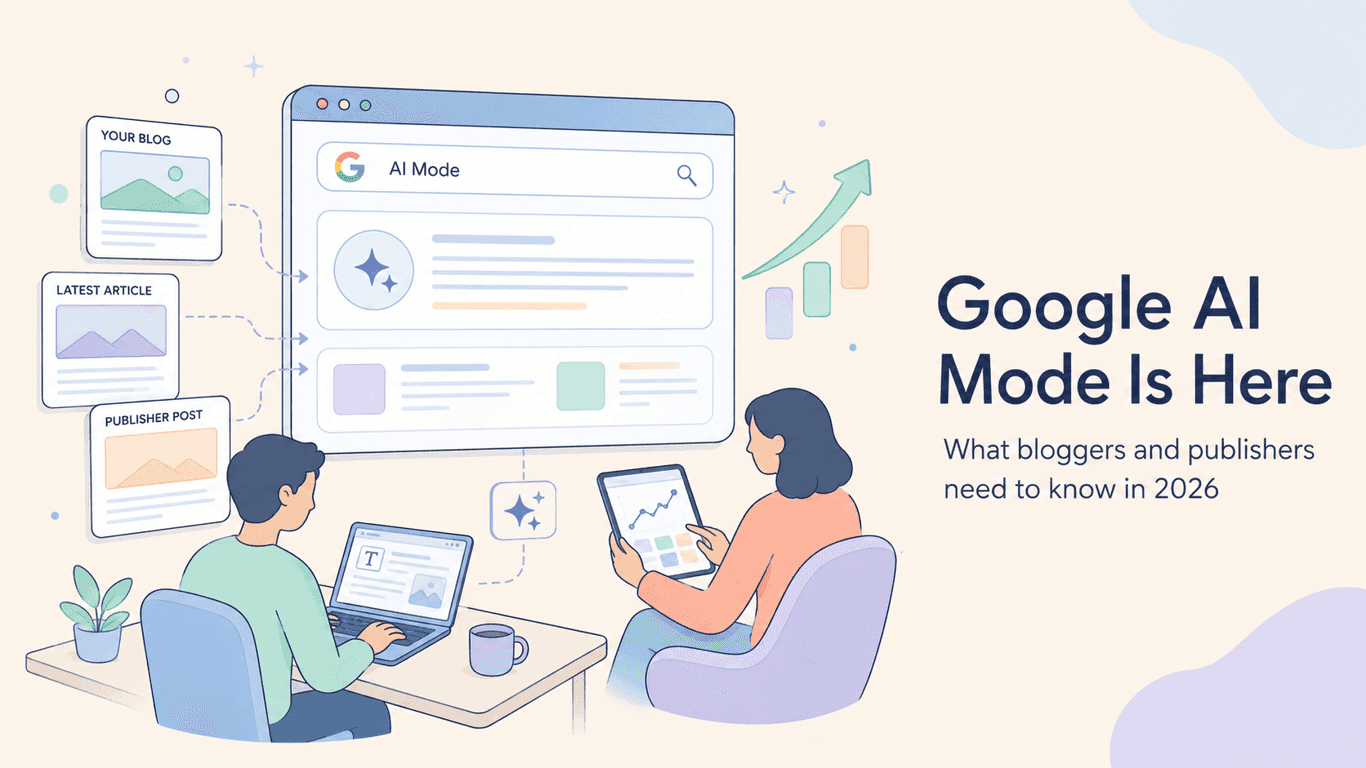
Your rankings look fine on paper, but traffic keeps dropping. If that sounds familiar, you're not imagining it. AI overviews are absorbing informational traffic from "what is" articles, and the question in 2026 isn't just where you rank; it's whether you get included in the answer at all.
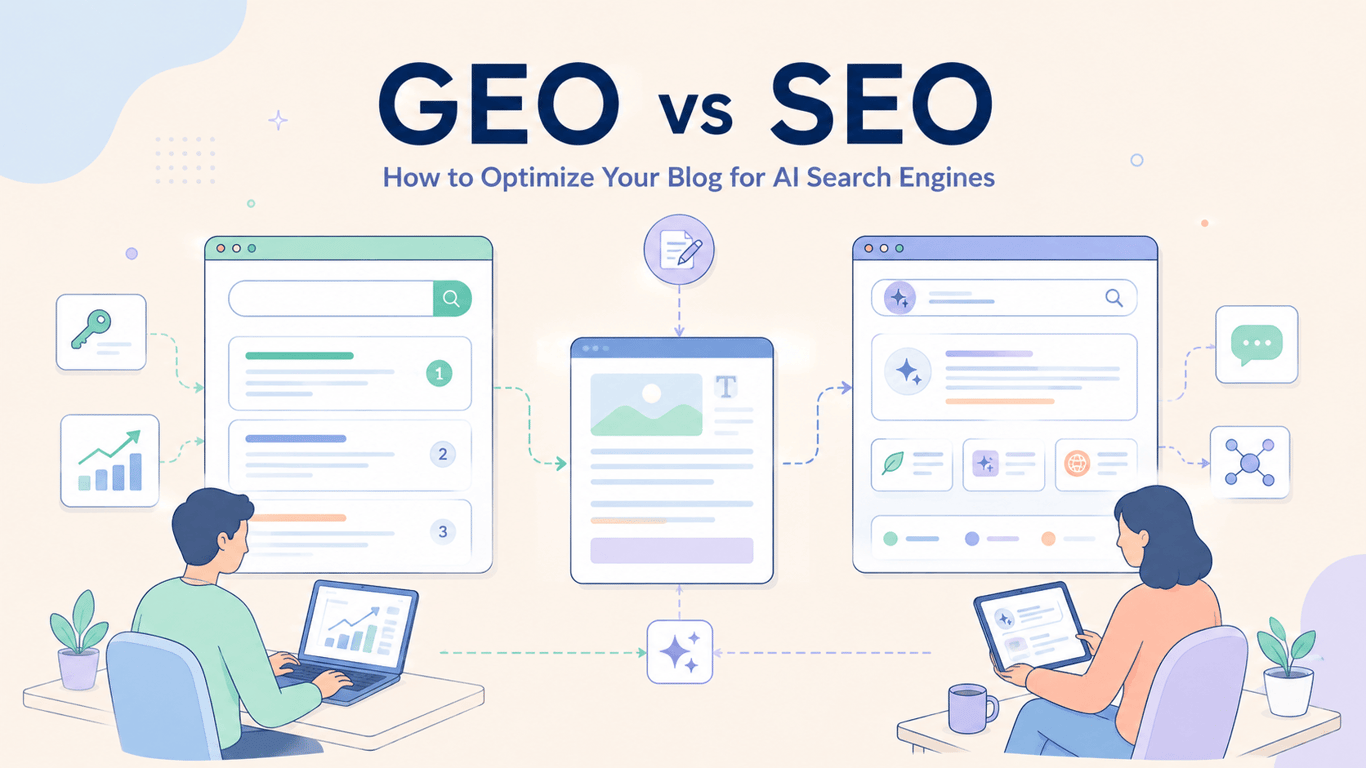
This is where the distinction between Search Engine Optimization (SEO) and Generative Engine Optimization (GEO) becomes critical. SEO gets you onto the list of blue links, while GEO gets you cited inside the answer that replaces those links. Both matter, but they require different thinking.
Here's how the two strategies stack up, where they overlap, and how to run both on your blog in 2026.
The New Rules of Discovery: SEO vs. GEO Defined
SEO is the practice of improving your website's visibility in traditional search engine results pages (SERPs). The primary goal is to rank high and earn a click. The core levers are keyword targeting, backlink acquisition, and click-through rate optimization. According to Semrush's breakdown of GEO vs SEO, traditional SEO has always been about being the most relevant destination for a query.
GEO takes a different angle entirely. Generative Engine Optimization is the practice of optimizing content to be found, understood, and cited by AI-driven search engines like Perplexity, ChatGPT Search, and Google's AI Mode. The goal isn't to be the destination; it's to be the source. You're not optimizing for a click; you're optimizing to become the authoritative reference that an AI model draws from when synthesizing an answer.
The core levers for GEO are authority signals, source credibility, structured answers, entity coverage, and machine readability, a different toolkit than traditional SEO, even if the foundation looks similar.
Why GEO Is Now a Non-Negotiable Strategy
Search behavior has fundamentally shifted. Research from a16z's analysis of GEO shows that average query length has grown to 23 words, and sessions average 6 minutes. Users are having extended, conversational exchanges with AI engines, not firing off quick keyword searches and scanning links.
The downstream effect is zero-click results at scale. As one contributor noted on Reddit, "60-70% of searches" now end without a click. AI-generated answers are absorbing informational queries, once the bread and butter of top-of-funnel blog content. The clicks that remain skew heavily toward high-intent, bottom-of-funnel queries where users want to compare, buy, or sign up.
The performance metrics are changing too. Click-through rate (CTR) mattered when the goal was traffic. In an AI-first search world, the emerging metric is reference rate, or how often your content gets cited as the source in AI-generated responses. New tools like Profound and Goodie are emerging to track this shift. If your content strategy still lives or dies by organic traffic volume alone, it's measuring the wrong thing.
Key Differences in Optimization Tactics
Traditional SEO and GEO share some DNA, but their day-to-day tactics diverge meaningfully.
Traditional SEO focuses on:
Keyword targeting. Matching the exact terms users search for to surface relevant pages.
Backlinks. Acquiring links from authoritative sites to signal credibility to search algorithms.
Click-through optimization. Crafting meta titles and descriptions to maximize clicks from the results page.
Generative Engine Optimization focuses on:
Authority signals. Demonstrating expertise through comprehensive, well-cited content that proves you're a trustworthy source.
Citation worthiness. Creating factual, well-structured content that an AI model can confidently reference without risking a hallucination.
Structured answers. Using formats like FAQs, bullet lists, and tables so both humans and machines can parse the information cleanly.
Entity coverage. Covering a topic so thoroughly that you become the definitive resource for that subject in the AI's knowledge graph.
The mindset difference is this: SEO asks "how do I rank for this keyword?" GEO asks "why would an AI cite me as the source for this answer?"
Where SEO and GEO Overlap (And Where They Diverge)
GEO does not replace SEO. Google has been explicit about this in its official AI optimization guide: generative AI features in Google Search still rely on the same core ranking and quality systems that power traditional results. If your content isn't findable and crawlable, it can't be used in an AI-generated answer either.
The underlying mechanism here is Retrieval-Augmented Generation (RAG). When AI engines respond to queries, they retrieve fresh information from the web index to supplement their training data. That retrieval step depends on your content being indexed, structured, and authoritative, which are classic SEO fundamentals.
Where they overlap:
Technical health. Fast load times, clean crawlability, strong Core Web Vitals. This is especially true for locally-focused businesses running lean without an in-house dev team – local SEO for small business is often where they need to start.
Content quality. Both systems reward helpful, reliable, experience-backed content over thin summaries.
Backlinks. Still a strong authority signal for traditional search, and increasingly relevant for AI models that evaluate source credibility.
Where they diverge:
The key split is in the end goal. SEO is about being the best destination. GEO is about being the most citable source. That shift changes how you write, how you structure content, and what you treat as a success metric. SEO optimizes a page for a ranking position. GEO optimizes a fact for a citation slot.
One other divergence: GEO places a premium on originality. AI engines have seen every generic summary of every common topic. They cite sources that bring something new, like original research, a unique point of view, or a specific data point not found elsewhere. The community sentiment here is direct: "What's working now is focusing on content that offers unique value beyond what AI snippets provide, like in-depth analysis, original research, and personalized insights."
A Practical Checklist for Blog Optimization in 2026
This is where theory becomes execution. The following checklist covers the geo vs seo blog optimization actions content teams should be running right now.
Content:
Provide a unique point of view. Don't just summarize existing content. Google's helpful content guidance specifically calls for content derived from personal experience or original research. Generic AI-generated summaries won't earn citations. Human perspective will.
Add original data or analysis. A survey result, a proprietary benchmark, or a documented case study makes your content citable in a way that a rewording of Wikipedia never will.
Write for conversational queries. As query length grows, content that directly answers longer, nuanced questions performs better in AI retrieval. Think "how do I optimize my blog for AI search in 2026" not just "AI SEO tips."
Structure:
Use FAQ sections. FAQs are machine-readable by design. They map directly to conversational queries and are easy for AI models to extract as structured answers.
Add schema markup. Implement Article, FAQ, and BreadcrumbList schema at minimum. This gives AI models explicit metadata about your content's purpose and structure, as outlined in Google's technical requirements.
Use short paragraphs and clear headings. Content that's easy to parse visually is easier for AI to segment and cite accurately.
Authority:
Cite your sources. Link out to authoritative external sources to signal that your content is well-researched and trustworthy. If you cite credible institutions, AI models are more likely to treat you as one.
Build topical authority with internal linking. Cover your subject area comprehensively and connect your posts with a dense internal linking structure. Search engines, both human and AI, reward sites that own a topic, not just a page. Wisp's AI-powered related post suggestions automatically surface semantically related content, making it easier to build this kind of internal linking network.
Technical:
Control your metadata. Title tags, meta descriptions, and Open Graph (OG) tags still matter. Clean metadata signals to both traditional crawlers and AI retrievers what a page is about.
Keep HTML clean and semantic. Use proper heading hierarchy, avoid div soup, and don't bury your main content in JavaScript that can't be parsed.
Check your indexability. None of this matters if search engines aren't crawling your pages. Confirm all key posts are indexed and there are no crawl blocks on your most important content.
What not to do: Google's AI optimization guide is clear that you don't need special AI text files, content "chunking" strategies, or rewrites aimed at AI bots specifically. Optimizing for the reader — with accuracy, structure, and depth — handles the AI side as a byproduct.
The Right Infrastructure for a GEO-Ready Blog
Running this strategy well requires a content platform that doesn't get in the way. If every metadata update needs a pull request, or if your writers can't publish structured content without opening a code editor, you're burning time on tooling instead of content.
Wisp is a headless blog Content Management System (CMS) built specifically for blogs on Next.js and React. Its clean API output means the HTML served to crawlers and AI retrievers is semantic and structured from the start, with no plugin bloat or rendering layers to work around. Content teams get full metadata control directly in the editor, so optimizing title tags, descriptions, and OG fields doesn't require developer involvement.
For structured content, Wisp's Custom React Components let developers register interactive components (like comparison tables, calculators, and data visualizations) that writers can insert into posts via slash commands. These components render on the live site, not in the editor preview, which means you can ship your most citable, unique content without a custom dev build every time. That kind of original, structured content is exactly what GEO rewards.
Wisp's AI contextual CTAs use embeddings to match calls-to-action to article content automatically, a useful layer for bottom-of-funnel conversion once your GEO efforts start driving brand visibility and direct traffic. And with the Next.js Starter Kit, the technical foundation for a fast, crawlable, SEO-ready blog is already in place.
Wisp is now part of Synscribe, a leading SEO agency specializing in AI search visibility. That means the infrastructure layer and the strategy layer are connected. Wisp handles the platform; Synscribe handles the content strategy to make you the authority in your space.
Get Cited, Not Just Seen
The goal of your blog is no longer just to get clicks; it's to become the source AI engines cite. This shift requires a two-part strategy. First, keep your SEO foundation strong so AI can find you. Second, create citable content with original data and clear, structured answers.
Your next step is simple: pick one high-performing article and add a well-structured FAQ section. This small change makes your content more machine-readable and citable overnight.
If your current CMS makes simple updates like that a chore, it might be holding you back. A clunky publishing process is the last thing you need when adapting to AI search. To see if a headless CMS can remove that friction, explore Wisp's demo. The free plan includes everything you need to ship structured, citable content.
FAQs
What is the main difference between SEO and GEO?
The main difference between SEO and GEO is the goal. SEO aims to earn a click from a list of search results, while GEO aims to have your content cited directly within an AI-generated answer. One targets the click; the other targets the citation.
Do I still need SEO if I'm focusing on GEO?
Yes, you absolutely still need SEO. Generative engines use traditional search indexing to discover and evaluate sources. A strong SEO foundation is what makes your content visible and authoritative enough for an AI to consider citing it.
What kind of content is best for Generative Engine Optimization?
The best content for GEO provides original value that an AI can confidently reference. This includes unique data, expert analysis, or proprietary research. Structuring content with clear headings and FAQ sections also makes it easier for AI to parse and cite.
How can I measure the success of my GEO strategy?
You can measure GEO success by tracking your "reference rate," which is how often your content is cited in AI-generated answers. Also monitor increases in brand mentions and direct traffic, as being featured in AI overviews builds authority and recognition.
What is the first step I should take to optimize for GEO?
The best first step for GEO is to enhance existing content. Take a high-performing article and add a well-structured FAQ section. This simple change makes your content more machine-readable and directly answers the conversational queries that AI engines value.
Why is structured data important for GEO?
Structured data is important for GEO because it acts like a roadmap for AI systems. This markup explicitly defines your content's meaning and structure, making it easier for AI to accurately extract and cite your information in its answers.
Will GEO replace all clicks to my website?
No, GEO will not replace all clicks. While many informational queries will be answered by AI, high-intent commercial and navigational searches will still drive traffic. GEO builds brand authority that helps capture users for those later clicks.