Key Takeaways
With low URL consistency in Google's new AI Mode, traditional SEO is becoming less effective for driving traffic.
The new goal is to become a citable source by focusing on authority, structured data (schema), and clear, direct answers to complex questions.
Actionable steps include adding FAQ sections to posts, implementing schema markup, and building a strong internal linking architecture to signal topical expertise.
A blog-first headless CMS like Wisp helps by ensuring clean semantic markup and providing tools for structured content, making your blog visible and citable in AI-driven search.
Your traffic dashboard looks fine until it doesn't. Google AI Mode is now live for most users in the US, and it's changing how search works. Since AI can pull from different sources for each query, URL consistency is expected to be low, making classic rank-tracking a less reliable measure of success.
This guide cuts through the noise. You'll get a plain-English explanation of what Google AI Mode actually is, why it changes content discovery, and the concrete steps to take right now to protect and grow your blog's traffic.
Here's what every blogger publishing in 2026 needs to understand about Google AI Mode and how it reshapes the rules of visibility.
What Is Google AI Mode (and How Is It Different?)
Google has shipped several AI-related features in rapid succession, and the confusion is real. Commenters on Reddit have openly admitted they can't understand the specific function of each product. Here's a clean breakdown of the three features that matter for publishers:
Gemini. The engine. Gemini is Google's core AI model, the underlying intelligence that powers the other features. It handles reasoning, language understanding, and multimodal input (text, voice, images).
AI Overviews. The summary. These are the AI-generated boxes that appear at the top of standard search results for certain queries. They synthesize information into a short answer, often with source links. They help users grasp topics quickly but can absorb clicks before anyone scrolls to organic results.
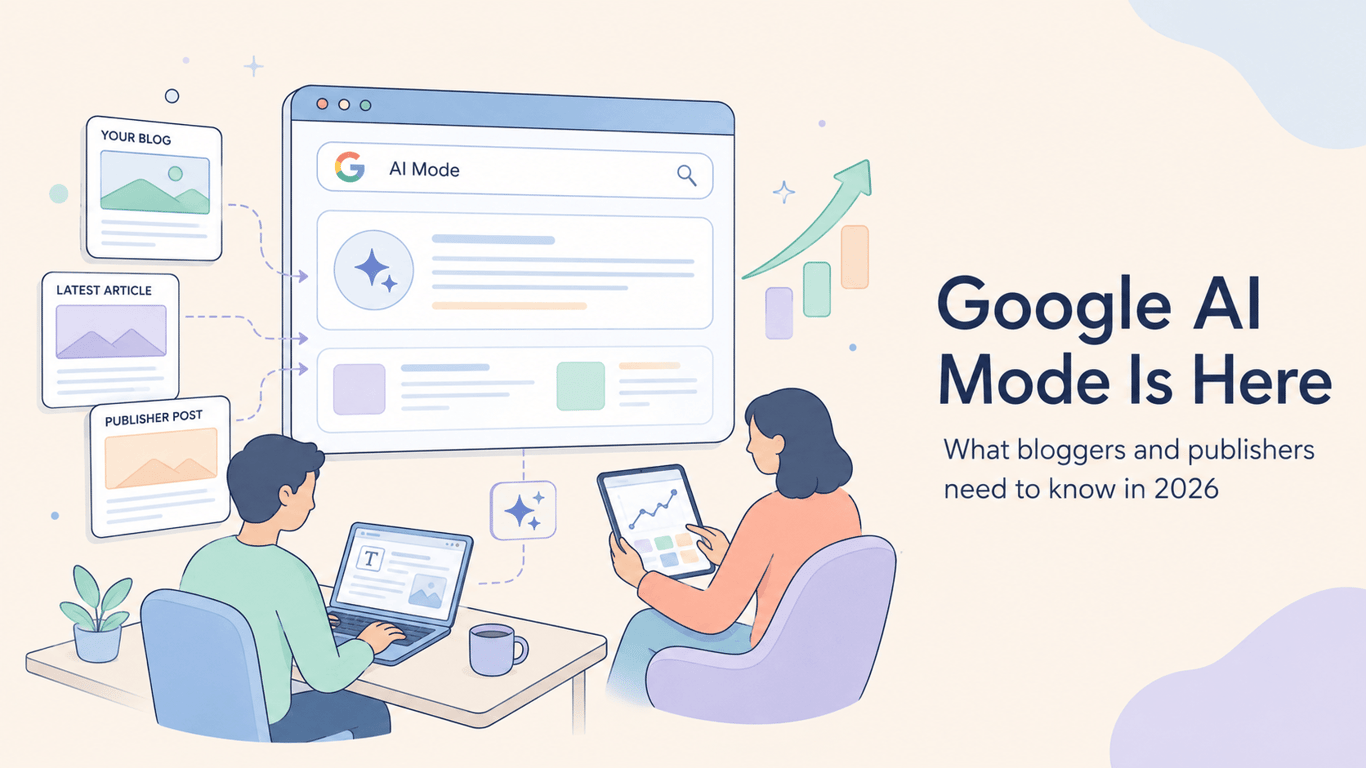
AI Mode. The conversation. This is the full, chatbot-style tab within Google Search, as described by Zapier. It's designed for complex questions where users can explore topics with follow-ups, not just get one answer. It uses a "query fan-out" technique to run multiple related searches and build a more comprehensive response.
The practical difference for bloggers: AI Overviews threaten traffic on simple informational queries, while AI Mode creates an opportunity to become a cited, linked source for complex ones.
How AI Mode Selects Content to Surface
The shift here isn't subtle. According to SEOZoom's analysis of Google AI Mode, AI-driven search has moved away from keyword matching toward something closer to contextual relevance and source credibility. Four signals now carry the most weight:
Authority signals. The AI favors sources with a track record of reliable, high-quality output. This goes beyond backlink counts to include brand recognition and topical consistency.
Structured content. Clean organization with proper metadata and schema markup helps the AI categorize and extract information correctly. A brand with poorly structured content gets summarized poorly, or skipped entirely.
Direct answers. Content that answers specific questions clearly and concisely is more likely to be extracted and cited. Ambiguous or meandering content is harder for the AI to use.
Entity coverage. AI search thinks in terms of entities, meaning people, places, products, and concepts, and the relationships between them. Content that thoroughly covers a topic and connects it to related ideas signals depth and expertise.
These signals compound. A post that is authoritative, well-structured, answers questions directly, and covers an entity comprehensively is significantly more likely to appear in AI-generated responses.
The Real Risk and the Real Opportunity for Bloggers
AI Overviews are the threat most bloggers fixate on, and the concern is legitimate. For simple "what is" and "how to" queries, Google increasingly provides the answer inline. Users don't need to click. This is an accelerated version of the featured snippet problem that content teams have been managing for years.
But AI Mode tells a more complicated story. According to Google's own developer documentation, these features can increase the diversity of website visits as users seek help with complex queries. For deep, multi-part questions, the AI can't fabricate a credible answer from thin air. It needs to cite sources.
That's the opportunity. If your blog is the most authoritative, clearly structured, and comprehensively entity-rich source on a topic, you become a reference the AI cannot ignore. The goal is no longer just ranking at position one. The goal is becoming an indispensable source the AI surfaces in its answers.
6 Things Bloggers Should Do Right Now
Here are the concrete steps worth prioritizing for Google AI Mode visibility in 2026.
1. Implement Schema Markup for Your Content
Structured data is direct communication with search crawlers. Use FAQPage, Article, and HowTo schema types where they match your content. As Google's developer documentation specifies, structured data must align with the visible text on your pages to be valid. Mismatches get ignored or flagged.
2. Add FAQ Sections to High-Intent Posts
FAQ sections convert your expertise into an easily parsable format. Write them as genuine questions your readers ask, not keyword-stuffed placeholders. Each answer should stand alone as a complete, useful response. This directly feeds the "direct answers" signal that AI Mode relies on to generate cited responses.
3. Build Clear Entity Signals Throughout Your Content
When you introduce a term or concept, define it. When you reference a tool, product, or person, link to a canonical source. Use internal links to connect related posts and create topical clusters on your site. This reinforces entity relationships and signals depth of expertise to both Google's crawlers and the AI layer on top of them.
4. Source Everything with Authority
Your outbound links are part of your credibility profile. Citing primary sources, official documentation, original research, and expert commentary positions your content as a trustworthy hub, not a content aggregator. Thin citations undermine trust signals. Specific, named sources build them.
5. Build a Strategic Internal Linking Architecture
Internal linking isn't just for user navigation. It communicates site structure and topical authority to search infrastructure. Connect your posts in logical clusters. A post on schema markup should link to your post on technical SEO fundamentals. A post on content strategy should link to your post on keyword research. Depth and connectivity matter more now than they did in keyword-era SEO.
6. Prioritize Page Experience as a Foundation
Google's guidance on succeeding in AI search is direct: poor page experiences undermine good content. Slow load times, cluttered layouts, and mobile-unfriendly designs reduce the chances that your content gets surfaced, regardless of quality. Core Web Vitals are a floor, not a ceiling. Get them right before focusing on anything else.
Why Your CMS Choice Matters More Than You Think
Strategy is only half the equation. You also need the tooling to execute it. Many of the steps above, including schema markup, structured metadata, clean semantic HTML (Hypertext Markup Language) output, and fast page delivery, depend heavily on what your Content Management System (CMS) actually produces under the hood.
Legacy platforms like WordPress can create friction here. Plugin conflicts introduce bloated code. Theme templates often produce messy markup that's difficult for AI crawlers to parse. Every metadata change can require navigating a tangle of settings or custom code.
A headless CMS built specifically for blogs changes that dynamic. Wisp, a blog-first headless CMS for Next.js and React, gives publishers direct control over metadata at the post and site level, outputs clean semantic HTML that search infrastructure can read accurately, and pairs with a developer-built frontend where page experience is fully in your hands.
Wisp also supports Custom Content Types, which means you can build structured content models, like FAQ blocks or entity-tagged definitions, natively into your publishing workflow rather than bolting them on as afterthoughts. And because it's headless, your developer controls the frontend stack entirely, making performance optimization straightforward rather than a plugin arms race.
For teams managing multiple blogs, Wisp's multi-tenancy support lets you apply consistent structure and metadata patterns across every property from a single account. That consistency compounds into stronger authority signals over time.
As part of Synscribe, a leading SEO agency specializing in AI search visibility, Wisp is built on direct experience with the changes reshaping search right now.
From SEO to GEO: The Framing Shift Worth Making
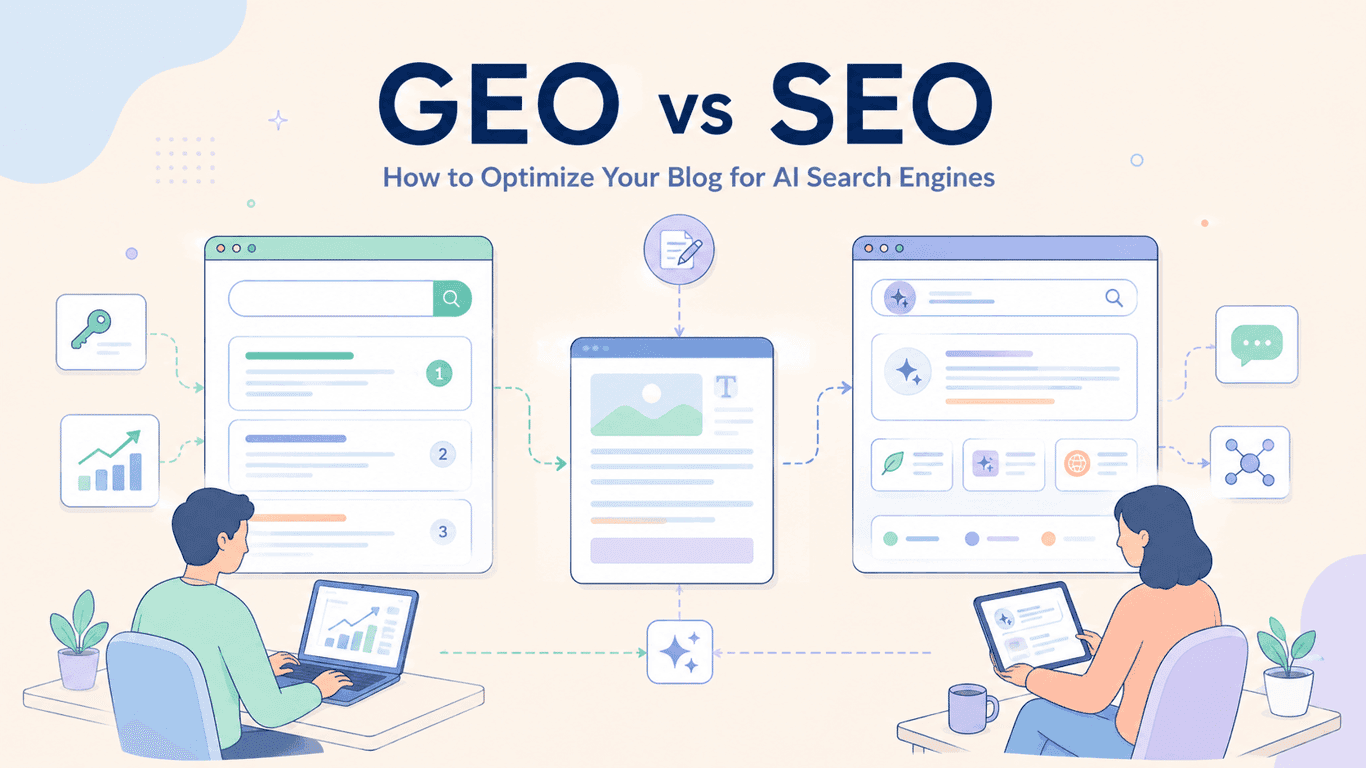
GEO, or Generative Experience Optimization, is the term SEOZoom and others are using to describe what comes after traditional SEO. The concept is straightforward: where SEO meant optimizing for keyword placement and backlink volume, GEO means optimizing for the full experience a user has when your content is surfaced in a direct click, an AI Overview citation, or an AI Mode response.
AI Mode is the clearest expression of this shift. It doesn't want a page that ranks for a query. It wants a source it can trust, extract from, and recommend to a user asking a complex question. Your content strategy needs to reflect that difference. Keyword targeting remains useful as a research signal. But the output should be authoritative, structured, entity-rich content that satisfies intent, not just matches terms.
The good news is that the fundamentals haven't changed as much as the headlines suggest. Original research, clear writing, accurate information, and fast delivery have always mattered. AI Mode just makes it harder to fake any of them.
Turn Your Blog Into a Citable Source
The shift to AI search is here, but it’s not about chasing algorithms. It’s about becoming a citable source. The most practical way to do this is by structuring your content for clarity—think direct answers in FAQ sections and clean schema markup. This signals to Google's AI that your content is a reliable reference worth surfacing.
As a next step, take one of your most popular blog posts and add a short FAQ section. It’s a small change that can directly impact your visibility in AI-driven search.
If your CMS makes these foundational tasks feel like a chore, you're losing a competitive edge. Wisp is designed to remove that friction. Its free plan has all the core features for publishing structured, AI-ready content—try it out to see how much faster you can ship.
FAQs
What is Google AI Mode?
Google AI Mode is a conversational search feature for complex questions. It provides AI-generated answers by synthesizing information from multiple cited web sources, creating a more interactive experience than standard search.
How is AI Mode different from AI Overviews?
AI Overviews are brief, AI-generated summaries for simple queries at the top of search results. AI Mode is a separate, conversational interface designed for deeper exploration of complex topics and follow-up questions.
Will AI Mode hurt my blog's traffic?
AI Mode can hurt traffic for simple posts, as users get answers without clicking. However, it creates an opportunity for deep, authoritative content to be cited as a source, driving highly qualified traffic from complex queries.
Why is becoming a citable source so important now?
Becoming a citable source is crucial because Google's AI constructs its answers from trusted web pages. If your content isn't seen as a reliable and citable reference, it won't be surfaced in AI Mode, making you invisible.
What is the first thing I should do to prepare my blog for AI search?
The best first step to prepare your blog is to implement structured data, like FAQPage and Article schema. This helps the AI understand your content's context and structure, making it easier to cite you accurately.
Does my CMS choice affect my visibility in AI search?
Yes, your CMS choice affects AI visibility. A modern CMS produces clean semantic markup and gives you control over metadata, which are critical technical signals for being understood and surfaced by AI crawlers.
Is keyword research still useful for AI-driven search?
Yes, keyword research is still useful for understanding user intent and topics. The focus shifts from just matching keywords to creating comprehensive, authoritative content that thoroughly answers the questions behind the search terms.