You've opened a chat window, typed "Write a blog post about [topic]," and watched the AI produce 800 words of competent-sounding nothing. No structure, no real keyword strategy, no brand voice, just fluffy prose that could have been written by anyone, about anything.
The good news is that this is a prompting problem, not an AI problem. While many marketing professionals now use generative AI to create content, the gap between mediocre output and publish-ready drafts almost always comes down to prompt quality. This guide covers exactly what separates the two, with templates you can use today.
Here's how to move from vague commands to structured, search-optimized content that actually reflects your brand.
Key Takeaways
Vague prompts are the primary reason AI-generated content fails at SEO, leading to drafts that ignore user intent, structure, and key optimization elements.
Treat your prompt as a detailed content brief by defining the AI's role, task, audience, format, and tone to produce strategic, search-optimized results.
Use a chained prompting workflow—generating an outline first, then writing section-by-section—to create more coherent and controllable content than single-shot generation.
To maintain a consistent brand voice, provide the AI with 2-3 paragraphs of your best content as examples ("Few-Shot" prompting), which is more effective than just describing your tone.
Once your draft is ready, a headless CMS like Wisp solves the publishing bottleneck by letting writers ship content without developer queues.
Why Most AI Blog Content Fails at SEO
The core failure is simple: vague prompts produce vague content. AI models are powerful pattern-matchers, but they don't have strategic judgment unless you give it to them explicitly. This generic output is a common complaint; as one marketer put it, "AI content still had the AI voice. Everything sounded the same."
Three specific breakdowns happen when prompts are underdeveloped. First, there's no user intent signal. A prompt like "write about remote work" doesn't tell the AI whether the reader is a job seeker, a manager, or someone comparing tools. The AI guesses, and according to Yoast, mismatched search intent is one of the most common reasons AI content fails to rank.
Second, structure gets ignored. Without explicit instructions, you get a wall of text with no H2s, no bullets, and no visual hierarchy, all of which, as noted in a Reddit thread, are "crucial for reader retention and SEO." Third, SEO elements are missing entirely: no meta description, no keyword placement rules, no FAQ schema, just prose.
The fix isn't a better AI. It's a better prompt.
The Anatomy of a High-Performance Blog Prompt
A strong prompt for prompt engineering for blog content isn't one sentence: it's a structured brief. Think of it as a content brief you'd hand to a human writer, but one that also specifies formatting rules, tone, and output structure. W3era's framework and Ryan Robinson's breakdown both land on the same core components.
Every high-performance blog prompt needs these seven layers:
Role. Define the AI's expertise before asking it to write.
"You are a [senior SEO content strategist](https://www.w3era.com/blog/seo/prompt-engineering-seo/) with 10 years of B2B SaaS experience"produces a meaningfully different output than leaving the AI to assume its own identity.Task. State the specific deliverable.
"Write a 1,500-word blog post"is better than"write about X".Context. Supply the background: primary keyword, competitor content length, target SERP features, and any relevant product or brand information.
Audience. Define who's reading. Age, role, technical level, and specific frustration all shape how the AI frames its arguments.
Format. Specify the exact structure: H1, number of H2 sections, bullet list placement, meta description, FAQ section. If you don't specify it, the AI invents its own structure.
Tone. Describe the voice precisely. "Conversational but sharp, like a senior engineer giving advice" produces better output than "professional."
Constraints. Set hard rules: paragraph length, keyword placement requirements, banned words, and passive voice limits.
Leaving out any of these layers is where most content teams drop the ball. The prompt becomes a wish, not an instruction.
5 Prompt Templates for SEO-Ready Blog Posts
Each template below follows the anatomy above. The "Before" shows what most teams send. The "After" shows what actually produces structured, search-optimized output.
1. The TOFU Educational Post
Before: "Write a blog post about headless CMS options."
After:
Role: You are a senior developer and content strategist who builds blogs on Next.js.
Audience: Founders and content marketers on modern tech stacks who want editorial autonomy without dev dependency.
Task: Write a 1,400-word educational post titled "What Is a Headless CMS and Why Does Your Blog Need One?"
Context: Primary keyword is "headless CMS for blogs." Readers are aware of WordPress but frustrated by its limitations.
Format: H1, 2-paragraph intro, 4 H2 sections, a 3-question FAQ using H3s, and a conclusion. Include a meta description under 160 characters.
Tone: Conversational but technically precise. Use "you" language throughout. Avoid corporate filler.
Constraints: Primary keyword in H1, first paragraph, one H2, and conclusion. Paragraph max: 4 sentences.
2. The Comparison Post
Before: "Compare two CMS platforms."
After:
Role: You are a developer who has shipped production blogs on multiple headless CMS platforms.
Audience: Technical founders evaluating CMS options for a Next.js blog.
Task: Write a 1,500-word comparison: "Wisp vs. Contentful: Which Is Right for Your Next.js Blog?"
Context: Wisp is blog-first and purpose-built; Contentful is general-purpose and enterprise-oriented.
Format: Intro, H2 for each tool, H2 for a markdown comparison table (Use Case, Developer Experience, Editor Experience, Pricing), "When to Choose Each" section, Conclusion.
Tone: Objective but opinionated. Acknowledge Contentful's strengths; clearly favor Wisp for blog-centric use cases.
Constraints: Frame Contentful as capable but over-engineered for pure blogging needs. No fabricated pricing.
3. The Tutorial Post
Before: "Explain how to set up a blog with an API."
After:
Role: You are a Next.js engineer who has helped dozens of teams migrate off WordPress.
Audience: Developers building a blog on an existing Next.js app who want a clean CMS integration.
Task: Write a step-by-step tutorial: "How to Add a Blog to Your Next.js App with a Headless CMS."
Context: Primary keyword is "add blog to Next.js." Readers are comfortable with APIs and SDKs but want minimal setup friction.
Format: Intro, numbered H2 steps (each with a short code snippet or command), a "Common Mistakes" H2, and a brief conclusion.
Tone: Direct and technical. No hand-holding on React basics. Be specific about commands and file paths.
Constraints: Every step must have a clear outcome statement. Include at least one code block per step.
4. The Thought Leadership Opinion Piece
Before: "Write a thought leadership post about AI in content marketing."
After:
Role: You are a content strategist and SEO consultant who has run campaigns for SaaS companies.
Audience: Marketing leads and founders who are skeptical of AI hype but open to evidence-based takes.
Task: Write a 1,200-word opinion piece: "Why AI Won't Replace Your Content Strategy (But Bad Prompts Will Slow It Down)."
Context: The piece should challenge the assumption that AI quality is fixed and argue it's entirely prompt-dependent.
Format: Intro (hook with a counterintuitive claim), 3 argument H2s, a "What This Means in Practice" H2, Conclusion.
Tone: Confident and slightly provocative. Use first-person sparingly. Back arguments with specific examples, not platitudes.
Constraints: No "the future of content is AI" framing. Ground every claim in a concrete scenario.
5. The Product-Focused SEO Post
Before: "Write an SEO post about our blog CMS."
After:
Role: You are a product marketer who specializes in SEO content for developer tools.
Audience: Developers and content managers evaluating a headless CMS for their blog.
Task: Write a 1,400-word product-focused SEO post: "Why Wisp Is the Best Headless CMS for Next.js Blogs."
Context: Primary keyword is "headless CMS for Next.js blogs." Wisp differentiators: blog-first, [JS SDK](https://www.wisp.blog/docs/core-concepts/js-sdk), no-code editor, [AI contextual CTAs](https://www.wisp.blog/features/contextual-cta), global CDN delivery.
Format: H1, problem-framing intro, H2 per key differentiator (3–4 total), a FAQ section with 3 questions, Conclusion with CTA.
Tone: Confident and specific. Let product capabilities do the selling, not superlatives.
Constraints: Mention specific features by name. No performance guarantees stated as fact. Keyword in H1, intro, one H2, and conclusion.
How to Prompt for Specific SEO Elements
A complete article prompt gets you structure and tone. These targeted prompts get you the individual SEO components that search engines actually read.
Meta descriptions:
"You are a [senior SEO copywriter](https://www.w3era.com/blog/seo/prompt-engineering-seo/) focused on click-through rates. For a post about [topic] with primary keyword [keyword], write 3 meta description options. Each must be under 160 characters, include the keyword, and end with an action phrase."Keyword placement review:
"Review the following article. Confirm the primary keyword '[keyword]' appears naturally in the first paragraph, the conclusion, and at least two H2 subheadings. Also weave in these semantic variants: [list]. Flag any forced usage."This approach, recommended by Yoast's prompt engineering guide, turns keyword integration from an afterthought into a systematic check.FAQ sections:
"Based on the article about [topic], generate a 4-question FAQ targeting common search queries. Format as H3 questions with 2–3 sentence answers in plain prose. Prioritize questions that could trigger a featured snippet."Internal linking:
"Read the following blog post. Identify 3–5 natural placements for internal links to these pages: [Page Title — URL]. For each, suggest the exact anchor text and the sentence where it should sit."Content without proper links is one of the clearest signals of low-effort AI output, as one user noted.
Why Chaining Prompts Beats Single-Shot Generation
Asking an AI to produce a 2,000-word article in one go is like handing a writer a blank page and walking away. You get something back, but the middle sections drift, the tone shifts, and paragraphs start repeating points made three sections earlier.
Chaining prompts, a technique related to prompting described by ALM Corp, breaks the article into sequential steps, each building on the last. The result is more coherent, more controllable, and far easier to edit.
A practical four-step chain looks like this:
Outline prompt. Ask for a detailed brief: H1, meta description, H2 headings, and 2–3 bullet points under each H2 explaining what to cover. Review and adjust before writing a single word.
Section-by-section writing. Pass one H2 at a time back into the prompt:
"Using our agreed outline, write the section for '[H2 Title]'. Target 350–400 words. Tone: [tone guidelines]."This keeps each section tight and prevents the AI from wandering.Intro and conclusion last. Write these after the body is complete. The intro should hook on the reader's pain; the conclusion should drive a specific action. Writing them last means they actually reflect what the article delivers.
Review pass.
"Review the full draft below. Flag: any repeated phrases, any section that contradicts another, and any claims that need sourcing. Suggest 3 specific improvements."This replaces the instinct to blindly accept the first output.
This workflow requires more prompts, but it produces a draft that needs less editing. For teams publishing at volume, that tradeoff compounds quickly.
Maintaining Brand Voice Across AI-Assisted Content
Generic AI voice is a symptom of one missing input: examples. The fix is Few-Shot prompting (giving the model 2–3 paragraphs that demonstrate exactly how your brand sounds before asking it to write anything).
Here's the structure:
Role: You are a content writer for [Brand Name].
Task: Write an introduction for a blog post about [Topic].
Voice Guide: Your writing must match the style below exactly. Pay close attention to sentence rhythm, vocabulary choices, and how arguments are framed.
---
[Paste 2–3 paragraphs from your best-performing content here.]
---
Now write the introduction.
The "Voice Guide" block is doing the heavy lifting. It gives the model a specific stylistic target, not an abstract instruction like "be conversational." This approach, known as Few-Shot or One-Shot inference, consistently outperforms tone-description prompts alone according to ALM Corp's analysis.
For teams maintaining multiple blogs or publishing across different brand voices, this becomes even more important. Wisp's multi-tenancy support lets you manage separate blogs under one account, so if each client or product line has its own voice guide, you can keep content entirely separate without juggling multiple logins.
Turn Your Prompts Into Performance
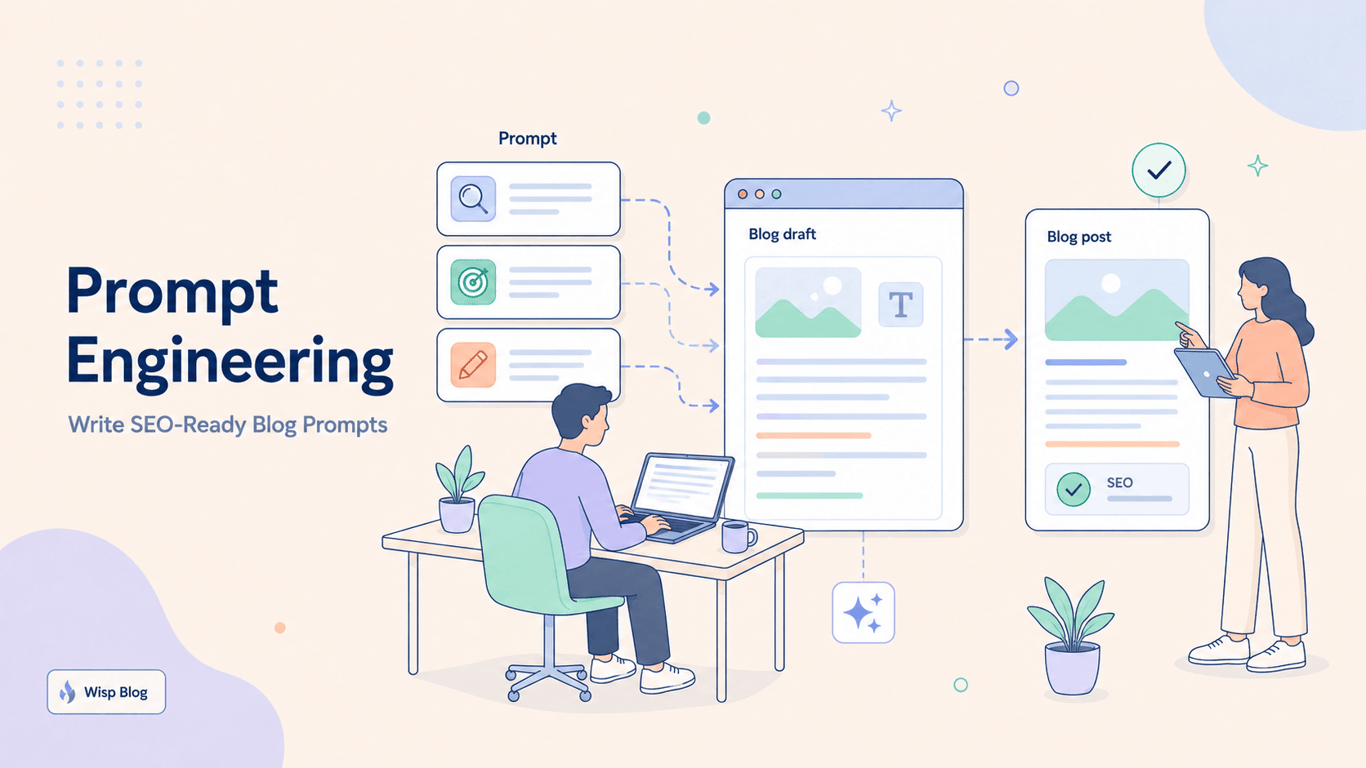
Great AI content doesn’t come from better models; it comes from better instructions. Start treating your prompts like detailed content briefs, defining everything from audience to format. For even more control, generate your outline first, then write section-by-section. This simple workflow shift gives you a stronger, more coherent first draft every time.
Your next step is simple: grab one of the templates above and use it for your next article. Once you see how much better your drafts are, the final bottleneck becomes publishing. If your team is tired of waiting on developer queues, Wisp’s Notion-style editor can make all the difference. The free plan includes unlimited posts and lets you publish without a single PR.
FAQs
What is prompt engineering for SEO content?
Prompt engineering for SEO content is the practice of creating detailed instructions for an AI to generate blog posts optimized for search engines. This includes defining the audience, keywords, format, and tone to ensure strategic, high-quality output.
Why do vague AI prompts produce bad blog posts?
Vague AI prompts produce bad blog posts because they lack specific instructions on user intent, structure, and key SEO elements. The AI is forced to guess, resulting in generic content that fails to rank or engage readers effectively.
How can I make an AI write in my specific brand voice?
To make an AI write in your brand voice, use "Few-Shot" prompting. Provide the AI with 2-3 paragraphs of your best content as examples. This gives the model a concrete stylistic target to emulate, which is far more effective than just describing your tone.
What is chained prompting?
Chained prompting is a workflow where you guide an AI through content creation in sequential steps. You start with an outline, then write each section individually. This method gives you more control and produces a more coherent and well-structured draft.
What are the most important parts of a blog post prompt?
The most important parts of a blog post prompt are defining the AI's Role, Task, Audience, Format, and Tone. Providing context, such as primary keywords, and constraints, like paragraph length, are also crucial for getting a search-optimized result.
Can AI help with more than just writing the article text?
Yes, AI can help with more than just writing text. You can use targeted prompts to generate meta descriptions, find internal linking opportunities, create FAQ sections, and systematically review keyword placement throughout your article.