 Summary
Key stat: 7 tools reviewed — most are fluent text generators with an optimization layer, not writers grounded in your own facts.
Key learning: Drafts come out generic because the tool reads the same top-ten SERPs as everyone else; the fix is to start from your approved internal facts, not the SERP.
Key learning: A saved brand voice plus citation integrity removes the per-draft editing pass that otherwise burns hours stripping AI tells and checking claims.
Action item: Judge each tool on five criteria — source of truth, citation integrity, automated brand voice, human-led strategy, and collaborative workflow.
Action item: For sourced, on-brand long-form that executes your brief, Mole's AI SEO & GEO Agent writes from your approved Company Brain.
Most teams discover the problem after the first few drafts. The article looks polished. The headings are clean, the word count is right, and the SEO score is green. Then you read it and realise it says exactly what every competitor says — because the tool read the same top-ten results and paraphrased them back.
That is the core failure of most tools marketed as an AI SEO content writer. They are fluent text generators with an optimization layer. They do not know your product, they cannot verify what they assert, and brand voice is something you re-teach every session.
The tools worth using work the other way. They write from your approved product facts before they touch the SERP, they cite only what they actually read, and they apply your brand voice automatically. That is the standard this list is built around.
Quick Picks
Rank | Tool | Best For |
|---|---|---|
1 | Sourced, brand-voice-first long-form from your own facts | |
2 | Premium SERP-grounded optimization + light AI drafting | |
3 | Brand-governed content across a full marketing team | |
4 | Real-time content scoring while you write | |
5 | Budget SERP research and brief automation | |
6 | Semantic NLP optimization on a tight budget | |
7 | High-volume short-form and GTM workflow automation |
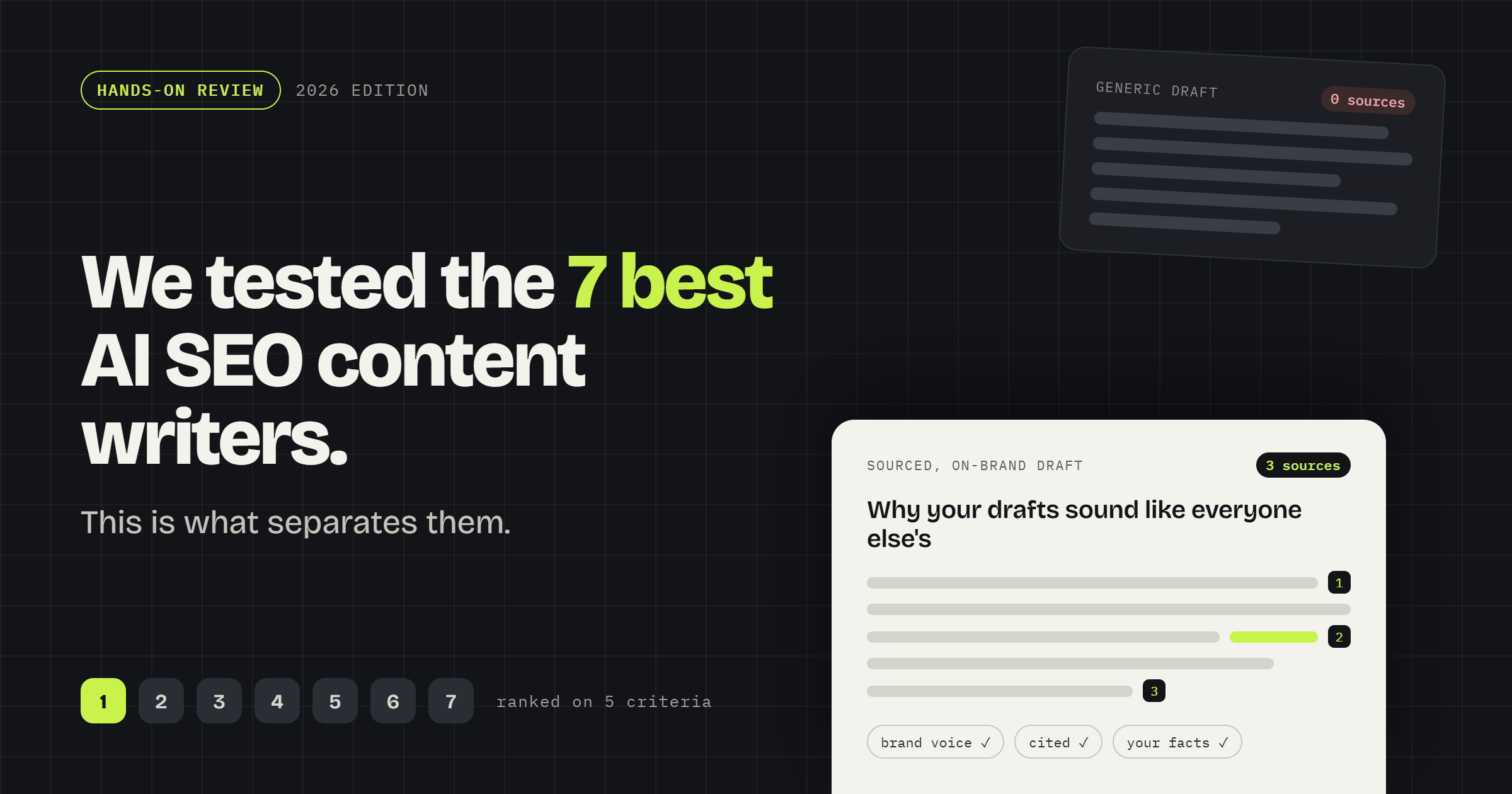
Drafts come out generic when the tool reads the same SERPs as everyone else. Fix that by starting from your internal facts.
If every draft needs a full editing pass to strip AI voice and re-insert your terminology, you need a saved brand voice applied automatically.
For sourced, on-brand long-form that executes your brief: Mole's AI SEO Content Writer is the pick.
How I Picked These Tools
Five criteria separated the real picks from the noise:
Source of truth: Does the tool write from your approved internal facts, or does it default to whatever is already ranking?
Citation integrity: Does every factual claim carry a verifiable source, and does the tool strip links it has not actually read?
Automated brand voice: Can you save your tone rules and off-limits words once, and have them applied to every draft without re-prompting?
Human-led strategy: Does the tool execute a brief you wrote, or does it re-interpret your intent independently?
Collaborative workflow: Is there a shared editor with revision history and built-in client sign-off, or just a generic export button?
The 7 Best AI SEO Content Writers in 2026
1. Mole
The AI SEO & GEO Agent's content writer that drafts verifiable, on-brand long-form from your approved company facts before it reads a single SERP.
Writes from your truth first. Mole starts from the client's Company Brain — approved product facts, positioning, and buyer language — then researches the web. The result is content written from material that is actually yours, instead of the same page-one results everyone else copied.
Sourced, not just fluent. Every factual claim in a draft carries a citation. The agent links only to pages it has actually read; any other link is stripped before the draft reaches the editor.
Brand voice saved once, applied automatically. Tone rules and off-limits words are saved per client and applied on every draft. The first version already sounds like the client — no re-prompting, no manual find-and-replace pass.
Limitation: Mole is built to amplify a strategy you own rather than run one autonomously in the background. The brief determines the direction, and the operator stays in the loop at review and sign-off — so it is best when you want speed without handing the thinking to a black box.
2. Clearscope
A content optimization platform that grounds every draft in real SERP data and grades it as you write.
SERP-based content grading. Clearscope analyzes the top-ranking pages for your target keyword and surfaces the terms, headings, and readability signals that correlate with ranking. The editor updates the grade in real time as you write.
"Draft with AI" integration. The platform includes an AI drafting layer that generates content inside the editor, guided directly by its optimization recommendations rather than as a separate step.
Content inventory and audit tools. Clearscope tracks existing pages over time and flags articles that have decayed in relevance, giving editorial teams a prioritized list of refresh candidates.
Limitation: Clearscope is built around optimizing content against the current SERP. Its generative capability is an addition to that core workflow — it does not write from an internal knowledge base or enforce citation integrity on factual claims.
3. Jasper
An AI marketing platform with governed brand voice features, built for content teams managing output at scale.
Jasper Brand IQ. Jasper can ingest your website and documents to learn your style, tone, and terminology, then apply those rules across different content formats. Pricing starts from $59 per seat per month.
Large template library. Covers blog posts, ad copy, social updates, email sequences, and video scripts — useful across multiple channels from a single platform.
Team collaboration and governance. Built for marketing departments with campaign-level pipelines, approval workflows, and access controls across seats.
Limitation: Jasper's content generation is grounded primarily in general AI model outputs and SERP signals rather than a strict, verifiable process that starts with an approved internal facts brief. Citation management is not a core feature.
4. Surfer
A real-time content editor that scores your article against competitor pages as you write, built for SEOs who optimize first and generate second.
Live content score. Surfer's Content Editor provides a 0–100 score based on NLP term usage, document structure, and length relative to the top-ranking pages for your keyword. The score updates with every paragraph.
Content audit. Analyzes existing pages and produces a prioritized task list of on-page changes — term additions, structural fixes, internal links — to recover or improve rankings.
Topical map. Surfer's cluster-planning feature identifies the supporting articles needed to build topical authority around a target topic, helping teams plan content beyond single posts.
Limitation: Surfer is an optimization layer, not a drafting system. Its AI writing features help refine or generate text toward a target score, but the tool does not maintain business context between sessions or enforce factual sourcing.
5. Frase
A budget-friendly research and brief automation tool that accelerates the early stages of the content workflow.
Automated content briefs. Frase analyzes the top SERP results for a keyword and produces a structured brief in minutes, including common questions, relevant headings, and topic areas competitors cover.
Outline generator. Builds a structured article outline from SERP patterns, giving writers a starting framework without manual research.
In-editor content scoring. An optimization layer inside the editor scores the draft against competitors, similar to other SERP-grounded tools.
Limitation: Frase is strongest at the research and brief stage. Its generative output quality and brand voice control are less advanced than higher-tier tools, and it does not provide verifiable citation management for factual claims.
6. NeuronWriter
A content optimization tool focused on semantic SEO and NLP-entity recommendations for writers who want technical precision on a limited budget.
NLP-driven recommendations. NeuronWriter identifies semantically related terms and entities found across top-ranking content and surfaces them as specific optimization targets inside the editor.
SERP layout and intent analysis. Breaks down SERP features and competitor content structures to help writers match the format that performs for a given query type.
Internal linking suggestions. Recommends internal linking opportunities to strengthen topical clusters and distribute authority across a site.
Limitation: NeuronWriter is primarily a technical optimization tool. Its AI writing features are secondary to the semantic analysis engine, and it lacks the workflow infrastructure — brand voice, citation management, client workspace — of more complete platforms.
7. Copy.ai
An AI writing platform designed around automating sales and marketing workflows rather than producing research-backed long-form content.
Workflow automation. Copy.ai is built to automate repetitive tasks: outreach emails, social media copy, ad variants, and other short-form content that GTM teams produce at volume.
90-plus tools and templates. Covers a wide range of short-form marketing and sales copy formats, making it a practical utility for teams with diverse short-form needs.
GTM team focus. The platform is structured around go-to-market workflows rather than individual SEO articles, positioning it as a team productivity tool rather than a content quality system.
Limitation: Copy.ai is not built for long-form, research-backed SEO content. It lacks deep SERP analysis, content scoring, and citation management. Teams using it for article production will carry the optimization and sourcing work themselves.
What Separates a Real AI SEO Content Writer from a Text Generator
The practical gap is not model quality. Every tool on this list uses a capable foundation model.
The gap is context and accountability.
A text generator reads the SERPs and produces fluent prose about what is already out there. The output is coherent, the keyword density is fine, and the editor spends two hours stripping the AI voice and fact-checking claims that turned out to be wrong or unverifiable. This pattern — polished-looking drafts that require substantial editing before they are publishable — is the most consistent complaint across practitioner communities working with AI writing tools.
A purpose-built AI SEO content writer solves this at the input stage, not the editing stage. It enters the draft with your approved facts already loaded, so it is not guessing at what your product does or why it matters to your buyer. It cites only what it verified, so the editor is reviewing substance rather than tracing invented references. It applies your brand voice automatically, so the first draft is not a starting point to be rewritten but a working draft to be refined.
This matters most in technical, regulated, and competitive categories — where an unsourceable claim is a liability, and a draft that sounds like everyone else fails regardless of its technical SEO score.
That is also the test to apply to this list. The tools worth shortlisting are the ones that close the gap at the input stage rather than leaving it for your editing pass: they write from your approved facts, verify every source before they link it, and apply a saved brand voice so the first draft already sounds like you. Of the seven here, Mole's AI SEO & GEO Agent is the clearest example of that approach, with its AI SEO content writer running from a Company Brain you approve and handing back a draft you and your client can review in one place before it publishes. If that matches how you want to work, the best way to judge it is to run one brief through it and compare the draft to what your current process produces.
Frequently Asked Questions
What is an AI SEO content writer?
An AI SEO content writer is a tool that researches, structures, and drafts content built to rank in search results and be cited by AI answer engines. Unlike a general-purpose language model, a purpose-built one keeps persistent business context — your approved product facts, brand voice, and buyer language — and follows a structured research process before it writes a first sentence.
How is an AI SEO content writer different from a general AI chatbot?
A dedicated AI SEO content writer keeps persistent context and verifies its claims, while a general chatbot starts every session from zero. With a general model you re-supply your product facts, tone rules, and audience in every prompt — and you still fact-check every output yourself. A dedicated tool holds a knowledge base, applies a saved brand voice automatically, cites only the sources it actually read, and feeds into a publish-and-track workflow.
Why do AI-written SEO drafts come out generic?
Most AI drafts read generic because the tool is summarising the same top-ranking pages every competitor already read. When the input is page one of Google, the output is a paraphrase of the consensus: clean headings, correct word count, and nothing a buyer could not get elsewhere. The fix happens at the input stage — start from your approved internal facts, then use the SERP for structure and intent rather than for substance.
Can AI-generated content rank on Google?
Yes. Google rewards helpful, accurate, original content regardless of how it was produced. AI-written content ranks when it serves search intent, is factually correct, and adds something the existing results do not. What fails is thin, unverified prose rewritten from the SERP — which is exactly what general text generators tend to produce. Google evaluates the quality of the output, not the method behind it.
Who should use an AI SEO content writer?
The strongest fit is a team with an existing content strategy that needs to execute more briefs without adding headcount. In-house marketing teams, agencies managing multiple client voices, and founders in technical, regulated, or comparison-heavy categories get the most from it — anywhere an unsourceable claim is a liability and a draft that sounds like everyone else fails on its own. Occasional solo publishers can manage with lighter tools.
When does an AI SEO content writer pay for itself?
It pays for itself when the editing hours it saves per draft exceed its subscription cost. Measure how long you currently spend stripping AI tells, re-inserting your terminology, and fact-checking claims across your last ten drafts. If that runs past thirty minutes per article, a tool with a saved brand voice, sourced citations, and an internal knowledge base recovers that time on every draft — which is usually the point where the maths turns positive.
How much does an AI SEO content writer cost?
Pricing falls into three broad tiers: free generalist models with no business context or optimization layer, mid-range optimization platforms billed per seat, and done-for-you agents priced on output. The subscription is the smaller part of the total cost. The real number is subscription plus the internal editing and fact-checking hours each draft demands — which is why a cheaper tool that needs heavy cleanup often costs more overall.
Which AI SEO content writer should I choose?
Choose the tool that starts from your approved facts, verifies its citations, and applies your brand voice without re-prompting. That's the standard Mole's AI SEO & GEO Agent is built to. Most tools in this category are fluent text generators with an optimization layer bolted on, so the deciding variable is your own strategy: if you need sourced, on-brand long-form that executes a brief you wrote, the agent writes from your Company Brain. Test it on one brief and compare the draft to what your current process produces.
How do I get started with an AI SEO content writer?
Start with one brief and one approved source of truth. Assemble the facts your content has to be grounded in — product details, positioning, buyer language — then run a single brief through your chosen tool and compare the draft against your existing process. To see that workflow end to end, get in touch with the Mole team. Founders building the strategy layer themselves can begin with the self-paced SEO/GEO Course for Founders.