Key Takeaways
An estimated $15 billion in tariff refunds go unclaimed annually because the traditional drawback process is too slow and complex for most companies.
New AI-powered software reduces the drawback timeline from 9–12 months to just 10–15 days and can recover 15–20% more in refunds than manual methods.
When choosing a platform, prioritize algorithmic refund optimization, automated document handling, and a performance-based pricing model to ensure aligned incentives.
Companies of all sizes can now access this program; platforms like Zollback offer a free eligibility assessment to estimate your potential refund.
If you're paying significant import duties, you're almost certainly eligible to recover a large portion of them — but the traditional process for doing so is slow, manual, and expensive enough to make most companies give up before they've even started.
The legacy drawback process depends on spreadsheets, manual data entry, and 20-year-old desktop software. Providers take 9–12 months to file a claim that should take weeks. And the pricing structures at major platforms have gotten steep enough that customs brokers are openly shopping for alternatives — as one broker shared, "Our company was going to go through Descartes but they significantly raised their quote so now we are looking into other options."
The result? An estimated $15 billion in eligible refunds go unclaimed every year — not because companies don't qualify, but because the tools to claim them were either too expensive, too slow, or too complex to justify.
That's changing. A new generation of duty drawback software is using AI and algorithmic automation to compress timelines, maximize refunds, and serve companies that the old guard simply wouldn't touch. This guide breaks down the eight best options in 2026 — what they do, who they're built for, and how to choose the right one.
What To Look For In Duty Drawback Software
Not all drawback platforms are built the same. Before diving into the list, here are the criteria that actually matter when evaluating your options:
Refund optimization. Does the software use algorithms to evaluate every possible import-export match, or does it rely on simple manual or first-in-first-out logic? The matching method directly determines how much you recover.
Processing speed. How long from data submission to claim filing? Automation can compress this from months to days — and faster means better cash flow.
Document handling. Can the platform ingest unstructured data from PDFs, CSVs, and ERP exports automatically, or does it require clean, pre-formatted inputs and manual data entry?
Compliance infrastructure. Is the software backed by licensed customs brokers? Does it offer audit support, a complete audit trail, and direct filing via certified Automated Broker Interface (ABI) software?
Pricing model. High upfront license fees create misaligned incentives. Performance-based pricing — where the provider earns only when you recover — is the model that keeps everyone accountable.
Accessibility. Some platforms are designed exclusively for Fortune 500 volume. If you're a mid-market manufacturer or retailer, confirm the solution can economically serve your claim size.
The 8 Best Duty Drawback Software Solutions for 2026
Here is a look at the eight strongest platforms and services available today, from AI-native startups to established enterprise suites.
1. Zollback — Algorithmic Optimization for Maximum Refunds
Zollback is a modern duty drawback platform that combines AI-powered automation with in-house licensed customs brokerage services. Co-founded by Elena Zhao — whose Stanford PhD research focused on combinatorial optimization — and Daniel Park, former Staff Engineer at Palantir and engineering lead at Descartes Systems Group, the platform was purpose-built to fix the core problems with traditional drawback: slow timelines, manual matching, and a service model that excludes smaller companies.
Backed by Y Combinator (S24 batch) and SOC 2 Type 1 certified, Zollback has processed over $10 million in tariff refunds within its first ~1.5 years of operation.
Key features:
Algorithmic refund optimization. Proprietary algorithms compute all possible import-export combinations under regulatory constraints to find the permutation that maximizes your refund — recovering 15–20% more in head-to-head comparisons.
AI document ingestion. The platform parses trade documents in any format — PDF, CSV, ERP export — with no manual data entry required.
10–15 working day processing. End-to-end automation compresses the drawback timeline by approximately 95% compared to the industry standard of 9–12 months.
Software + licensed brokerage hybrid. Every claim is reviewed by in-house licensed customs brokers before electronic submission via certified ABI software — fully vertically integrated.
Continuous drawback monitoring. Ongoing tracking of import/export activity identifies new eligible claims automatically, turning drawback from an annual project into a continuous cash flow source.
Best for: U.S. manufacturers, distributors, and retailers of all sizes — especially SMBs under $50M revenue — who want maximum refunds with no upfront cost or manual effort.
Pricing: Performance-based and tiered — you only pay a percentage of the refund actually recovered, with the rate decreasing as total refund value increases. No retainers, no setup fees.
✅ Serves companies of all sizes, including SMBs that legacy providers won't touch
✅ Fastest processing time in the market at 10–15 working days
✅ Algorithmic optimization consistently outperforms manual matching
✅ No upfront fees — fully aligned incentives
✅ Free eligibility assessment to determine potential before any commitment
❌ Newer company — lacks the multi-decade track record of incumbents
❌ Focused exclusively on U.S. duty drawback, not a broader global trade management (GTM) suite
2. Pax AI — AI-Driven Drawback Automation
Pax AI is part of the newer wave of AI-powered drawback platforms, founded by experts with backgrounds from top-tier technology institutions. The platform uses machine learning to automate the claims process and provide real-time visibility into claim status.
Key features:
AI-driven refund maximization with the goal of recovering 15% more than traditional methods
Claims to process data 99% faster than manual workflows
Live dashboards providing real-time insight into claim progress
Free eligibility assessment for new users
Best for: Companies looking for a modern, AI-first approach to drawback with a focus on analytics and data visualization.
✅ Fast data processing and user-friendly interface
✅ Free initial eligibility check
❌ Newer company with a shorter track record than established providers
❌ Government processing times at CBP (external to the platform) still apply regardless of how fast the software operates
3. Descartes — Established ABI Software for Customs Professionals
Descartes Systems Group is one of the most recognized names in global trade compliance software. Its Automated Broker Interface (ABI) software has been widely used by brokers and freight forwarders for customs filings, including duty drawback, for decades.
Key features:
Certified ABI filing with U.S. Customs and Border Protection (CBP)
Drawback module supporting direct claim submissions
Product file and entry record management for compliance documentation
Deep integration with existing Descartes logistics and compliance modules
Best for: Large customs brokerages and enterprise importers already embedded in the Descartes ecosystem with internal drawback expertise.
✅ CBP-certified and highly trusted by established brokerage operations
✅ Broad suite of trade compliance tools beyond just drawback
❌ Pricing can be prohibitive — brokers seek alternatives when Descartes raises its rates
❌ Less focused on algorithmic optimization; relies more on manual processes
4. MIC-CUST® — Comprehensive Customs Procedure Management
MIC is a global provider of customs compliance software. Their MIC-CUST® U.S. Duty Drawback module is part of a larger suite designed to manage special customs procedures with a strong emphasis on inventory control.
Key features:
Full coverage of all three drawback claim types: manufacturing drawback, unused merchandise drawback, and rejected merchandise drawback
Real-time Bill of Materials (BOM) tracking and automated expiry date calculations
Complete audit trail from customs declaration to final stock reduction
Document Image System (DIS) certified for streamlined CBP submission
Best for: Companies that need a comprehensive customs compliance suite with rigorous inventory management requirements baked in.
✅ Supports all drawback types with precise regulatory alignment
✅ Strong audit trail and compliance documentation
❌ Part of a larger, complex implementation — not a standalone drawback solution for most SMBs
❌ Less AI-driven optimization compared to newer platforms
5. Oracle Global Trade Management — The Enterprise GTM Suite
Oracle Global Trade Management (GTM) is an enterprise-level platform covering the full spectrum of global trade compliance. Duty drawback is one module within a broad suite that also handles import/export controls, sanctions screening, and landed cost calculations.
Key features:
Centralized compliance management with automated document collection
Duty drawback module for filing claims with government bodies
Deep integration with Oracle ERP, SCM, and supply chain applications
Purpose-built for multinational, high-volume operations
Best for: Large multinational corporations already running Oracle's enterprise software ecosystem.
✅ End-to-end visibility across all trade processes in one platform
✅ Highly scalable for global operations
❌ Complex, expensive implementation — requires significant internal resources
❌ Not a viable option for SMBs or companies without Oracle infrastructure
6. Alteryx — Configurable Data Analytics for Drawback Workflows
Alteryx is not a dedicated duty drawback software — it's a data analytics platform that can be configured to automate drawback data workflows. Companies with strong in-house analytics teams use it to build custom import-export matching pipelines.
Key features:
Data extraction and normalization from over 100 source types
Configurable record-matching workflows for CBP entries and export invoices
Drag-and-drop workflow builder — accessible to non-developers
Strong visualization and reporting capabilities
Best for: Companies with internal data analytics teams capable of building and maintaining custom drawback workflows.
✅ Extremely flexible for complex data environments
✅ Saves significant manual hours on data preparation once configured
❌ Not an out-of-the-box solution — requires substantial setup time and expertise
❌ High license cost (typically starting around $5,000 per user annually per available estimates) makes ROI difficult for smaller operations
7. J.M. Rodgers — Service-Led With Proprietary Technology
J.M. Rodgers is one of the largest and most established duty drawback service providers in the United States, with decades of experience working directly with CBP. They operate with in-house, custom-built software designed around their service delivery model.
Key features:
Proprietary software tailored to their managed service workflow
100% audit review of claims before submission
Deep expertise from specialists focused exclusively on drawback
Best for: Large companies seeking a fully managed, hands-off drawback program from a provider with a proven long-term track record.
✅ Decades of CBP relationships and a strong industry reputation
✅ Comprehensive audit support and risk protection
❌ Less of a self-service software platform — it's a traditional service engagement
❌ Manual, expertise-driven approach with limited algorithmic optimization
8. Comstock & Holt — Multinational Drawback Specialist
Comstock & Holt is a long-standing drawback and tariff refund service provider focused on large multinational clients with complex supply chains. Their proprietary software is built around their service model and tailored to individual client configurations.
Key features:
Custom software solutions built around each client's operational structure
Deep regulatory expertise for navigating complex, evolving trade policy
Specialized focus on high-volume, multinational drawback programs
Best for: Large multinational corporations with high claim volumes, complex HTS classification needs, and multi-jurisdiction supply chains.
✅ Highly tailored service with deep regulatory knowledge
✅ Extensive experience handling complex multinational drawback scenarios
❌ Less automation than modern AI-powered platforms
❌ Service model not typically accessible or economical for smaller companies
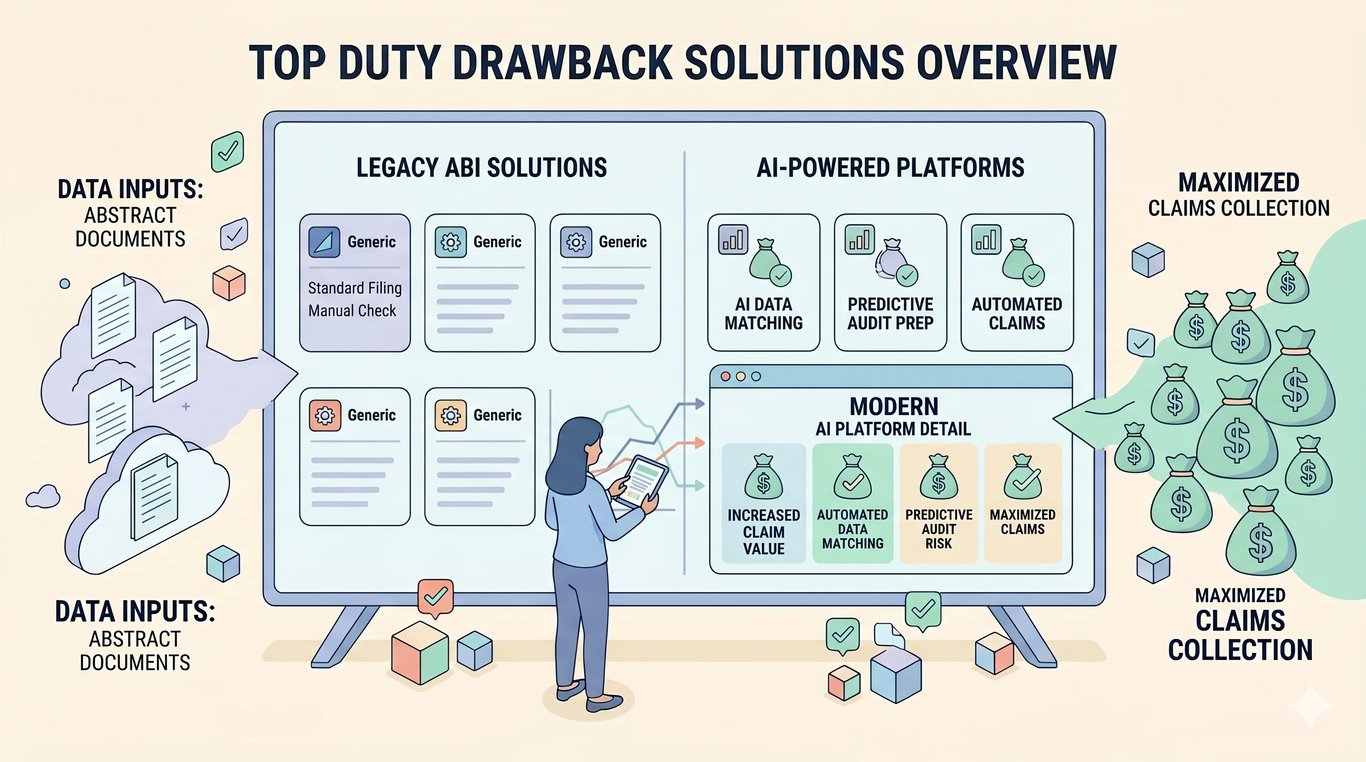
Traditional vs. AI-Powered Drawback: How the Two Approaches Compare
The fundamental gap between legacy drawback services and modern AI-native platforms comes down to how they handle the core math problem: matching millions of import records to export records across HTS classifications, accounting methods, and regulatory constraints to find the combination that pays you the most.
Traditional Drawback Providers
Processing time: 9–12 months from data submission to filed claim.
Data handling: Manual data entry from PDFs and spreadsheets, often outsourced to offshore teams.
Refund optimization: Manual or first-in-first-out matching in Excel — leaves significant money on the table.
Core technology: Legacy desktop software (e.g., DutyCalc, a Windows 98-era application still widely used across the industry).
Pricing model: High service fees or retainers, often with minimum refund thresholds that exclude SMBs outright.
Client experience: A slow, largely opaque annual filing project requiring heavy document coordination from your team.
AI-Powered Drawback Platforms
Processing time: 10–15 working days end-to-end.
Data handling: AI document parsing that automatically extracts and structures data from PDFs, CSVs, and ERP exports — no manual entry.
Refund optimization: Algorithmic computation of all possible import-export combinations to maximize the refund within regulatory constraints.
Core technology: Modern cloud infrastructure with machine learning models and direct ABI integration with CBP.
Pricing model: Performance-based with no upfront fees — you only pay a percentage of what's actually recovered.
Client experience: A fast, transparent, and continuous process that operates largely in the background with minimal effort from your team.
The practical implication: companies that were previously told they didn't have enough volume to make drawback worthwhile are now discovering they qualify — and that the refund lands in weeks, not at the end of the fiscal year.
Stop Leaving Tariff Refunds on the Table
The right duty drawback software doesn't just save your team time — it directly affects how much cash comes back to your business. Optimization matters. Speed matters. And for the majority of eligible companies who have never filed a drawback claim, just getting started matters.
If you're paying import duties on goods that are ultimately exported, re-exported, used in manufacturing for export, or destroyed, you're likely eligible to recover up to 99% of those duties under U.S. law (19 U.S.C. § 1313). The question is whether you have the infrastructure to claim all of it.
We built Zollback specifically for companies that want the maximum possible refund without a 12-month wait or a six-figure retainer. Our algorithmic optimization engine evaluates every possible import-export match. Our AI handles the document parsing. Our in-house licensed customs brokers review everything before we file electronically via certified ABI software. And our performance-based pricing means we only earn when you do.
Most clients have their claims filed within 10–15 working days of submitting their trade documents. There are no upfront fees.
Find out if your operation qualifies — get a free eligibility assessment and see what you could recover before committing to anything.
Frequently Asked Questions
What is U.S. duty drawback?
U.S. duty drawback is a program by U.S. Customs and Border Protection (CBP) that provides a refund of up to 99% on duties, taxes, and fees paid on imported goods that are later exported or destroyed. This program allows companies to recover costs on goods that do not ultimately enter the U.S. consumer market.
How do I know if my company is eligible for duty drawback?
Your company is likely eligible if you pay U.S. import duties on goods that are later exported, used as materials in a product that is exported, or destroyed. The easiest way to confirm your eligibility and estimate your potential refund is to get a free assessment from a drawback specialist like Zollback.
Why is AI-powered software better than traditional drawback services?
AI-powered software is better because it maximizes your refund and dramatically shortens the timeline. Our algorithms evaluate every possible import-export match to recover 15–20% more than manual methods, and we compress the filing process from the typical 9–12 months down to just 10–15 business days.
How long does it take to get a duty drawback refund?
The time to receive a refund depends on your provider's processing speed and CBP's review time. While traditional providers take 9–12 months to prepare a claim, modern platforms like Zollback can file it in 10–15 days. After filing, CBP typically processes the refund in a few weeks to a few months.
What does duty drawback software typically cost?
Pricing models vary, but modern platforms increasingly use performance-based pricing. Zollback operates on this model, charging only a percentage of the refund we successfully recover for you. This means there are no upfront license fees, retainers, or setup costs, ensuring our incentives are fully aligned with yours.
Is my company too small to benefit from duty drawback?
No, companies of all sizes can benefit from duty drawback. While legacy providers often focused only on very large enterprises, new AI-powered platforms are designed to efficiently serve small and medium-sized businesses (SMBs). If you pay tariffs and export goods, you likely have a recoverable amount worth pursuing.
What documents are required for a duty drawback claim?
You will typically need records of your imported goods and your exported goods. This includes import documents like the CBP Form 7501 Entry Summary, commercial invoices, and packing lists, along with export documents like bills of lading, export invoices, and proof of export. Our platform can ingest these in any format.