Seed-stage startup delivers finished, ACGME-compliant physician schedules using mathematical optimization — now serving 19 departments across 14 hospitals
Every July, a new chief resident inherits a spreadsheet. Maybe it's color-coded. Maybe there's a COUNTIF formula or two holding it together. And maybe — if they're lucky — the outgoing chief left a note explaining the logic. More often, they didn't.
Then the schedule has to be built from scratch: block rotations across the full academic year, call shifts distributed fairly, clinic sessions balanced against educational requirements, and attending coverage coordinated on top of all of it. This sentiment isn't an exaggeration — it's the consensus.
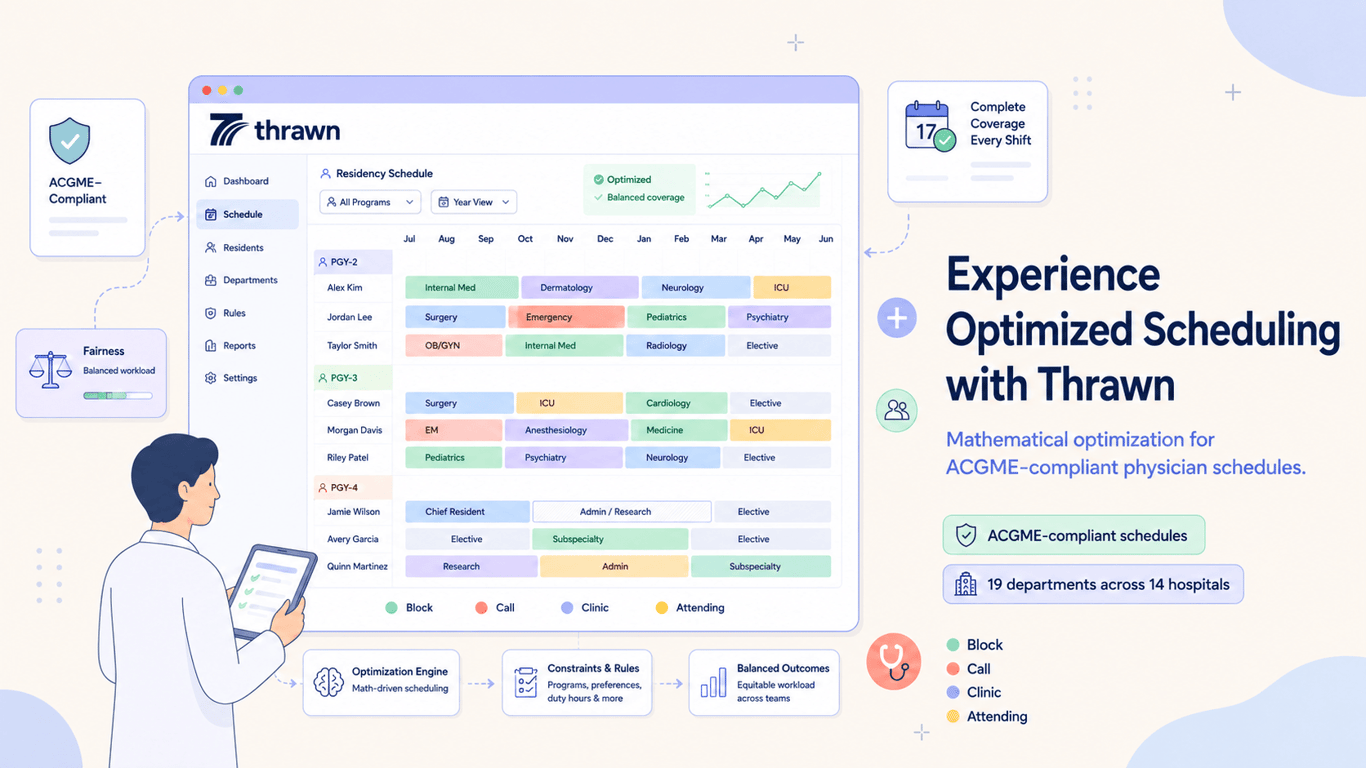
Thrawn, founded in 2024 by a team of MIT-trained mathematicians, computer scientists, and logistics experts, is eliminating this workflow entirely. The company built a proprietary Scheduling Programming Language (SPL) — a domain-specific optimization engine rooted in mathematical programming and operations research — that produces complete, mathematically optimal Block, Call, Clinic, and Attending schedules directly from a program's constraints. No spreadsheets. No rule-based suggestions that still need manual resolution. Finished schedules, delivered for review.
Thrawn currently serves, according to the company, 19 departments across 14 hospitals at multiple top-20 academic health systems spanning the East Coast, West Coast, and Southwest.
Residency Scheduling Is a Structural Failure
Physician scheduling in Graduate Medical Education (GME — the system of residency and fellowship training that follows medical school) is one of the most time-consuming administrative workflows in academic medicine. Each academic year, chief residents and program directors must build four deeply interconnected schedule types:
Block schedules. Year-long rotation assignments placing every resident in the correct clinical service at the correct time.
Call schedules. On-call shift distribution across nights, weekends, and holidays — with strict Accreditation Council for Graduate Medical Education (ACGME) duty hour compliance required.
Clinic schedules. Continuity clinic assignments that balance educational requirements against patient care coverage.
Attending schedules. Faculty coverage that satisfies contractual obligations, FTE requirements, and time-off requests.
Most programs build these in separate spreadsheets — one tab for rotations, another for call, a third for clinic. A change in one cascades across the others. Chiefs describe this as the "domino effect": one swap request, one vacation change, one unexpected absence, and you're rebuilding a house of cards. As one chief resident put it on r/Residency, "scheduling is an absolute beast to conquer."
Research on residency scheduling challenges identifies four structural hurdles that make this problem so persistent: incorporating program requirements, balancing workloads equitably, engaging residents in the process, and managing supply and demand across coverage needs. None of these are solved by better spreadsheet technique. They're solved by treating the schedule as what it actually is — an NP-hard optimization problem, similar in complexity to the well-studied Nurse Rostering Problem — and applying the right mathematical tools to it.
The tools available haven't done that. Enterprise physician scheduling platforms like QGenda, used by an estimated 86% of U.S. health systems, are built for all provider types across entire institutions — powerful but complex and expensive for the specific workflow of a chief resident managing an annual GME schedule.
Legacy on-call platforms like Amion display and publish call schedules but don't generate or optimize them. (As one chief resident noted on r/Residency, "Amion is clunkier. But functional.") Self-serve residency tools like Chiefly and Intrigma automate parts of the process — but still require the chief to operate the software and manually resolve conflicts.
Rule-based engines, which underlie most scheduling tools on the market, flag violations and suggest assignments. But a human still has to resolve the conflicts and balance the tradeoffs. "No schedule software was useful given the customization and specific rules to follow," one chief shared. The result: Excel remains the dominant tool not because it's good, but because "nothing was able to deliver quite like Excel."
![Still Building in Spreadsheets?]() How Thrawn Works: Mathematical Optimization, Not Rule-Based Suggestions
How Thrawn Works: Mathematical Optimization, Not Rule-Based Suggestions
Thrawn operates as a done-for-you managed scheduling service. The workflow is straightforward:
Programs send their constraints. Rotation requirements, ACGME duty hour rules, resident preferences, vacation requests, PGY-level requirements, educational goals, and any program-specific rules.
Thrawn's SPL optimizes everything simultaneously. All four schedule types are treated as a single interconnected optimization problem. The domino effect is eliminated by design.
Programs review finished schedules. Chief residents and program directors receive complete, ACGME-compliant schedules. Adjustments needed? Thrawn re-optimizes.
The architectural difference is what sets Thrawn apart from every competitor in the space. Rules-based engines generate suggestions that still require human intervention. Thrawn's SPL generates complete solutions from constraints — the same approach used in operations research to solve problems like airline crew scheduling, military logistics, and supply chain optimization.
ACGME duty hour compliance is a generation constraint in Thrawn's system. Violations aren't flagged after the fact — the engine is mathematically incapable of producing a schedule that violates duty hour rules. Similarly, fairness in assignment distribution isn't a judgment call. The SPL optimizes the distribution of desirable and undesirable assignments — nights, weekends, holidays, coveted electives — as a mathematical variable, producing schedules where equity is provable, not assumed.
Cross-schedule simultaneous optimization is the capability no competitor replicates. Most programs build block, call, clinic, and attending schedules independently, then spend weeks manually resolving the conflicts between them. Thrawn's SPL treats all four as a single scheduling optimization problem — so a change in one propagates correctly through the others.
The done-for-you service model solves a problem that software alone cannot: institutional knowledge retention. Because Thrawn's scheduling specialists learn each program's rules, constraints, and institutional quirks, that knowledge persists across the annual chief resident transition. The incoming chief doesn't inherit a spreadsheet and a steep learning curve — they inherit a working system. As one chief resident observed, "Every time we use it, there's a learning curve." With Thrawn, there's no software to learn at all.
The Founding Team
Thrawn's founding team brings deep expertise in mathematical optimization, logistics, and computer science — with personal ties to medicine.
Marcus Chen, Co-Founder and CEO. A published mathematician with degrees in mathematics and operations research from MIT, and additional training in applied mathematics at a leading European research university. He received a government research grant for logistics optimization algorithm development, with prior work in athletic conference scheduling and defense logistics research.
Daniel Park, Co-Founder and CTO. Holds degrees in computer science and economics from MIT. He previously built optimization software at a major technology company, deployed across government and commercial clients, and is an AWS Certified Cloud Solutions Architect. His entire immediate family are physicians — giving him direct, firsthand exposure to the scheduling burden in academic medicine.
Ava Restrepo, Co-Founder and COO. Studied economics with a minor in computer science at MIT. She brings operations and logistics experience from major global supply chain companies, along with NLP research focused on healthcare misinformation. Her mother is a practicing physician.
Early Traction at Top Academic Health Systems
According to Thrawn, the company currently serves 7+ programs across 19 departments at 14 hospitals, including multiple top-20 academic health systems. Specialties served include Neurocritical Care, Neurology, and Family Medicine, with active expansion into additional specialties.
Dr. R. Kapoor, a Clinical Fellow in a Neurocritical Care Fellowship at a leading academic medical center, described their experience:
"Scheduling can be one of the most stressful and time-consuming parts of the role, but Thrawn made the entire process seamless. We provided the team with the vacation requests of our clinical fellows and scheduling requirements for various rotations, and Thrawn quickly followed up with a couple of clarifying questions. Within such a short time, our yearly block fellowship schedule was complete! I would highly recommend their services to any program looking for a reliable and efficient way to build equitable schedules!"
Thrawn was also a gold sponsor at the APPD Pediatric Medical Education Conference, signaling its growing presence in the GME community.
What Makes Thrawn Different
Thrawn | Incumbent Software (QGenda, Intrigma) | Spreadsheets (Excel, Google Sheets) | |
|---|---|---|---|
Engine | Mathematical Optimization | Rule-Based Heuristics | Manual Human Effort |
Model | Done-for-you service | Software you operate | Fully DIY |
Output | Finished, globally optimal schedules | Suggestions requiring human tweaking | Brittle, error-prone schedules |
Compliance | Guaranteed by design (generation constraint) | Post-generation conflict flagging | Manual, unreliable tracking |
Knowledge Retention | Retained by Thrawn across transitions | Resets every July | Walks out with the outgoing chief |
Two structural advantages underpin this positioning — and both are difficult for incumbents to replicate.
The first is architectural. Thrawn's SPL is fundamentally different from the rule-based engines powering QGenda, Lightning Bolt, Intrigma, and most other scheduling platforms. Rebuilding a scheduling engine from rules to mathematical optimization is a multi-year effort. This isn't a feature gap that can be closed with a software update.
The second is the service model itself. Programs don't learn, configure, or operate scheduling software. They describe their constraints and receive finished schedules. This collapses the adoption barrier to near zero — and removes the annual re-training problem that plagues every self-serve tool.
Beyond Scheduling: A Healthcare Logistics Platform
Thrawn's longer-term vision extends beyond GME scheduling. The company is extending its optimization engine into clinical care coordination — patient triaging, provider management, and resource allocation — with design partnerships underway at major academic health systems.
The underlying thesis is that healthcare inefficiency is a supply-side problem. The bottleneck isn't patient demand — it's the inability to efficiently match patients with available providers and resources. Manual workflows across scheduling, triaging, and care coordination contribute to what Thrawn estimates is $760 billion in annual healthcare operational inefficiency.
Physician scheduling is the entry point. Care coordination is the platform play.
Who Thrawn Serves
Thrawn's managed scheduling service is built for:
Chief residents and fellows who are responsible for building the annual schedule and want to stop spending hundreds of hours in spreadsheets
Program directors and Associate Program Directors (APDs) who need defensible ACGME compliance and mathematically fair schedules
Program coordinators and GME administrators who manage schedule changes, swap requests, and compliance documentation after the schedule is published
Stop Building Schedules. Start Reviewing Them.
Residency scheduling doesn't have to be the most dreaded part of the chief year. The problem isn't that chiefs aren't smart enough to build good schedules — it's that the problem itself, with its interdependent constraints and compliance requirements, is genuinely hard. It's the kind of problem that operations research was built to solve.
Thrawn's managed service handles the entire scheduling workflow from constraints to finished schedules, with ACGME compliance built in and fairness mathematically provable. Programs at multiple top-20 academic health systems have already moved to optimization-based scheduling.
If your program is still building in spreadsheets, a free scheduling consult is a reasonable first step.
Frequently Asked Questions
How does Thrawn ensure schedules are fair for all residents?
Thrawn ensures fairness by using a mathematical optimization engine to equitably distribute all assignments. Desirable and undesirable shifts, such as nights, weekends, and holidays, are balanced across all residents, making fairness provable and transparent, not a subjective judgment call.
What makes mathematical optimization different from other scheduling software?
Most scheduling software uses rule-based engines that flag conflicts for you to solve manually. Mathematical optimization finds the single best solution that satisfies all constraints simultaneously. It generates a complete, finished schedule, eliminating the need for manual trial-and-error adjustments.
How does the service handle unexpected schedule changes like a sick call?
Thrawn can rapidly re-optimize schedules to accommodate last-minute changes. When an absence occurs, the system generates a new, fully compliant schedule that minimizes disruption. This eliminates the "domino effect" where one change requires manually rebuilding multiple interconnected spreadsheets.
What types of schedules can Thrawn create?
Thrawn builds all core schedules for residency and fellowship programs, including Block, Call, Clinic, and Attending schedules. Its key capability is optimizing all of these simultaneously, treating them as a single interconnected system to prevent conflicts before they happen.
How does Thrawn prevent knowledge loss during the annual chief resident transition?
Because Thrawn is a managed service, our scheduling specialists retain your program’s unique rules and preferences. This institutional knowledge persists year-over-year, so new chief residents inherit a proven system and a dedicated partner, not a complex spreadsheet with no instructions.
Who is Thrawn's scheduling service for?
Thrawn is for any residency or fellowship program leader—including chief residents, program directors, and coordinators—who wants to eliminate the administrative burden of scheduling. It is ideal for programs looking to save hundreds of hours, ensure ACGME compliance, and improve resident equity.