 Key Takeaways
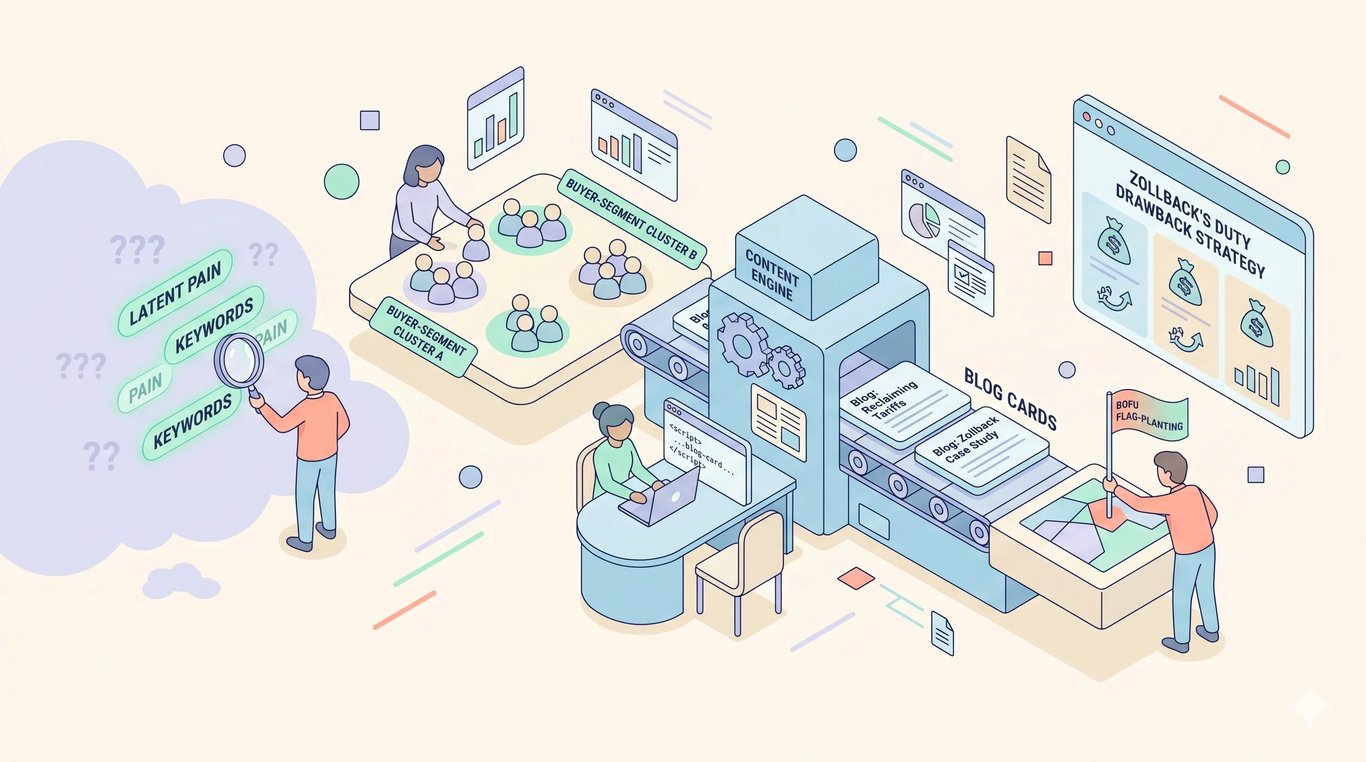
When buyers don't know your solution category exists, focus on "latent pain keywords"—the symptoms they search for, not the solution they don't know about.
Structure content around buyer segments, not product features, and build authority with hyper-specific language and credible sources.
This strategy turns content into a demand creation engine, educating buyers and building your market from the ground up.
Executing a demand creation strategy requires a flexible content stack. A headless blog CMS helps teams publish without engineering bottlenecks.
The Problem With Most Content Strategy Advice
Almost every SEO playbook starts from the same hidden assumption: your buyer already knows the category exists. They're Googling "best project management software," "CRM for startups," or "headless CMS comparison." They're solution-aware. Your job is just to rank.
But there's a large class of B2B products where this assumption fails completely. The buyer has the pain. They just don't know a solution exists — or in many cases, don't even have a name for the problem. They're not searching for your category because they've never heard of it.
In SEO terms, the entire bottom-of-funnel keyword cluster doesn't exist yet. And that's the hardest content challenge in B2B: how do you build organic acquisition when there's nothing to capture?
This article answers that question with a concrete playbook — and a real company actively executing it.
Case Study Setup: Zollback and the $11–15 Billion Invisible Market
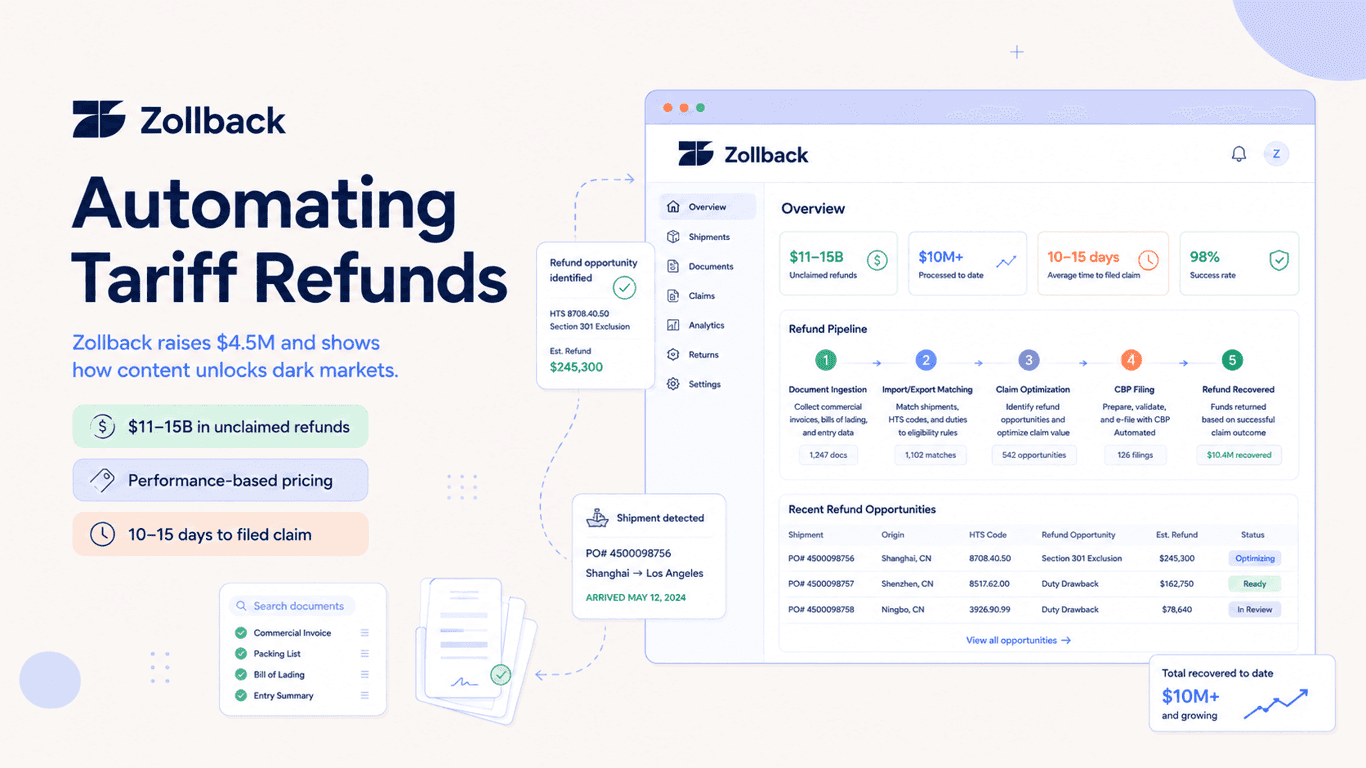
Zollback is an AI-powered duty drawback platform. Duty drawback is a U.S. government program that refunds up to 99% of import duties when goods are later exported, used in manufacturing for export, or destroyed. As Zollback explains in their own deep-dive on the problem, the scale of what goes unclaimed is staggering: between $11–15 billion in eligible refunds go unclaimed annually. Around 80% of eligible companies never file at all.
Why? Legacy providers rely on decades-old software, require $500K+ minimums, and take 9–12 months to process claims. The entire SMB segment — manufacturers, retailers, e-commerce operators — has been effectively locked out. Zollback compresses that timeline to 10–15 days with AI-powered optimization and charges nothing upfront (performance-based pricing only).
Here's the content challenge: Zollback's target buyer — a mid-market manufacturer paying six figures in import tariffs — has almost certainly never Googled "duty drawback software." Many have never encountered the phrase "duty drawback" at all. The market is real and massive, but the demand is completely latent.
There is no BOFU keyword cluster to capture. So how do you build a content engine anyway?
The Latent Pain Keyword Strategy
The core shift is moving from solution-aware keywords to latent pain keywords. Here's how they differ:
Solution-Aware Keywords | Latent Pain Keywords | |
|---|---|---|
Buyer state | Knows the category, comparing options | Has the pain, doesn't know a solution exists |
Search behavior | "best duty drawback software" | "how to reduce import costs" |
Funnel position | Bottom (capture demand) | Top/Mid (create demand) |
Competition | Often high | Often near-zero |
Content's job | Convince them you're the best | Convince them the category exists |
Examples | "CRM comparison," "best headless CMS" | "can I get tariffs refunded," "why are import costs so high" |
Latent pain keywords are undervalued because most content teams start with keyword tools. But keyword tools only measure existing search volume — they're blind to unvoiced pain. To find latent pain keywords, you have to start with your buyer's complained-about problems, not their search queries.
Here's how to apply this in practice.
Step 1: Map the Pain Language Your Buyer Already Uses
Don't open Ahrefs first. Open your sales call notes, customer interviews, and industry forums. What exact phrases does your ICP use when they complain?
For Zollback's buyer, that sounds like: "tariffs are killing our margins," "import costs keep going up," "is there any way to reduce duties after we've already paid them?" These phrases — not "duty drawback" — are the keyword seeds.
The buyer isn't searching for the solution. They're searching for relief from the symptom. That's where you meet them.
Step 2: Build Content Around the Pain, Then Bridge to the Solution
Once you have the pain vocabulary, the article structure almost writes itself:
Validate the problem in their exact words
Quantify the cost (make it feel urgent, not abstract)
Reveal that a solution category exists
Explain how it works and who qualifies
Zollback executes this consistently across their blog. "Can You Avoid Tariffs Legally? A Complete 2026 Guide" targets people searching for general tariff relief — and progressively educates them on duty drawback as the answer. "
3 Ways To Reduce Import Tariffs After Paying Them" meets the buyer at a moment of sunk-cost frustration: "I already paid, now what?" And "China Tariffs at 35%? Here's How to Get Your Duties Refunded" rides a trending news event to connect an acute, timely pain to the solution.
Each of these articles starts where the buyer actually is, not where you wish they were.
Step 3: Organize Content by Buyer Segment, Not Product Feature
Most SaaS content is organized around what the product does. Zollback's is organized around who their buyer is.
Their site has dedicated use case pages and content clusters for:
Manufacturers
Retailers
E-commerce operators
Importers
Customs brokers
Freight forwarders
Accounting firms
Each segment has a dedicated hub at zollback.com/uses/[segment]. A manufacturer and an e-commerce operator both qualify for duty drawback, but their situations, terminology, and concerns are completely different. Generic content loses both. Segment-specific content converts each.
This is the difference between a buyer thinking "this seems like it might apply to me" and thinking "this was written for exactly my situation."
Step 4: Plant the Flag on BOFU Content — Even When Search Volume Is Near-Zero
A small but important slice of the market is already solution-aware: customs brokers, trade consultants, CFOs who've heard of drawback but don't know modern options exist. Zollback covers this too:
"5 Best Duty Drawback Companies for Small and Mid-Size Importers"
"Duty Drawback Software Comparison: DutyCalc vs. AI-Powered Platforms"
"The 5 Best Duty Drawback Services in 2026"
These pages won't drive massive traffic today. But they own the SERP for when the market catches up. Every time a trade publication covers tariffs, new import regulations drop, or a customs broker recommends drawback to a client, there are more solution-aware searchers entering the funnel. The flag is already planted.
Building Authority When Nobody Else Has Published Seriously in Your Space
In a dark market, authority isn't granted — it's constructed piece by piece. Vague, high-level content is worse than no content, because it signals that you don't actually know the space.
A few tactics that work:
Specificity as a credibility signal. Zollback's content doesn't just reference "relevant regulations" — it cites 19 CFR Part 190, 19 U.S.C. § 1313, and Section 301 tariffs by name. In regulated industries, precision is the proxy for expertise. Both readers and search engines notice.
Use the expert's vocabulary. Terms like "HTS classifications," "ABI filing," and "substitution drawback" aren't jargon for its own sake. They signal fluency to buyers who already know the space — and create topical authority for search engines indexing the content. When a skeptical customs broker vents on Reddit about AI duty drawback programs, saying they'd rather stick with "old school programs," the antidote isn't softer language. It's more precision.
Third-party proof does the trust work. Zollback references their SOC 2 certification, cites the U.S. Chamber of Commerce, and links directly to CBP.gov. When you're asking a business to hand over trade data and trust you with a six-figure refund claim, content has to do the trust-building that a sales rep would normally handle in person.
Founder credibility is a content asset. CEO Elena Zhao holds a Stanford PhD in operations research, worked at both CBP and Maersk, and her family's business was eligible for drawback but couldn't access the legacy system. That story is woven into Zollback's content. In a market full of faceless, decades-old incumbents, a founder's specific expertise and personal connection to the problem is a genuine differentiator — and a reason to believe.
 The Demand Creation Flywheel
This strategy isn't a linear funnel. It's a compounding system.
Educate. Publish latent-pain content that helps buyers name a problem they didn't know they had.
Bridge. Within that content, introduce the solution category as the natural next step.
Qualify. Offer a free tool or self-serve assessment so buyers can qualify themselves with zero friction. Zollback's free eligibility checker does exactly this — no sales call required to find out if you're eligible.
Convert. Leads who have educated and qualified themselves arrive at sales with far higher intent than any inbound lead from a BOFU keyword.
Compound. Every article creates a new discovery entry point. As external forces — new tariff announcements, trade press coverage, word of mouth — grow market awareness, your content is already ranked and waiting.
The insight that ties it together: in a dark market, content isn't just one acquisition channel sitting alongside sales. For the first half of the buyer journey, content is the sales process. It does the market education work that normally takes years of industry lobbying, conference presence, and analyst coverage.
What This Means for Your SaaS Content Strategy
If you've built a product that solves a real problem and your ICP still isn't searching for you, this isn't a product problem. It's a content architecture problem.
You need a content engine that can publish fast across multiple audience segments, surface programmatic pages for use cases and comparison terms, and integrate free tools alongside educational content — all indexable from day one. That's not a particularly exotic infrastructure requirement, but it does mean your content and engineering stacks have to move at the same speed.
This is where a headless blog CMS built for Next.js removes friction. With Wisp, you can spin up segment-specific content clusters without waiting on engineering, use AI-powered contextual CTAs to match the right offer to each article automatically, and let semantic related post suggestions keep readers moving through your content library. Developers register the components; writers publish the content — no PRs, no deployment cycles, no blocked publishing queues.
The strategy described in this article is genuinely hard. Building the infrastructure to execute it doesn't have to be. Wisp's free plan includes unlimited blogs and posts — worth exploring if your current setup is the bottleneck.
Turn Your Content Into a Demand Engine
If buyers aren’t searching for your product, it doesn’t mean they don’t need it. It means your content has a bigger job: creating demand, not just capturing it.
The playbook is straightforward. First, listen for the “latent pain” keywords your buyers use to describe their symptoms—not the solution they don’t know exists. Then, build content around those specific pains for each buyer segment, turning their frustration into education.
Your next step today? Listen to a sales call recording and write down one prospect’s exact phrasing. That’s your next headline.
Executing this strategy requires moving fast. If a clunky CMS is slowing you down, see how Wisp helps you publish segment-specific content without engineering bottlenecks.
FAQs
What are latent pain keywords?
Latent pain keywords are the specific terms and phrases people use to describe a problem's symptoms, not the solution. They search for relief from their pain, unaware a solution category like yours exists.
How can I find my customers' latent pain keywords?
You can find latent pain keywords by analyzing customer language directly. Review sales call notes, customer interviews, and industry forums to identify the exact phrases your ideal customers use when they complain.
Why is it important to create content for different buyer segments?
Creating content for different buyer segments is important because it makes your message hyper-relevant. A manufacturer and an e-commerce operator face different challenges, so segment-specific content shows you understand their exact situation.
What is the goal of creating content around zero-volume keywords?
The goal of creating content for zero-volume keywords is to "plant the flag" for future demand. This content ensures you own the search results when the market eventually becomes aware of the solution and starts searching for it.
How does a demand creation strategy differ from traditional demand capture?
A demand creation strategy differs from demand capture by focusing on education. Instead of targeting solution-aware buyers, it educates problem-aware buyers, making them realize a solution category exists in the first place.
Who should use a latent pain keyword strategy?
A latent pain keyword strategy should be used by companies whose target buyers are unaware that a solution category for their problem exists. It's ideal for innovators or businesses in emerging or "dark" markets.
What kind of article structure works best for this strategy?
The best article structure for this strategy validates the reader's pain in their own words, quantifies the cost, introduces the solution category, and then explains how it works. This bridges their problem to your solution.