Key Takeaways
The most profitable content opportunities are in "boring" B2B industries where content competition is low and buyer intent is high.
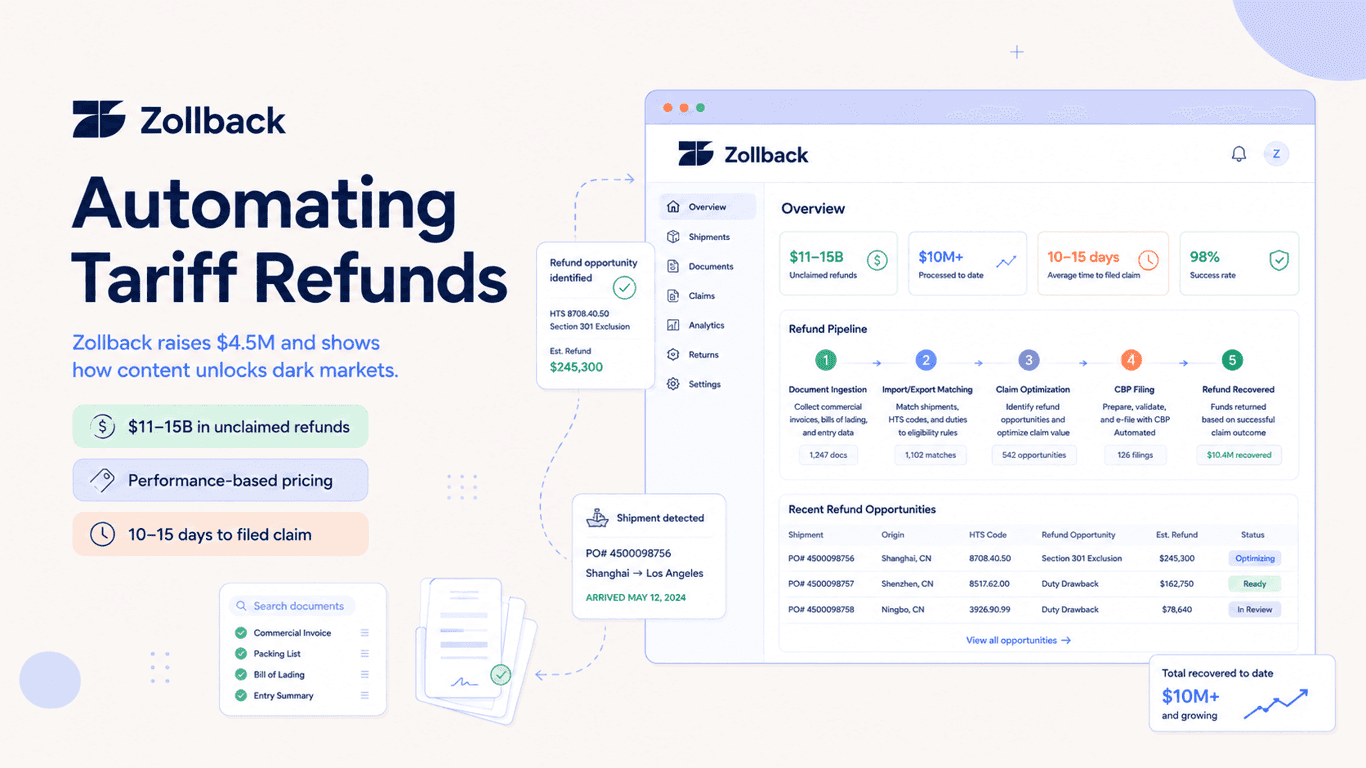
Companies like Zollback (tariff refunds) and Cyber Sierra (cybersecurity compliance) dominate by creating educational content that addresses specific, high-pain search queries.
In regulated "Your Money or Your Life" (YMYL) verticals, genuine expertise is rewarded by Google, creating a durable advantage over low-effort competitors.
To capitalize on this first-mover advantage, you need to publish quickly. A headless CMS with a Next.js starter kit helps you ship content without getting bogged down by engineering infrastructure.
Every founder building in a niche B2B vertical has said it — or at least thought it: "Our industry is too boring for content marketing. Nobody's going to read a blog post about duty drawback / GRC frameworks / QuickBooks reconciliation."
That instinct is understandable. And it's wrong. In fact, the belief that your industry is too boring is the strongest possible signal that content will work. Here's why.
The "Too Boring for Content" Myth
If you think your industry is boring, your competitors think so too. That means nobody is producing content. The SERPs are wide open. The incumbents are relying on referrals, trade shows, and a website that hasn't been updated since 2009.
Meanwhile, your buyers aren't casual readers. They're a CFO hunting for six figures in tariff refunds, a CISO scrambling to pass an audit, an accounting firm drowning in manual reconciliation for 50 clients. These are high-intent, high-LTV buyers who are actively Googling their problems — and finding nothing useful.
The combination is rare in any marketing context: zero content competition + high buyer intent + absent incumbents. That vacuum is what turns a single, well-executed content engine into a category-defining moat. Boring industries aren't a content liability. They're the highest-ROI content opportunity in all of B2B.
 Case Study #1: Zollback — Tariff Refunds
Let's start with the most extreme example. Duty drawback. Import tariff refunds. CBP regulations. 19 CFR Part 190. If your eyes glazed over reading that list, you've proven the point.
This is an $11–$15 billion market where 80% of eligible companies never file a claim — largely because nobody has ever told them they could. The legacy providers use outdated software like DutyCalc, require $500K+ minimum refund potentials, and take 9 to 12 months to process a claim. Their marketing strategy is an industry conference and a referral network. The SERP for every meaningful buyer query is either empty or full of government PDFs.
Zollback walked into this vacuum with a content engine built around one insight: their buyers don't search for "duty drawback software." They search for "can I get my tariffs back?" As they detailed in their launch announcement, the whole platform is designed around educating a market that didn't know a solution existed.
Their content architecture is worth studying closely:
Blog content targeting buyer pain directly. Posts like "Can You Avoid Tariffs Legally?", "3 Ways To Reduce Import Tariffs After Paying Them", and "China Tariffs at 35%? Here's How to Get Your Duties Refunded" answer the exact questions buyers Google before they've ever heard the phrase "duty drawback."
Segment-specific use case pages. Separate pages for manufacturers, retailers, e-commerce, importers, customs brokers, freight forwarders, and accounting firms. Each speaks the buyer's language and targets their specific search intent.
BOFU comparison content planted early. Posts like "5 Best Duty Drawback Companies" and "Duty Drawback Software Comparison: DutyCalc vs. AI-Powered Platforms" position Zollback for when the category matures and buyers get comparison-aware.
A free eligibility assessment as the conversion point. No friction, no upfront cost. Self-serve qualification that removes every barrier between a curious buyer and a qualified lead.
The results speak for themselves. Zollback has processed over $10M in tariff refunds and crossed $1M in booking revenue within its first year. Revenue tripled after expanded tariff actions — because when regulatory complexity increases, a company with topical content authority captures all the new search demand. They are now turning away customers in an industry most people have never heard of.
Case Study #2: Cyber Sierra — Cybersecurity Compliance & GRC
Now consider Governance, Risk & Compliance automation. The alphabet soup of regulated industries that makes most marketers immediately want to change the subject includes standards like:
SOC 2
ISO 27001
PCI DSS
HIPAA
RBI Cybersecurity standards
NIST SP 800-171
CISOs and security leads are constantly searching for answers: "What is a GRC framework?", "How does continuous control monitoring work?", "Third-party risk management best practices." These aren't casual searches. Getting compliance wrong means failed audits, lost enterprise deals, and regulatory penalties. The urgency is built into the query. As one GRC team noted, frequent cloud deployments create a workload that manual compliance processes simply cannot keep pace with — which is exactly the pain that drives buyers to search.
Cyber Sierra built their content engine to meet that search intent at every level:
Platform and use case pages for Continuous Control Monitoring, Third-Party Risk Management, and Governance Risk & Compliance — targeting the specific frameworks buyers are responsible for implementing.
Industry-specific pages for BFSI, Manufacturing, and HealthTech, because a CISO in banking doesn't think about compliance the same way a security lead in healthtech does.
Foundational educational content surfaced directly in their site footer: "What is GRC Framework?", "What is Third Party Risk Management?", "What is Continuous Control Monitoring?" — the exact queries a buyer Googles before they've even started evaluating vendors.
A full content hub: blog, case studies, newsletter, podcast, and a glossary of cybersecurity terms.
Their content authority is reinforced by credibility signals that compound over time. Cyber Sierra is recognized in the 2024 Gartner® Hype Cycle™ for Cyber-Risk Management as a Sample Vendor in Cyber GRC, and holds accreditation from the Cyber Security Agency of Singapore. Those signals make the content more credible to both buyers and search engines — especially in a YMYL category where Google's E-E-A-T standards reward genuine domain expertise.
The pattern is identical to Zollback. A technically complex, "boring" vertical. Buyers searching for education on frameworks, not product comparisons. A startup that shows up with structured, authoritative content and builds topical authority before competitors realize content matters.
Case Study #3: FinLens — QuickBooks Automation & Bookkeeping
Accounting is the canonical "boring industry." QuickBooks reconciliation, GAAP-compliant journal entries, automated accrual schedules — this is the back-office work that founders avoid thinking about and accountants endure every month-end. As one marketer put it, working in accounting feels like "a pretty boring industry" where creating engaging content seems almost impossible.
That perception creates the vacuum. QuickBooks has over 7 million business users. Founders and accounting firms are actively searching for "how to automate QuickBooks entries," "AI bookkeeping for small business," "GAAP accrual automation." The pain is acute — month-end close is chaos, manual data entry eats hours, and accountants are drowning in client work. But the SERP is dominated by Intuit's own help docs and generic listicles that barely scratch the surface.
FinLens built their content engine around the specific, searchable pain — not the product description:
Resource pages mapped to exact buyer queries: "QuickBooks Automation," "Accrual and Schedule Automation," "AI Accounting for CPA," "GAAP Compliant," "AI Accounting for Small Business Owners," "AI Accounting for Solopreneurs," "AI Accounting for SMBs."
Two distinct buyer tracks: "For Founders" and "For Accountants" — because the same product serves very different buyer journeys, and collapsing them into one funnel costs conversions.
A dedicated blog ("Off the Books") that stays problem-focused rather than product-focused.
The proof: FinLens has analyzed 30M+ transactions, suggesting the content-led, education-first approach is converting readers into active users at meaningful scale.
The Pattern: Why "Boring" Industries Win on Content
Across all three examples, the same formula holds. Here's what it looks like side by side:
Factor | "Sexy" Industries (CRM, AI, design tools) | "Boring" Industries (compliance, tax, accounting) |
|---|---|---|
Content competition | Brutal — hundreds of competitors producing content | Near-zero — incumbents don't have blogs |
Keyword difficulty | High — every valuable keyword is contested | Low — most high-intent keywords are uncontested |
Buyer intent | Mixed — many casual browsers and comparison shoppers | High — buyers searching due to regulatory or financial urgency |
Buyer value | Varies — many low-LTV users mixed in | Consistently high — enterprise deals, compliance requirements, recurring revenue |
Incumbent content presence | Strong — funded content teams and SEO agencies | Absent — a blog with five posts from 2019 |
Content moat durability | Weak — competitors can replicate content quickly | Strong — first-mover advantage compounds because competitors are slow to respond |
The formula is simple: low competition × high intent × absent incumbents = highest content ROI in B2B.
There's an additional accelerant worth naming. "Boring" regulated industries — finance, compliance, legal, customs — are YMYL (Your Money or Your Life) territory. Google's E-E-A-T standards actively reward authoritative, expert-led content in these categories. A startup with genuine domain expertise writing about duty drawback, GRC frameworks, or GAAP compliance gets a larger advantage than it would in a less regulated vertical — because the bar for content quality is higher, which further discourages low-effort competition.
Is Your "Boring" Industry a Content Goldmine?
Run through this diagnostic. If you answer "yes" to most of these, you're sitting on a first-mover content opportunity:
Your buyers Google their problem but not your product category — because they don't know your category exists yet
When you search your core topics, the top results are government PDFs, old consulting firm pages, or thin generic listicles
Your competitors' websites don't have a blog — or have one with five posts from 2019
Your buyer's purchase is driven by a regulatory requirement, financial urgency, or compliance deadline — not casual interest
Your average deal size is $10K+ or your customer LTV easily justifies content investment
You have genuine domain expertise that would take a generalist writer months to learn
Your industry has specific jargon, regulations, or processes that create a natural barrier against content farm competitors
If you checked most of those boxes, you don't have a boring industry problem. You have a first-mover advantage disguised as a niche.
Build the Content Engine — Don't Let Infrastructure Slow You Down
The strategic case is clear. The execution question is what trips most founders up.
The "boring industry" content playbook requires real publishing infrastructure. You need segment-specific landing pages and content clusters — Zollback's seven use case pages, Cyber Sierra's industry-plus-framework matrix, FinLens's separate founder and accountant tracks. You need programmatic capability to scale template-driven content across verticals and compliance standards. You need to move fast, because first-mover advantage is the entire thesis. And you need clean rendering and structured data to satisfy E-E-A-T signals — author metadata, schema markup, semantic organization.
If your blog lives inside your codebase and every new page requires a pull request, you're burning the one asset that makes the whole strategy work: speed. A headless blog CMS built for Next.js and React can remove that bottleneck — letting domain experts publish directly without filing dev tickets. Wisp's custom content types let you build out structured use-case and segment pages without reinventing your data model each time, and AI-powered contextual CTAs make sure every piece of content is working toward conversion automatically. The Next.js Starter Kit gets you from zero to a deployed, Wisp-connected blog quickly, so you're publishing content instead of configuring infrastructure.
Turn Your "Boring" Niche Into a Moat
The biggest content opportunities aren’t in crowded, "sexy" markets. They're in overlooked B2B niches where your competitors think content doesn't work. This is your advantage. Your buyers are searching for answers to urgent, expensive problems, and right now, they're finding nothing.
To capitalize, you need to answer their questions with genuinely helpful content and publish it quickly. Your next step today? Identify one specific, high-pain question your ideal customer Googles and write the definitive guide answering it.
If publishing feels like a chore, your infrastructure might be slowing you down. A clunky CMS creates friction and kills momentum. Wisp's free plan includes unlimited posts and a fast, modern editor. See Wisp in action to see how a content platform built for speed can help you build your moat, one expert post at a time.
FAQs
Why is a "boring" B2B industry good for content marketing?
A "boring" B2B industry is ideal for content marketing because of low competition and high buyer intent. This lets you attract high-value customers who are actively searching for solutions to urgent problems, creating a significant first-mover advantage.
How can I tell if my industry has a content opportunity?
You can tell if your industry has a content opportunity if competitors have no blog, search results are full of government PDFs, and buyers Google their problems, not product categories. These signs indicate a vacuum you can fill with expert content.
What kind of content works best in a niche B2B industry?
The content that works best in a niche B2B industry is educational material that answers your buyer's specific, high-pain questions. Focus on their problems and use cases with guides and how-tos, not just your product features.
Why is publishing speed so important in these industries?
Publishing speed is important in these industries to secure a first-mover advantage. By creating authoritative content before anyone else, you can build topical authority and a durable competitive moat while the competition is still inactive.
What does YMYL mean for B2B content?
YMYL (Your Money or Your Life) means for B2B content in regulated fields like finance or compliance, Google prioritizes genuine expertise (E-E-A-T). This gives true domain experts a durable advantage over low-effort competitors and content farms.
How do I get started with content marketing in a boring industry?
To get started, identify one urgent, specific question your ideal customer Googles. Then, write and publish the most comprehensive answer possible. Start small and focus on being genuinely helpful to build momentum and authority.
Won't my competitors just copy my content strategy?
While competitors might eventually copy your strategy, a first-mover advantage is significant. By the time they react, you will have already built topical authority and credibility, making your position in search results much harder to displace.