Key Takeaways
Zollback is targeting the $11-15 billion in unclaimed duty drawback refunds, proving that massive opportunities exist in "dark markets" where most customers don't know a solution exists.
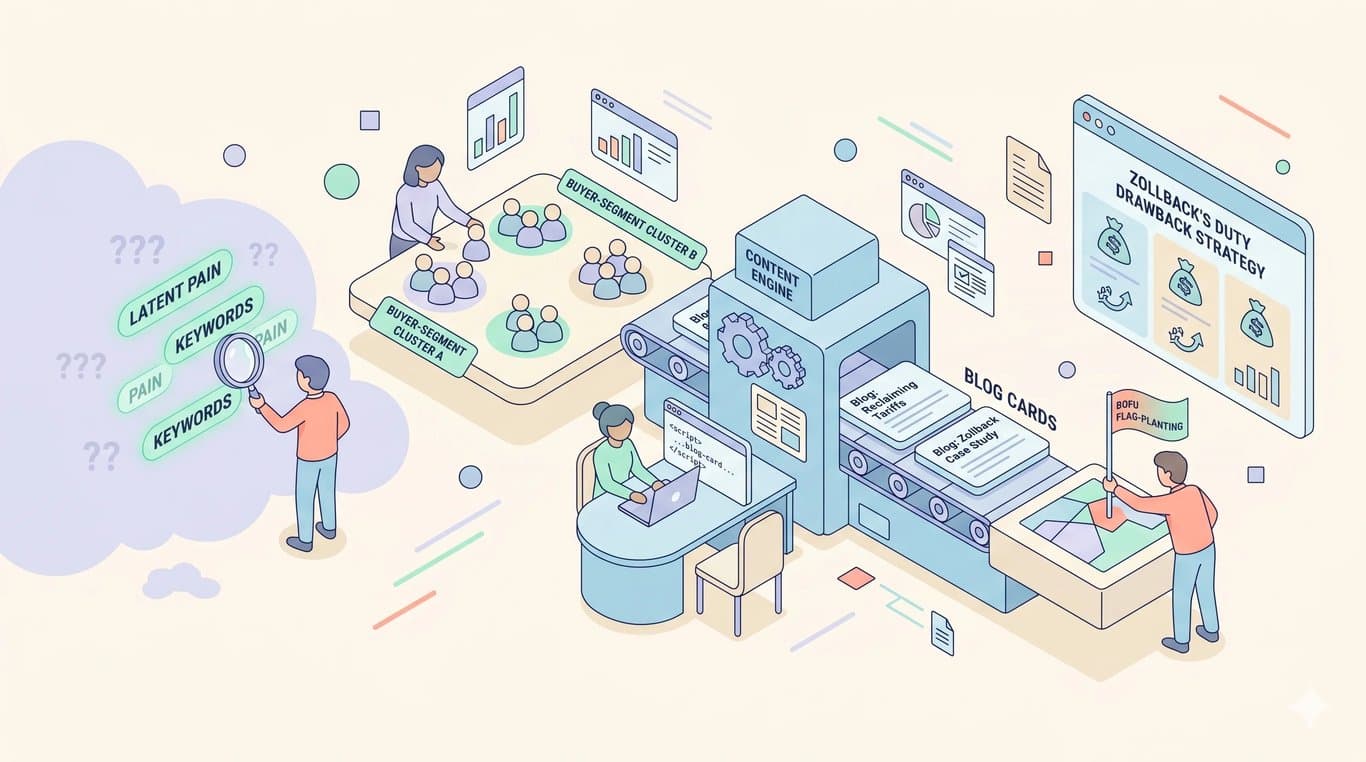
In markets with low awareness, create demand by targeting customer "pain searches" (e.g., "how to reduce import costs") instead of "product searches" that nobody is making.
Build trust in skeptical, traditional industries with highly specific, educational content that shows deep expertise, rather than relying on generic marketing claims.
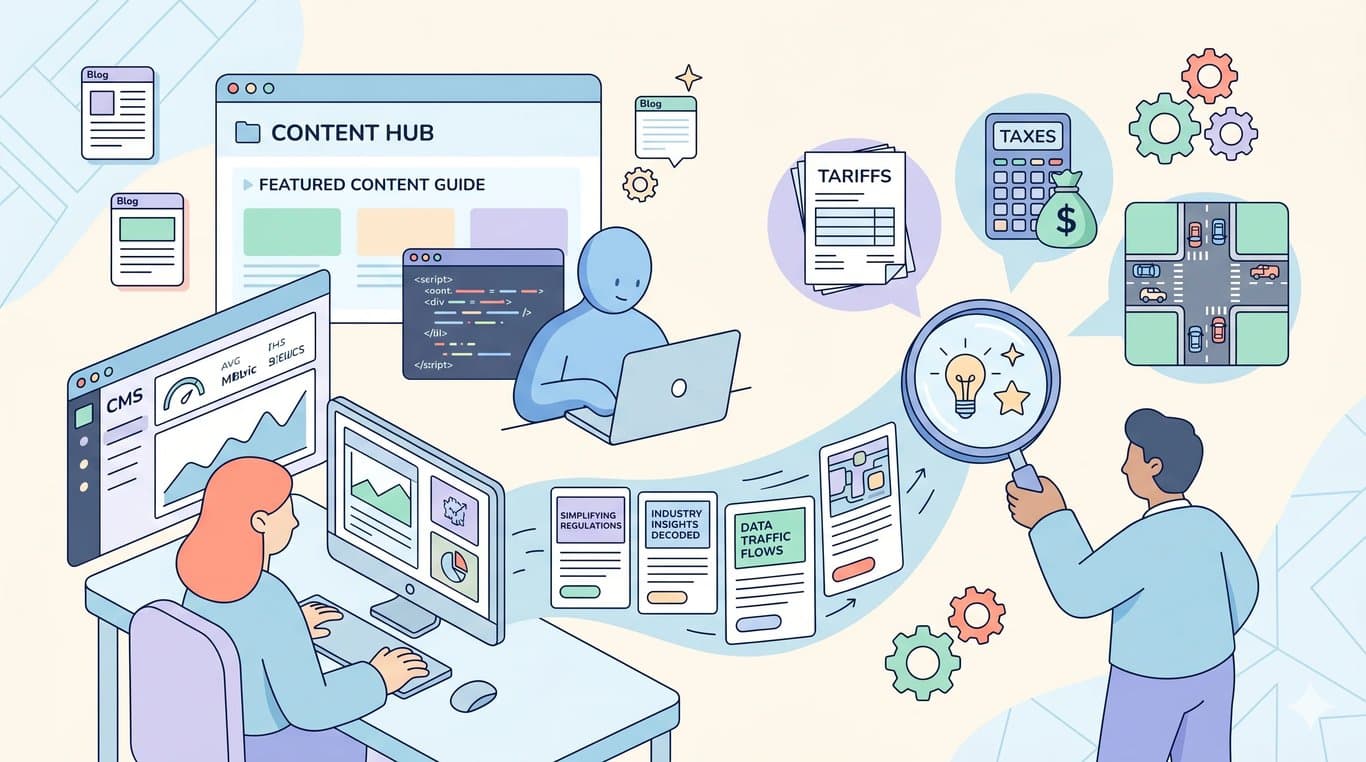
Executing this type of multi-audience content strategy requires a flexible platform; a headless CMS like Wisp empowers content teams to publish without engineering delays.
The $11–15 Billion Refund Nobody Claims
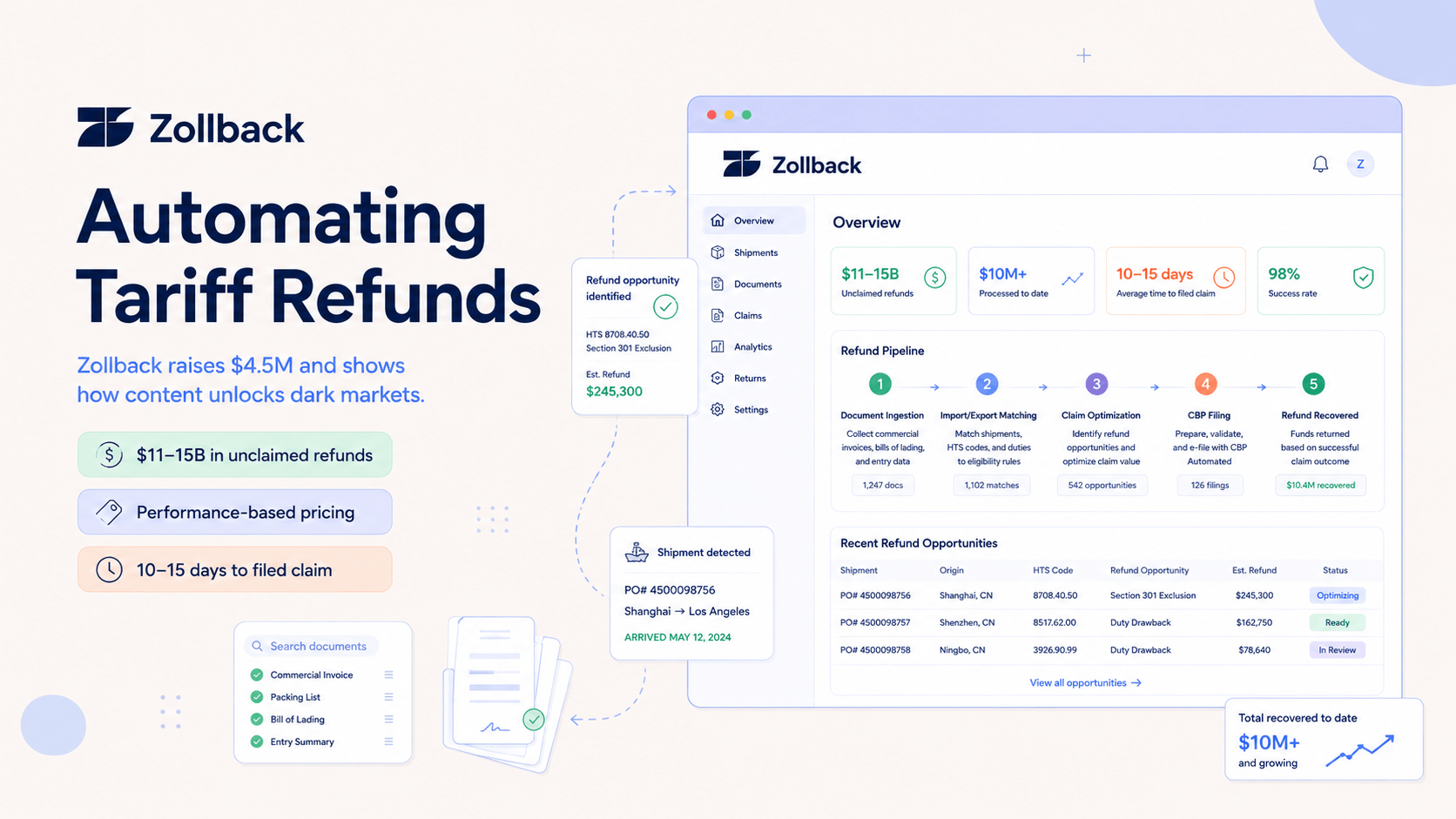
Every year, U.S. companies leave an estimated $11–15 billion in import duty refunds sitting on the table — unclaimed, untouched, and largely unknown. The figure almost defies belief.
The program responsible for those refunds is called duty drawback. It's a U.S. Customs and Border Protection (CBP) mechanism—established in 1789—that allows companies to recover up to 99% of duties paid on goods that are later exported, used in manufacturing for export, or destroyed.
It's a legitimate, codified program governed by 19 CFR Part 190, making it older than the federal income tax. And yet, a staggering 80% of eligible companies never file a single claim.
So why not? The legacy industry tells the story pretty clearly:
The dominant software in this space — DutyCalc — is a Windows desktop application that customs brokers on r/CustomsBroker openly describe as frustrating to work with. One broker summed it up bluntly: "Most top drawback firms have done this because the market blows."
Standard processing timelines run 9–12 months from document submission to receiving a refund.
Legacy providers require a minimum refund potential of $500,000+, which immediately locks out the vast majority of small and mid-sized businesses.
The workflow hasn't changed in decades: Excel spreadsheets, offshore data entry teams, and manual document matching.
This is what a "dark market" looks like. The TAM is enormous, and the regulatory infrastructure is well-established. But the buyers—the manufacturers, importers, and retailers who are owed this money—simply don't know it's available. They're not searching for "duty drawback software" or even "duty drawback."
Instead, they're Googling "how do I reduce my import costs" or wondering if there's any relief from Section 301 tariffs on Chinese goods. The solution to their problem has existed since George Washington's presidency, but the industry surrounding it has made it effectively inaccessible to everyone except Fortune 500 procurement teams.
That's the gap Zollback is stepping into.
Enter Zollback: Think Ramp for Tariff Refunds
Founded in 2024 in San Francisco, Zollback was built by two people with unusually specific credentials for exactly this problem. CEO Elena Zhao holds a Stanford PhD in operations research and spent time at both Maersk and CBP before starting the company. CTO Daniel Park comes from Palantir, Descartes Systems, and Stripe — a resume that screams "I know how to build data infrastructure that handles messy, high-stakes documents at scale."
The product they built reflects those backgrounds. As detailed in their launch announcement, Zollback's platform:
Ingests trade documents in any format. PDFs, spreadsheets, legacy exports—without requiring companies to reformat or restructure their data.
Runs proprietary optimization algorithms. Finds the import-export match combinations that maximize the recoverable refund, typically recovering 15–20% more than legacy methods.
Files claims electronically with CBP. All claims are filed via certified ABI (Automated Broker Interface) software and reviewed by in-house licensed customs brokers before submission.
The results speak for themselves: Zollback has processed $10M+ in tariff refunds and crossed $1M in booking revenue within its first year of operation. Revenue tripled after the expansion of Section 301 tariffs on Chinese imports increased the potential refund pool for their customer base. They're currently turning away new customers due to capacity constraints.
The speed improvement alone is remarkable: 10–15 working days from document upload to filed claim, compared to the 9–12 month industry standard. The pricing model removes the biggest barrier for SMBs — it's fully performance-based, meaning companies pay nothing upfront. Zollback takes a percentage of the recovered refund, with the rate decreasing as total recovery increases. SOC 2 Type 1 certification rounds out the trust signals for finance and ops teams doing due diligence.
It's a genuinely impressive product. But the product isn't the story that matters most here.
The Content-Led Growth Playbook for Dark Markets
Here's the challenge every founder in a "dark market" faces: your ideal customer doesn't know your product category exists. You can't buy intent that isn't there. You can't run Google Ads against keywords nobody searches. So how do you build demand from scratch?
Zollback's approach is worth breaking down, because it's a cleaner execution of this playbook than almost anything else out there right now.
1. Target the pain, not the product
When nobody searches for "duty drawback software," you don't try to rank for "duty drawback software." Instead, you map the pains that your buyers are already Googling — and you build content around those.
For Zollback, that means capturing queries like "how to reduce import costs," "are tariffs refundable," "Section 301 tariff relief for manufacturers," or "tariff recovery program for small business." Each of these represents a real problem that a CFO, controller, or logistics manager might type into Google after a bad quarterly import bill. None of them are product searches. All of them are pain searches.
Zollback's launch article is itself a live demonstration of this approach — it opens with the problem, educates the reader on the mechanism, and only then introduces the company as the solution. It's structured like a resource, not a sales page. That's not an accident — especially when research shows that content marketing generates 3x more leads than outbound marketing and costs 62% less.
2. Build audience-specific long-tail clusters
Zollback doesn't try to speak to everyone with the same content. They've built dedicated use-case pages for manufacturers, retailers, e-commerce companies, customs brokers, freight forwarders, and accounting firms — each written in the language of that specific buyer, targeting that specific buyer's search intent.
This is the compound interest of content strategy. A logistics director at an apparel manufacturer and a partner at a customs brokerage firm have completely different frames, vocabulary, and concerns. Low-volume, high-specificity pages for each of those audiences generate near-zero competition in search while converting at dramatically higher rates than generic content. Over 18–24 months, those pages compound.
3. Use a free tool as the top-of-funnel
Zollback's primary CTA isn't "book a demo" or "talk to sales." It's a free eligibility assessment — no upfront cost, no commitment, just "let's find out if you qualify." This is the duty drawback version of a savings calculator, and it's a smart move in a market where skepticism runs high.
Readers of the Baremetrics case studies will recognize this pattern immediately: free tools that quantify potential value are among the most effective lead-gen mechanisms for complex financial products. The value proposition isn't "trust us, we're good" — it's "here's a concrete number with your name on it." That's a fundamentally easier conversion.
4. Build credibility through specificity
A revealing Reddit thread on duty drawback software highlights the skepticism Zollback faces. When one user mentioned being approached about an AI-powered drawback program, the response was flat: "I was approached for an AI Duty drawback program but not into it. I use a service center with old school programs." That's the ambient skepticism Zollback is selling into.
The antidote isn't more enthusiasm. It's specificity. Zollback's content cites exact regulations — 19 CFR Part 190 — names their in-house licensed customs brokers, publishes their SOC 2 certification, and explains the ABI filing process in concrete terms. Content that walks buyers through exactly how drawback works, who qualifies under each claim type, and what the actual filing process looks like does more to overcome institutional resistance than any case study ever could. Show the work, then show the credentials.
5. Make the founder story a content asset
In an industry populated by faceless consultancies and legacy service bureaus, Elena Zhao's origin story is a differentiator. Her family ran a mid-sized business that was eligible for duty drawback — and couldn't access it, because the barriers were too high. That's not a boilerplate "founder vision" statement. It's a direct emotional mirror for the exact customer Zollback is trying to reach. When that story appears in content, interviews, and founder-led posts, it makes the brand memorable in an otherwise anonymous category.
Why This Playbook Works Beyond Tariffs
The Zollback story is specific, but the underlying logic applies to any startup building in a category where buyers don't yet know they have a problem worth solving.
Ask yourself: does your ideal customer's buying journey start with a product search ("duty drawback software") or a pain search ("how do I stop losing money on imports")? If it's the latter — and in most technical, regulatory, or traditionally offline markets, it is — then your content strategy needs to begin where buyers actually are, not where you wish they were.
The markets where this approach generates the most asymmetric return are the ones where:
Category awareness is near zero. If 80% of companies never file, the first job of your content isn't to convince buyers you're the best option — it's to convince them the option exists at all.
Incumbents have no content presence. Legacy providers in this space have operated entirely on referrals and enterprise relationships for decades. There is no "HubSpot of duty drawback" ranking for educational content. The field is open.
Trust is a prerequisite to purchase. SMB operators don't hand over five years of trade documents to a company they Googled 20 minutes ago. Content that builds credibility over multiple touchpoints is the only scalable way to earn that trust before a sales conversation starts.
This is the same dynamic that drove the early content strategies of Ramp (making corporate cards a strategic lever, not just an accounting tool), Pilot (making outsourced bookkeeping feel institutional-grade), and every fintech brand that had to persuade SMB owners to change behavior they'd maintained for years. None of them competed for existing search demand. They built it.
The difference between "content for SEO" and "content for market creation" is this: one captures intent that already exists, and the other manufactures it. In a dark market, the second is the only option — and the moat it creates is substantially harder to replicate once established.
Put This Playbook to Work
The Zollback playbook is a powerful model for building in a space where customers don't know to look for you. The key is to stop chasing product searches and start answering "pain searches." Build trust by sharing deep, specific expertise—not just generic marketing claims.
Your next step is simple: identify one pain-point query your ideal customer is Googling today.
When you're ready to ship content that answers it, you shouldn't have to wrestle with a clunky CMS or wait on developers. If publishing feels like a bottleneck, see how a modern content stack helps. Wisp’s free plan includes unlimited posts, letting you ship content without engineering delays.
FAQs
What is a "dark market" in business?
A "dark market" is an industry where a solution to a widespread problem exists, but most potential customers are unaware of it. Companies in these markets must educate buyers about the problem itself, not just their product.
How can a company create demand in a dark market?
To create demand in a dark market, focus on "pain searches" instead of product searches. Create content that answers the high-level questions customers are asking, like "how to reduce import costs," to lead them to your solution.
What is duty drawback and who is eligible?
Duty drawback is a U.S. Customs program that refunds up to 99% of duties paid on imported goods that are later exported or destroyed. Companies that import components for manufacturing and then export the final product are often eligible.
Why don't more companies claim duty drawback refunds?
Most companies don't claim duty drawback refunds due to a lack of awareness and a complex, slow legacy process. Historically, high minimums and manual paperwork made it inaccessible for most small and mid-sized businesses.
What makes Zollback's content strategy so effective?
Zollback's content strategy is effective because it targets customer pain points with highly specific, educational content. This approach builds trust and creates demand in a market where buyers don't know a solution like theirs exists.
Why is a headless CMS useful for this type of content strategy?
A headless CMS like Wisp is useful for this strategy because it gives content teams the flexibility to publish targeted content for multiple audiences without engineering delays. This agility is crucial for executing a high-specificity content plan.
How do I know if my business is in a "dark market"?
Your business is likely in a dark market if customers search for the problems you solve but not for your specific product category. If you have to explain the existence of the problem before you can sell your solution, it's a strong sign.