Key Takeaways
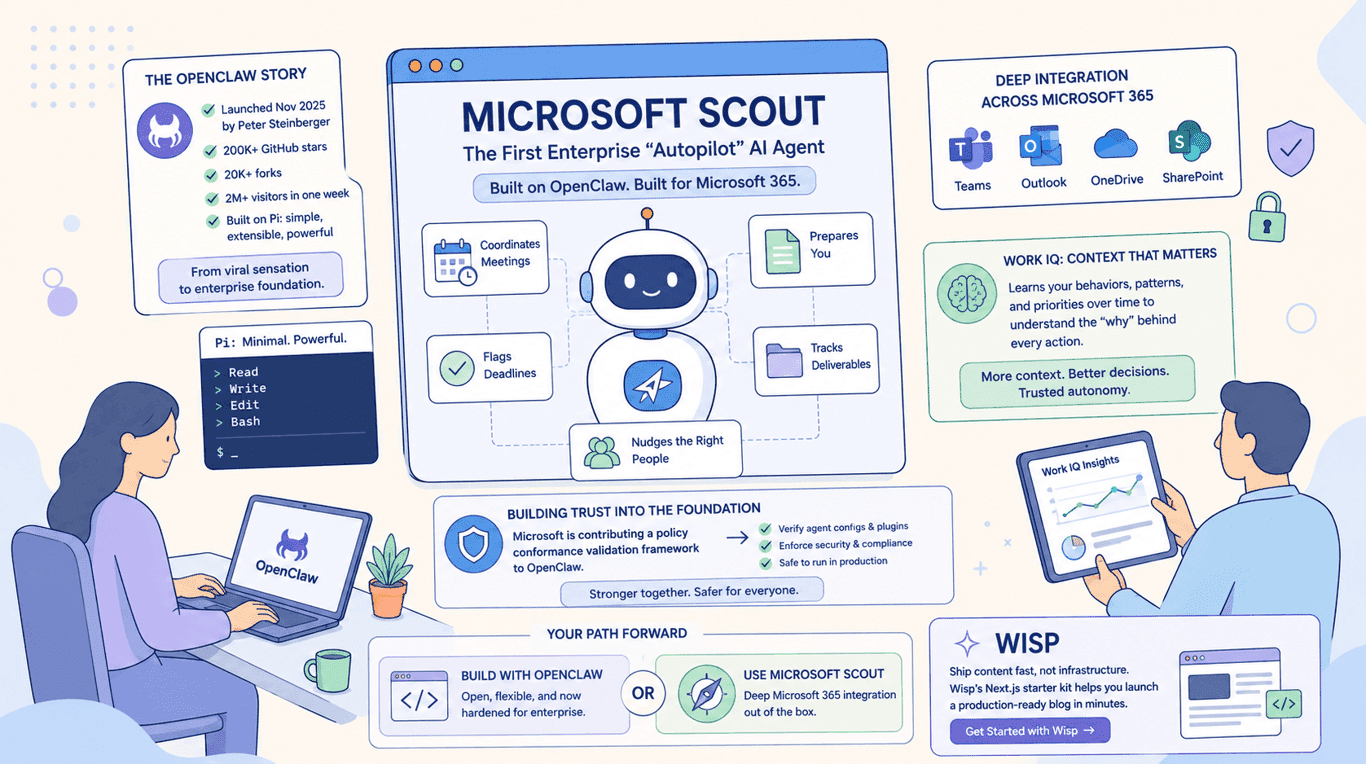
Microsoft Scout's key innovation is a persistent memory layer called "Work IQ" that ends the need to constantly re-explain context to your AI assistant.
Giving agents first-class identities and building in enterprise-grade security makes Scout's AI agents auditable and trustworthy for organizations.
The next wave of AI assistants will compete on cross-platform portability and reasoning transparency, which are still major gaps in the market.
AI agents will increasingly rely on public blogs and documentation for product information, turning your content layer into critical infrastructure.
An API-first headless CMS like Wisp helps make your content structured and machine-readable for this new reality.
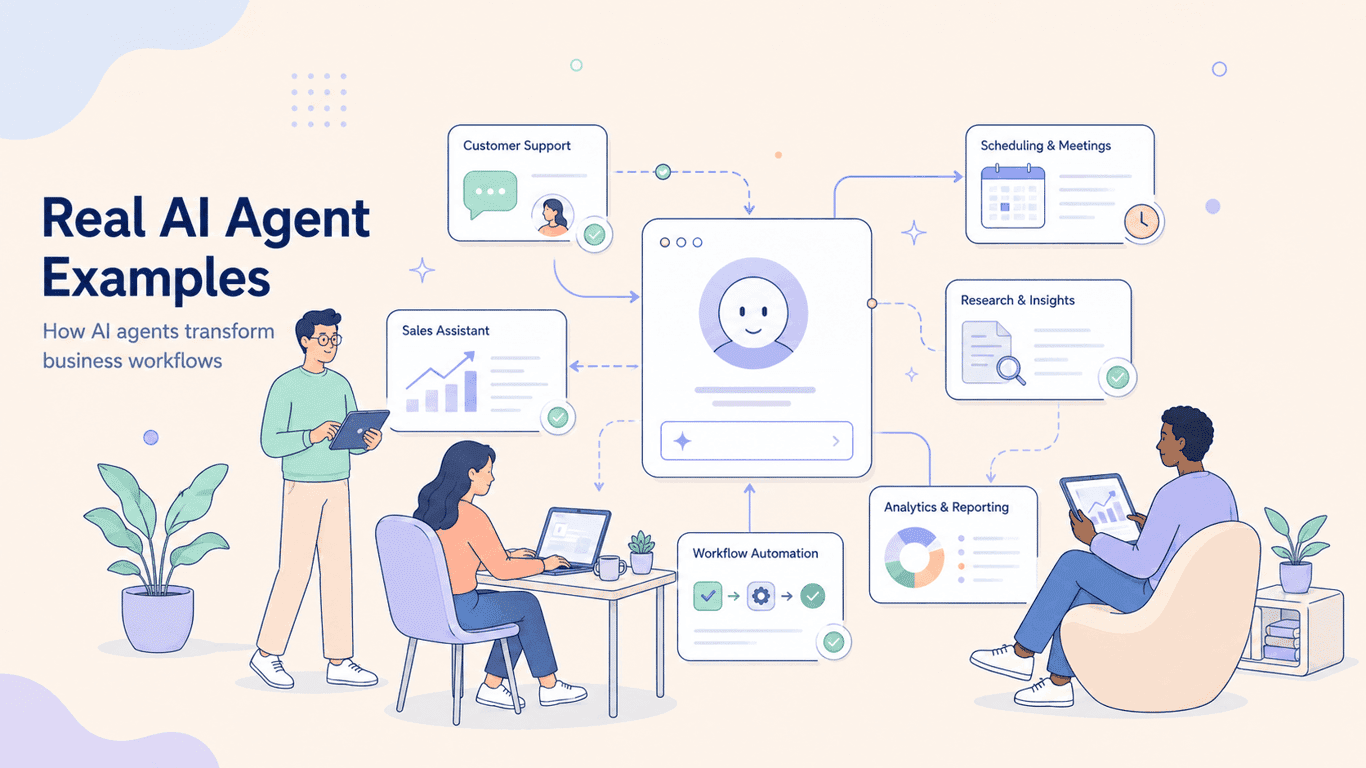
Every time you switch AI tools, you start over. "I use ChatGPT, but I also want to use Claude for questions, and I need to explain again to Claude what I've shared with ChatGPT." That's a real quote from a real user — and it captures exactly why the current generation of personal AI assistants feels like beta software dressed up in a production wrapper.
Microsoft hasn't helped its own cause. The company's AI product strategy has been, to put it charitably, chaotic. First came Project Opal, then Copilot Cowork, then Agent 365 AI Teammates, and now Scout—a series of products with different architectures and UIs but similar capabilities. The frustration among developers is legitimate.
But strip away the noise, and Scout — built on the OpenClaw framework and announced with considerably less fanfare than it deserved — actually articulates something important about where personal AI assistants are going. Four specific design decisions stand out as genuinely ahead of the market. Founders and product teams building in this space should pay attention.
The Memory Model: How "Work IQ" Ends Context Amnesia
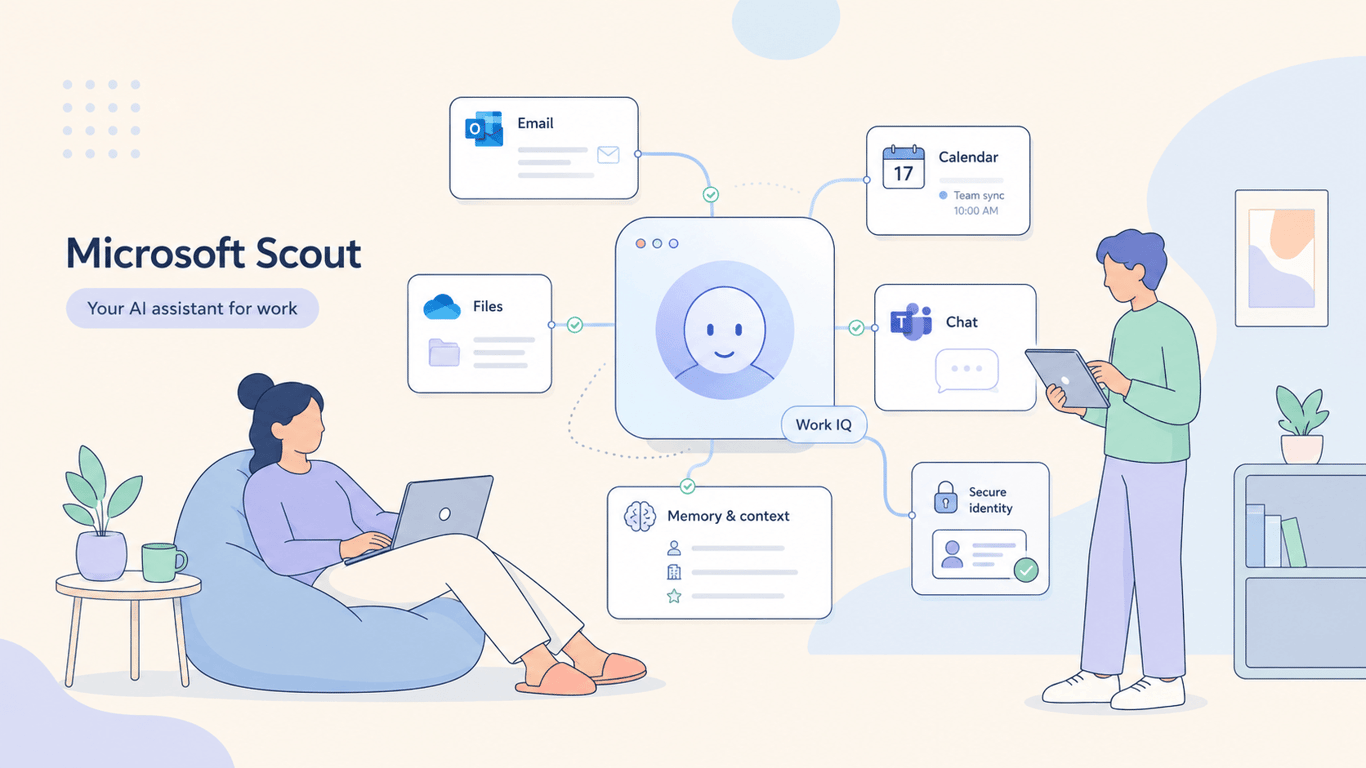
Scout's most important architectural decision is its persistent memory layer, which Microsoft calls Work IQ. This isn't session memory or a summarization trick. Work IQ is a continuous intelligence layer that learns how an individual works by tracking context like:
Their relationships
Active projects
Preferred communication styles
Recurring decisions
It connects that understanding to company-wide knowledge from sources that include:
Emails
Files
Meetings
Chats
According to Microsoft's Ignite 2025 announcement, Work IQ functions as Scout's long-term operating context. It doesn't reset between conversations. It codifies individual working patterns directly into the assistant's operational capabilities, so the assistant adapts over time rather than starting cold every session.
This directly addresses what users describe as the most exhausting part of using AI tools today — having to re-establish context every single time. "It feels a lot to ask for basic continuity," one user noted. Work IQ treats that continuity as a design primitive, not an afterthought.
The approach has a clear parallel in the open-source world. MacStories covered how OpenClaw uses a local, user-inspectable memory system stored as Markdown files — giving users direct visibility into what the assistant remembers and the ability to edit it. Scout takes that philosophy and operationalizes it at enterprise scale.
For product teams, the implication is clear: the shift from reactive to proactive AI isn't primarily a model capability problem. It's a memory architecture problem. Teams building personal AI assistant products need to treat memory as a first-order feature, not a future roadmap item.
The Identity Model: Agents Need a Badge, Not a Mask
Organizations are already nervous about AI agents. When businesses "have very little insight into what their users can actually access," as one cybersecurity discussion put it, the prospect of adding autonomous AI agents running against their infrastructure is alarming — not exciting.
Scout's answer is to make agents first-class identity citizens. According to TechCrunch's Scout launch coverage, each agent gets its own persistent identity tied to Microsoft Entra — not an anonymous process, not a shared service account, but a named, auditable entity with scoped permissions.
This matters for three concrete reasons:
Audit trails become real. When an agent takes an action, it's logged against a specific identity. You can reconstruct exactly what happened, when, and why.
Permissions stay scoped. The agent can only access what its identity is explicitly authorized to access — no silent privilege escalation.
Shadow AI gets a sanctioned alternative. If anyone in your organization is using Cursor or Claude Code, they likely have MCP servers configured that give AI direct access to repos, databases, or APIs — with zero visibility for the security team. Scout's identity model makes the managed path less painful than the workaround.
As one commenter put it: "Microsoft is emphasizing identity, permissions, policy enforcement, and managed access, which are all critical pieces if organizations are going to trust agents with ongoing responsibilities." That's not Microsoft hype — that's a practitioner acknowledging that the identity model is what separates a trusted agent from a liability.
The Customization Loop: Personalization as a Competitive Moat
Scout lets users name their assistant, define custom capabilities via SKILL.md files, and train it with feedback over time. That sounds like a feature list. It's actually a retention strategy — and a model for how AI products build defensibility.
Every custom skill a user creates, every preference the assistant internalizes, every workflow it learns deepens the switching cost. After six months of active use, your Scout instance isn't a generic AI assistant anymore. It's a specific asset that understands your context, your terminology, and your working style. Migrating to a competitor means starting over — and losing everything you've built.
Users already recognize this dynamic. "Cross-platform context portability weakens lock-in, and lock-in is the business model," one commenter observed. They're right. The major AI labs — OpenAI, Anthropic, Google — have made deliberate decisions not to make memory portable across platforms, precisely because portability erodes the moat.
Scout takes the same approach, but at a deeper level. The customization isn't just stored preferences. It's baked into how the assistant reasons about specific tasks, which makes it genuinely harder to replicate elsewhere. For product teams, this is the template: build systems where user investment compounds over time, where the product becomes measurably more valuable the longer a user stays.
The Microsoft Scout documentation describes the SKILL.md mechanism as a way for non-developers to extend Scout's capabilities without writing code. That's an important design decision — it makes the customization loop accessible to the people who will use the assistant most, not just the engineers who set it up.
The Security Model: Enterprise-Grade Trust by Default
The security problem with AI agents isn't theoretical. It's happening now. Tools like Cursor and similar coding assistants have MCP servers that provide execution-level exposure with minimal governance, including direct access to:
File systems
Shells
Internal APIs
Most security teams either don't know it's happening or can't stop it without blunt instruments like DNS-level blocking that get circumvented within days.
Scout's architecture treats security as a prerequisite, not an add-on. Three layers matter here:
Granular permissions: Scout requires explicit user approval before accessing the file system, executing shell commands, or automating browser actions. Users can mark directories as sensitive, triggering mandatory approval prompts before any agent action touches them.
Policy conformance: A continuous compliance layer checks agent actions against predefined organizational policies — not as a post-hoc audit, but in real time before actions execute.
Stack integration: Scout inherits existing enterprise security infrastructure rather than adding a parallel governance burden by plugging into:
Microsoft Defender
Entra
Purview
This mirrors the direction other enterprise AI tools are taking. Adobe's Acrobat AI Assistant details its enterprise security commitments explicitly: Azure OpenAI deployments that don't train on customer data, TLS 1.2+ in transit, AES-256 at rest, and granular administrative controls. Enterprise-grade security is becoming table stakes for any AI product asking organizations to delegate real work to an agent.
What's Still Missing from the Picture
Scout points in the right direction. But the current vision for personal AI assistants still has three significant gaps.
Cross-platform portability remains the biggest unresolved problem. Scout will work well inside the Microsoft ecosystem. It will not follow you with your context intact to other platforms, including:
A Mac
An Android device
A Google Workspace environment
The dream of a personal AI assistant whose memory travels with the user — not with the platform — is still aspirational.
Reasoning transparency is the next frontier. Scout generates audit trails for actions, which is useful. But users don't yet get insight into why the agent chose a specific course of action. For high-stakes decisions, that opaqueness is a real limitation on trust.
Cost and procurement friction are underrated obstacles. Scout requires a GitHub Copilot subscription, and getting those licenses hasn't been smooth. "It's been impossible to order GitHub Copilot business licenses for the past month or so. And most people have had the cost of their GitHub Copilot skyrocket," as one user reported. Enterprise-grade AI is still priced and distributed for enterprises — it remains out of reach for smaller teams that would benefit most from this level of personalization.
These gaps matter for product builders. They define where the next wave of opportunity lies. The next assistants should be:
Portable
Transparent
Accessible
They shouldn't require a Microsoft enterprise agreement to use.
Your Blog Is Now Your AI Strategy
Microsoft Scout shows where this is all headed: personal AI assistants that actually remember your context and have auditable identities, making them trustworthy enough for real work. For your team, the biggest takeaway isn’t about AI models—it’s about your content. Agents learn about your product from your public blog and docs. If that content is a mess, the AI’s answers will be wrong.
Your next move is to treat your content as critical infrastructure. Make it structured, machine-readable, and API-first.
That’s why we built Wisp. It’s a headless CMS designed to turn your blog into the clean, reliable context that AI agents need, without turning publishing into a technical chore. Wisp's free plan includes unlimited blogs and posts—you can start publishing in minutes.
FAQs
What is the main new feature in Microsoft Scout?
The main new feature in Microsoft Scout is "Work IQ," a persistent memory layer. This feature allows the AI to remember your context across sessions, so you don't have to re-explain projects or preferences every time you use it.
How does Scout make AI agents safer for businesses?
Scout makes AI agents safer by giving each one a unique, auditable identity within Microsoft Entra. This allows for clear audit trails and means agents only access data they have explicit permission for, just like a human employee.
Can I use Microsoft Scout on my Mac or with Google Workspace?
No, you cannot currently use Microsoft Scout outside of the Microsoft ecosystem. Its context and memory are not portable to other platforms like macOS or Google Workspace, which is a key limitation of the current version.
What makes Scout different from other Microsoft Copilot products?
What makes Scout different is its focus on being a persistent, personal assistant with long-term memory ("Work IQ") and a distinct identity. While other Copilots assist with tasks, Scout is designed to be an ongoing teammate that learns how you work.
Why is my blog content important for AI like Scout?
Your blog content is important for AI agents because they use public content to learn about your products. Structured, machine-readable content from your blog and docs helps AI assistants provide accurate, reliable answers about your company.
How does a user personalize their Scout assistant?
A user personalizes their Scout assistant by creating custom capabilities in simple SKILL.md files and providing feedback over time. This trains the assistant on specific workflows and preferences without requiring any coding knowledge.