Key Takeaways
Microsoft announced Scout, its first enterprise "Autopilot" AI agent, built on the massively popular open-source framework OpenClaw.
This partnership signals AI agents are maturing from demos to production tools, with the focus shifting from capability to enterprise trust and security.
To bridge this trust gap, Microsoft is contributing a policy conformance validation framework back to OpenClaw, hardening the open-source foundation for all developers.
This creates a clear path for developers: build on the hardened OpenClaw for custom work, or wait for Scout for deep Microsoft 365 integration. To avoid similar infrastructure overhead for content, Wisp's Next.js starter kit offers a fast path to a production-ready blog.
You've spent a week wiring up the openclaw ai agent framework. The demo worked. The GitHub stars don't lie. But then you tried to run it in anything resembling a production environment — and suddenly you weren't automating work, you were managing a new system.
That gap between demo excitement and production reality has defined the first wave of AI agent frameworks. At Microsoft Build on June 2, 2026, Microsoft announced something that directly targets it: Scout, the company's first "Autopilot" agent — built on top of OpenClaw, and baked into Microsoft 365.
This isn't just a headline partnership. It's a signal that the open-source agent ecosystem is crossing a threshold, and the terms of that crossing matter for every developer building on top of it.
From Viral Sensation to Enterprise Foundation: The OpenClaw Story
Before Scout, there was OpenClaw — and the story of how it got here is worth understanding, because it explains why Microsoft chose it over building from scratch.
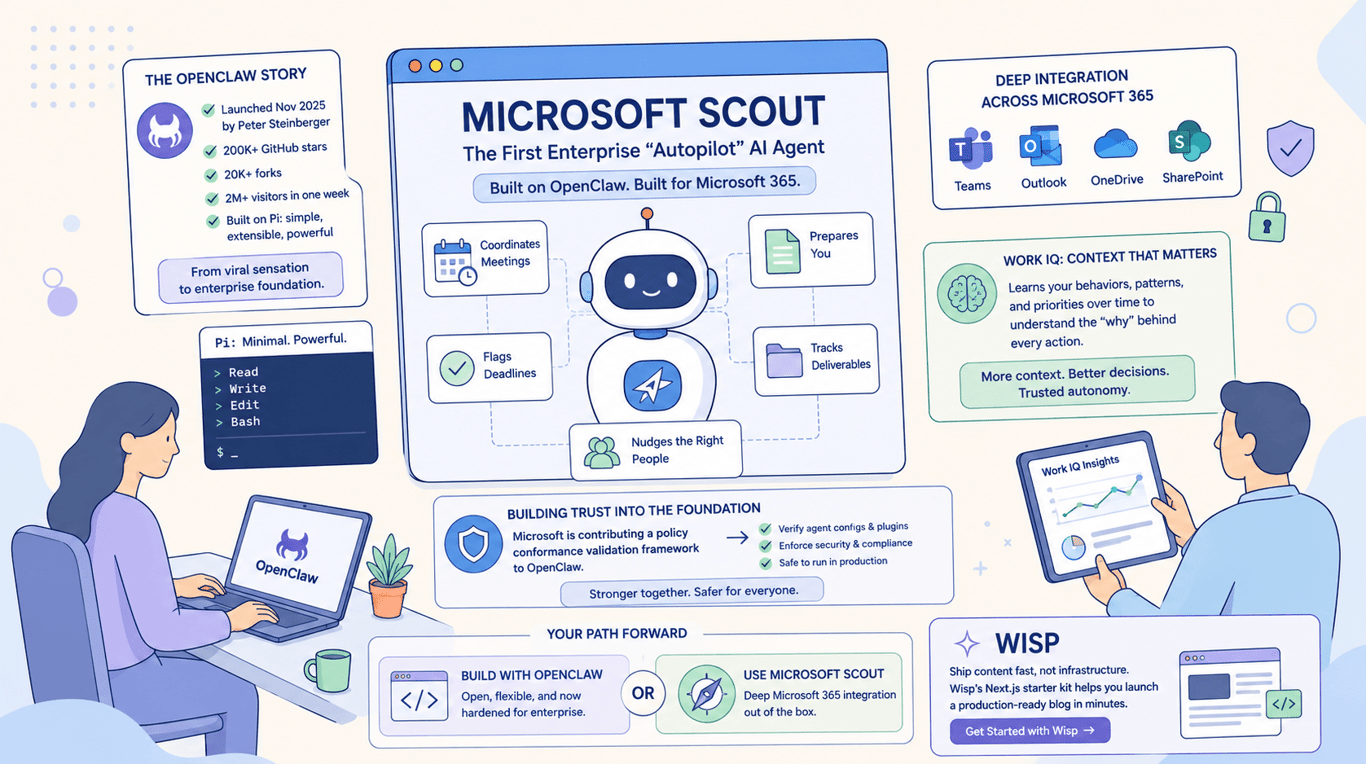
Peter Steinberger, founder of PSPDFKit, launched what would become OpenClaw in November 2025. According to the Monday Morning Substack, it originally started as a project called WhatsApp Relay before going through a naming gauntlet — ClawdBot, MoltBot — partly due to a trademark complaint from Anthropic. The numbers that followed were hard to ignore: 200,000 GitHub stars, 20,000 forks, and 2 million visitors in a single week.
What drove those numbers wasn't marketing. It was architecture.
OpenClaw is built on Pi, a minimal coding agent created by Mario Zechner. As documented on the Lucumr blog, Pi's strength is its deliberate simplicity — a tiny core and four primary tools:
Read
Write
Edit
Bash
That minimalism made it extensible without becoming a maze. Developers could build real, complex functionality on a foundation they could actually reason about.
OpenAI's response was to hire Steinberger — not to acquire OpenClaw outright, but to lead its personal agent initiatives. The project transitioned into an independent open-source foundation, keeping it neutral infrastructure rather than a captive product. That decision matters now more than ever.
What Is Microsoft Scout? The First Enterprise "Autopilot"
Microsoft's announcement defines Scout as the first member of a new agent category it calls "Autopilots." The distinction from a standard AI assistant is deliberate.
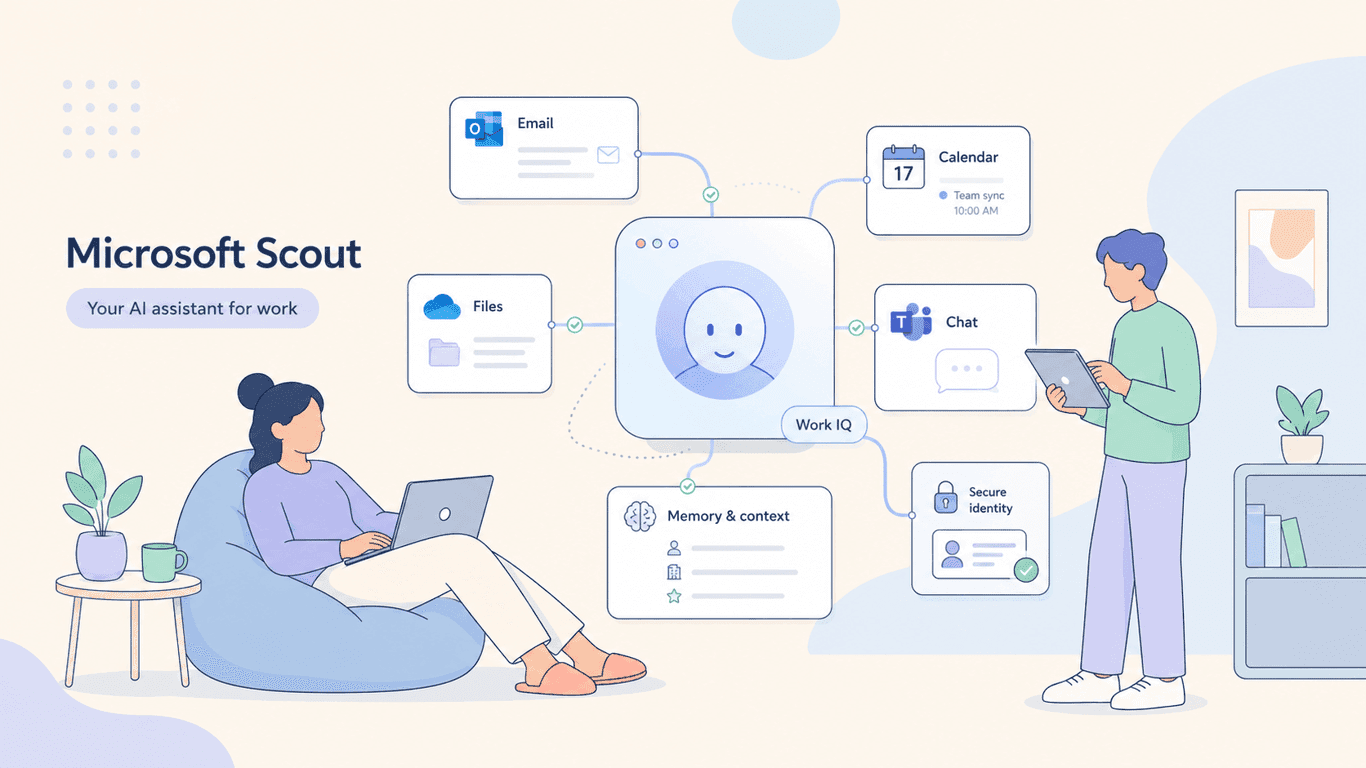
According to the Microsoft 365 blog, Scout operates as an always-on agent with its own managed identity. It doesn't wait for prompts. It monitors context across Microsoft Teams, Outlook, OneDrive, and SharePoint, and acts proactively to:
Coordinate meetings based on email and chat history
Flag upcoming deadlines from project files
Generate prep materials before calls
Track deliverables
Nudge the right stakeholders when decisions stall
Scout's managed identity model directly addresses the "chaos of access control" concern that surfaced repeatedly in developer discussions—agents acting with unclear permissions, overlapping with each other. Every action is attributable. Every permission is bounded.
Underlying Scout's contextual reasoning is Work IQ, Microsoft's proprietary context-learning layer. This is their answer to a problem described plainly in an enterprise agent failures thread: most enterprise systems record outcomes, not reasoning. A discount was approved. A ticket was escalated. But why those decisions happened rarely gets captured.
Work IQ is designed to learn a user's behaviors, communication patterns, and project priorities over time — building the "why" context that makes autonomous action trustworthy rather than unpredictable.
Bridging the Trust Gap: Microsoft's Contributions Back to OpenClaw
The most consequential part of the Scout announcement isn't what Microsoft built for itself. It's what it's contributing upstream.
Microsoft is adding a policy conformance validation framework directly to the openclaw ai agent framework. This gives teams a standardized way to verify that an agent's configuration, plugins, and runtime behavior comply with internal security and compliance policies — before anything runs in production.
That contribution addresses real, documented vulnerabilities. A published security analysis catalogued 470 advisories filed against OpenClaw organized by architectural layer and trust violation type. Among the findings: three Moderate- or High-severity advisories that, chained together, create a complete unauthenticated remote code execution (RCE) path from an LLM tool call to the host process. The analysis also identified invalid assumptions in the exec allowlist that could be bypassed using shell line continuations, and the risk of malicious skill execution through the plugin channel.
These aren't theoretical. They're the exact kind of issues that make enterprise security teams reject open-source agent frameworks outright, regardless of how good the core functionality is. Microsoft's upstream contribution doesn't just make Scout safer — it hardens the foundation that every developer building on OpenClaw is standing on.
As one commenter in the Copilot Studio thread put it: "Microsoft is emphasizing identity, permissions, policy enforcement, and managed access, which are all critical pieces if organizations are going to trust agents with ongoing responsibilities." That's exactly what the policy conformance layer delivers.
What This Means for the AI Agent Ecosystem
This partnership follows a recognizable pattern: a viral open-source project builds something genuinely powerful, a major platform adopts it, and the enterprise wrapper is where the value capture happens. But the direction of contribution here is worth noting.
Microsoft isn't forking OpenClaw. It's strengthening it. That's a meaningful signal about where the competitive battleground has moved.
As the Monday Morning Substack observed, the real competition in AI has shifted away from who has the best model. The fight is now over who owns the agent layer — the software that sits between a user, their data, and the actions taken on their behalf. Microsoft's Scout is a direct claim on that layer within enterprise environments.
The fact that it's built on an open-source foundation — and that Microsoft is actively contributing security infrastructure back upstream — changes the dynamics. It validates OpenClaw as neutral, production-grade infrastructure. It also raises the floor for what "production-ready" means in this space.
For the broader ecosystem, the message is that raw capability, however impressive, isn't the obstacle anymore. The gaps that kept agents out of enterprises are now being closed, including:
Security
Identity
Compliance
Contextual reasoning
And they're being closed in public, in the open-source codebase that developers are already building on.
 Should You Build on OpenClaw or Wait for Scout?
The announcement clarifies the landscape, but it doesn't make the decision for you. What's right depends on where your project sits.
Build Directly on OpenClaw
If you're running a startup, research project, or any context that requires deep customization and isn't tied to the Microsoft 365 ecosystem, build directly on OpenClaw. The framework remains the fastest path from idea to working agent. The tradeoff is that the hard problems — security, policy enforcement, identity — land on you. The arXiv security paper is required reading before you ship anything this way.
Wait for Scout GA
If you're building internal tooling for an enterprise environment already running on Microsoft 365, wait for Scout GA. The integration depth is significant, and the security and compliance infrastructure that would take months to build is included. The tradeoff is that you're operating within Microsoft's ecosystem, on Microsoft's roadmap. Customization stops where the Scout platform stops.
A Hybrid Path
A hybrid path makes sense for teams that need to move now but know they'll need production-grade infrastructure later. Prototype fast on the open-source openclaw ai agent framework. Build against the same abstractions Microsoft is reinforcing. Plan for the migration to Scout or a comparable managed layer when you're ready to harden.
Your Path Forward With AI Agents
Microsoft’s Scout announcement marks a turning point for AI agents, moving them from impressive demos to trustworthy production tools. The conversation has shifted from raw capability to enterprise security and trust. This leaves developers with two clear paths: build custom solutions on the newly hardened OpenClaw, or wait for Scout for deep, secure integration with Microsoft 365.
Your first step is to decide which path fits your project. This challenge—bridging the gap between a powerful tool and production-ready infrastructure—isn’t unique to AI. If your content operations suffer from similar friction, Wisp offers a production-ready headless CMS on a permanent free plan. Watch the demo to see how it removes infrastructure overhead.
FAQs
What is Microsoft Scout?
Microsoft Scout is the company's first "Autopilot" AI agent, designed to proactively manage tasks within the Microsoft 365 ecosystem. It operates as an always-on assistant to coordinate meetings, track deadlines, and simplify workflows.
How is Scout different from other AI assistants?
Scout is different from other AI assistants because it operates proactively as an "Autopilot" rather than waiting for user prompts. It uses a managed identity to act on your behalf across Microsoft 365 apps, with all actions being attributable and secure.
What is the relationship between Scout and OpenClaw?
The relationship between Scout and OpenClaw is that Scout is built on top of the open-source OpenClaw framework. Microsoft chose this popular AI agent framework as the foundation for its enterprise-grade "Autopilot" agent.
Why is Microsoft contributing back to the OpenClaw project?
Microsoft is contributing back to the OpenClaw project to enhance its security and enterprise-readiness for everyone. By adding a policy conformance validation framework, Microsoft is hardening the open-source foundation against common vulnerabilities.
Should I use OpenClaw or wait for Microsoft Scout?
You should use OpenClaw for projects requiring deep customization outside the Microsoft ecosystem. Wait for Microsoft Scout if you need a secure, deeply integrated agent for an enterprise environment that already runs on Microsoft 365.
What main problem does Scout solve for enterprises?
The main problem Scout solves for enterprises is bridging the trust gap for AI agents in production environments. It provides built-in security, identity management, and compliance features that are critical for enterprise adoption.
How does Scout understand my work context?
Scout understands your work context through Work IQ, Microsoft's proprietary context-learning layer. It learns your behaviors, priorities, and communication patterns over time to make its autonomous actions more trustworthy and relevant.