Key Takeaways
While powerful, Strapi's flexibility can create performance bottlenecks and significant setup overhead for Next.js developers.
The best Strapi alternative depends entirely on your needs: Payload for code-first control, Sanity for complex data, and Storyblok for visual editing.
For teams who just need to ship a fast blog on Next.js, a purpose-built solution like Wisp avoids unnecessary complexity with a clean SDK and a simple editor for non-technical users.
You wanted a headless CMS to "pump out some marketing content and get more traffic." So you set up Strapi, wired it to your Next.js app, and then spent two weekends fighting CORS errors, misconfigured populate queries, and database connection issues on your self-hosted server.
Strapi is a capable open-source CMS, but it comes with real operational overhead. As your project scales or your team grows, that overhead becomes friction. Here are seven Strapi alternatives worth considering, each with a migration difficulty rating and code to help you make the switch.
7 Strapi Alternatives for Next.js Developers
Each alternative below is assessed for Next.js compatibility, migration difficulty, and the type of project it suits best.
1. Wisp
Wisp is a headless blog CMS built specifically for Next.js and React. Where Strapi is a general-purpose headless CMS that you configure for your use case, Wisp is purpose-built for blogging. This means less setup, less configuration, and an editor designed so non-technical writers can publish without opening a code editor.
Best for: Founders, solo builders, and marketing teams who want to ship blog content fast without managing infrastructure.
Migration Difficulty: Low
Next.js compatibility: First-class. Wisp ships with a JS SDK, a Next.js Starter Kit, and features like Custom React Components that let developers register interactive React components writers can then insert into posts via the editor.
Key features:
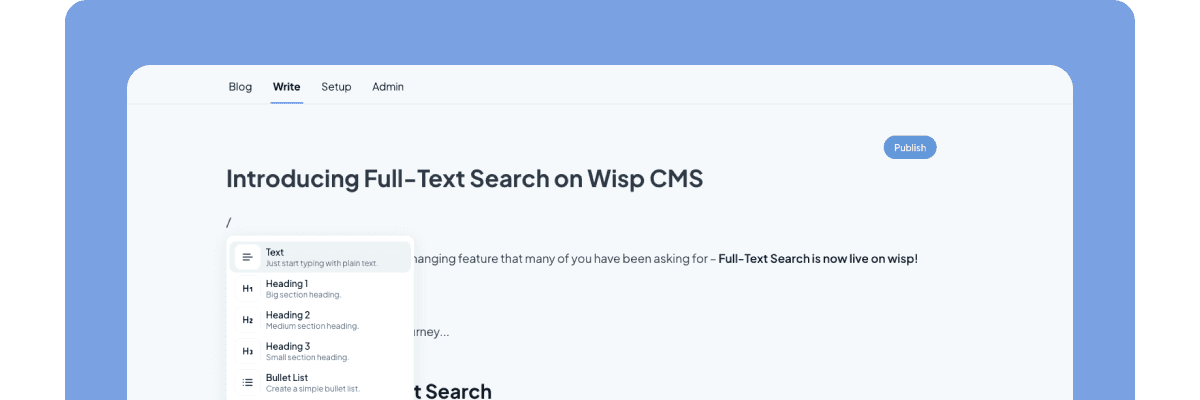
Distraction-free editor. Inspired by Medium and Notion — no Markdown required. Non-technical team members can write, format, and publish without touching the codebase.
Global CDN delivery. Content and images are served from a CDN out of the box, which can help with load times and Core Web Vitals.
AI-powered features. Includes contextual CTA suggestions matched to article content and AI-driven related post recommendations based on semantic similarity.
Multi-tenancy. Manage multiple blogs under one account — useful for agencies handling multiple client projects.
Migrating from Strapi to Wisp:
Export your Strapi content using Strapi's built-in data export tool (JSON format).
Create a free Wisp account and grab your Blog ID from the dashboard.
Write a short migration script to push posts to Wisp via the Content API:
const strapiPosts = require('./strapi-export.json');
const WISP_BLOG_ID = 'your-wisp-blog-id';
const WISP_API_KEY = 'your-wisp-api-key';

async function migratePost(post) {
  await fetch(`https://api.wisp.blog/v1/blogs/${WISP_BLOG_ID}/posts`, {
    method: 'POST',
    headers: {
      'Content-Type': 'application/json',
      'Authorization': `Bearer ${WISP_API_KEY}`,
    },
    body: JSON.stringify({
      title: post.attributes.title,
      content: post.attributes.content,
      slug: post.attributes.slug,
      status: 'published',
    }),
  });
}

strapiPosts.data.forEach(migratePost);
Install the Wisp JS SDK and replace your Strapi data-fetching logic:
import { WispAPI } from '@wisp-cms/client';

const wisp = new WispAPI({ blogId: 'your-wisp-blog-id' });

export async function getStaticProps() {
  const posts = await wisp.getPosts();
  return { props: { posts } };
}
Wisp's free plan includes unlimited blogs and posts, so you can run a parallel setup and validate everything before switching over.
2. Payload CMS
Payload is a code-first, open-source headless CMS built with TypeScript and Node.js. It integrates directly into your Next.js project rather than running as a separate service. Payload can be up to 7x faster than Strapi, a meaningful difference for content-heavy sites.
As one developer noted, "Payload is the easiest and most customizable imo. If you're using Next.js for your site Payload will feel right at home."
Best for: Developers who want self-hosting flexibility, TypeScript-first content modeling, and a CMS that feels native to the React ecosystem.
Migration Difficulty: Moderate
Next.js compatibility: Excellent. Payload can be embedded directly into your Next.js app.
Migrating from Strapi to Payload:
Initialize a new project with
npx create-payload-app.Recreate your Strapi content types as Payload Collections in TypeScript config files.
Export Strapi data and use Payload's Local API to import it:
import payload from 'payload';
const strapiData = require('./strapi-export.json');

strapiData.forEach(async (item) => {
  await payload.create({
    collection: 'posts',
    data: {
      title: item.attributes.title,
      content: item.attributes.content,
    },
  });
});
The main effort here is recreating your schema in code and transforming any rich text content. Plan for a day or two of migration work depending on your data complexity.
3. Sanity
Sanity is a platform for structured content with real-time collaboration and a powerful query language called GROQ. It's a strong choice when your content model is genuinely complex, with multiple content types with deep relationships.
Best for: Large teams, complex content models, and projects that need real-time collaborative editing.
Migration Difficulty: High
Next.js compatibility: Excellent. Sanity has first-class support for both the App Router and Pages Router.
Migrating from Strapi to Sanity:
Define your schemas in JavaScript via the Sanity CLI.
Export Strapi content to JSON.
Transform the data and import it using
@sanity/clientwith batched transactions:
import { createClient } from '@sanity/client';
const client = createClient({ /* config */ });
const strapiPosts = require('./strapi-export.json');

let transaction = client.transaction();
strapiPosts.forEach(post => {
  transaction.create({
    _type: 'post',
    title: post.attributes.title,
  });
});
await transaction.commit();
Sanity's GROQ query language is powerful but has a learning curve. Budget time to remap your data-fetching logic across the frontend.
4. Contentful
Contentful is one of the original API-first headless CMS platforms. It's stable, well-documented, and built for teams that need to deliver content across multiple channels: web, mobile apps, digital signage.
Best for: Enterprise teams managing omnichannel content delivery with strict governance and security requirements.
Migration Difficulty: Medium
Next.js compatibility: Very strong. Contentful has well-supported TypeScript SDKs and solid Next.js documentation.
Migrating from Strapi to Contentful:
Recreate your content models using Contentful's web UI.
Export Strapi content to JSON.
Use the Contentful Migration CLI to script the import:
module.exports = function (migration) {
  const strapiPosts = require('./strapi-export.json');
  strapiPosts.forEach(post => {
    // Contentful migration scripts use a different pattern
    // You'll typically pre-create entries via the Content Management API
  });
};
Contentful's free tier limits are more restrictive than some alternatives — worth checking the pricing page before committing.
5. Ghost
Ghost combines a world-class writing experience with built-in tools for memberships, newsletters, and subscriptions. It can run headlessly via its Content API, letting you build a custom Next.js frontend on top.
Best for: Publishers, creators, and businesses that need native newsletter and membership functionality alongside a great writing experience.
Migration Difficulty: Medium
Next.js compatibility: Good. Ghost's Content API is clean and well-documented. There is no dedicated Next.js SDK, but it offers straightforward REST integration.
Migrating from Strapi to Ghost:
Export your Strapi posts to JSON.
Transform the data into Ghost's import format (a specific JSON structure with a
postsarray).Import via the Ghost Admin panel under Settings > Labs, or use the Ghost Admin API for larger datasets.
Ghost shines when memberships and email newsletters are core to your content strategy. If you're purely building a marketing blog on Next.js, it may be more than you need.
6. Prismic
Prismic takes a "Slices" approach to content modeling: reusable, component-like sections that map directly to your React components. Its Slice Machine tool syncs your local codebase with the CMS editor, keeping content types and components in sync.
Best for: Marketing teams and developers building component-driven websites with structured page layouts.
Migration Difficulty: Low
Next.js compatibility: Strong. Prismic provides a dedicated
@prismicio/reactlibrary and first-class Next.js documentation.
Migrating from Strapi to Prismic:
Define Custom Types and Slices in Prismic via Slice Machine.
Export Strapi content to JSON and transform it to match Prismic's document structure.
Use Prismic's Import/Export feature to push your transformed JSON to your repository, either via the UI or the Migration API.
Prismic is relatively painless to migrate to compared to schema-heavy alternatives. Most of the work is the initial Slice setup.
7. Storyblok
Storyblok is built around its real-time visual editor, which lets content teams edit pages by clicking directly on components in a live preview. Content is structured as "bloks" that map to your React components.
Best for: Teams where visual, in-context editing is a top priority, particularly for e-commerce and marketing sites with complex page layouts.
Migration Difficulty: Medium
Next.js compatibility: Excellent. Storyblok's SDK includes a bridge that enables live visual editing with Next.js out of the box.
Migrating from Strapi to Storyblok:
Define your blok components in Storyblok to mirror your Strapi content types.
Export Strapi content to JSON.
Use the Storyblok Management API to import your content as "stories":
const StoryblokClient = require('storyblok-js-client');
const client = new StoryblokClient({ oauthToken: 'YOUR_OAUTH_TOKEN' });
const strapiData = require('./strapi-export.json');

strapiData.forEach(async (item) => {
  await client.post(`spaces/YOUR_SPACE_ID/stories`, {
    story: {
      name: item.attributes.title,
      slug: item.attributes.slug,
      content: {
        component: 'post',
        body: [],
      },
    },
  });
});
The visual editor is Storyblok's standout feature. If your team doesn't need it, simpler alternatives may be a better fit.
Why Developers Start Looking for a Strapi Alternative
Strapi works well when it's configured correctly. The problem is that "configured correctly" is harder than it sounds.
Strapi's own performance guide documents the most common traps:
N+1 query problems. Fetching a list of posts with related data can balloon into a dozen separate API requests. The fix is explicit population:
const qs = require('qs');
const query = qs.stringify({
  populate: {
    sections: {
      populate: { media: true, author: { populate: ['avatar'] } }
    },
  },
});
const response = await fetch(`${process.env.STRAPI_URL}/api/pages/${slug}?${query}`);
Over-fetching with
populate=*. This bloats every response and tanks page load times. You need selective population, always:
const query = qs.stringify({
  populate: {
    category: { fields: ['name'] },
    images: { fields: ['url', 'alternativeText'] }
  },
  fields: ['title', 'price']
});
Image configuration friction. Every Strapi deployment requires manually adding
remotePatternstonext.config.js:
module.exports = {
  images: {
    remotePatterns: [
      { protocol: 'https', hostname: 'your-strapi-domain.com', pathname: '/uploads/**' }
    ]
  }
};
Beyond performance, there's the deployment complexity. Self-hosting Strapi means managing a server, a database, and a CI/CD pipeline, all before you've written a single blog post. For teams that want to move fast, that's a significant cost.
Ship Your Blog, Not Your CMS
Choosing a Strapi alternative isn’t about finding a one-size-fits-all replacement. It’s about matching the tool to the job. For complex, multi-channel content, a powerful system like Sanity or Contentful is worth the investment. For developers who want total control in a self-hosted environment, Payload is a fantastic code-first option.
But if your goal is just to publish a fast, SEO-optimized blog on Next.js, the best move is to ditch the complexity. Stop wrestling with populate queries and server configurations. Instead, give your team a focused tool that lets them ship content friction-free.
Wisp's free plan includes unlimited blogs and posts, making it a risk-free way to ship your blog without the setup headaches. You can create a free account to see if it’s the right fit for your team.
FAQs
Why find a Strapi alternative for a Next.js project?
You should look for a Strapi alternative if you're facing performance issues or setup complexity. Common problems include N+1 query bottlenecks, over-fetching data, and the overhead of self-hosting, which can slow down development and page load times.
What's the fastest Strapi alternative for a Next.js blog?
The fastest Strapi alternative for a Next.js blog is often a purpose-built solution. A service like Wisp is optimized for speed with a global CDN and a clean SDK, removing the common performance traps found in general-purpose CMSs like Strapi.
How to choose a self-hosted vs. managed headless CMS?
To choose between self-hosted and managed, consider your team's resources. Self-hosted options like Payload offer control but require you to manage servers and databases. Managed solutions like Sanity or Wisp handle infrastructure for you, letting you focus on content.
Which Strapi alternative has the best visual editor?
For the best visual editing experience, Storyblok is a leading Strapi alternative. Its real-time visual editor allows content teams to edit components directly on a live preview of the site, making it ideal for marketing teams with complex page layouts.
What's the easiest Strapi alternative to migrate to?
The easiest Strapi alternative to migrate to is one with a simple data model and a clear migration path. Wisp is designed for this with a straightforward Content API, while Prismic's Slice-based approach also simplifies the transition for component-driven sites.
Are there any good open-source alternatives to Strapi?
Yes, there are excellent open-source alternatives to Strapi. Payload CMS is a popular choice for its code-first TypeScript approach that integrates directly into your Next.js project, offering great performance and a superior developer experience.
How much does a headless CMS typically cost?
The cost of a headless CMS varies widely. Self-hosted options like Strapi or Payload have infrastructure costs, while managed services like Contentful or Sanity have usage-based pricing. Others, like Wisp, offer generous free tiers suitable for many projects.