Summary
Traditional CMS platforms like WordPress can cause you to miss 2-6% of organic traffic from AI searches, a channel growing over 40% monthly.
AI engines favor structured data, semantic HTML, and API-first architecture—features native to modern headless CMSs but often lacking in WordPress.
Key action items include auditing your current CMS for AI readiness, exploring alternatives like Wisp or Webflow, and implementing a technical GEO checklist.
You've set up your website on WordPress because it was the familiar choice. Your clients insisted on it, your team knew how to use it, and honestly, you didn't have the budget for a bespoke solution. But now you're noticing something concerning: your carefully crafted content seems invisible to AI search engines like ChatGPT, Claude, and Perplexity.
While your site ranks decently in Google search results, it's nowhere to be found when users ask AI assistants for information in your niche. This isn't just a minor inconvenience—it's a growing blind spot in your digital visibility strategy.
Traditional CMS platforms miss 2-6% of organic traffic from AI searches, which are growing over 40% monthly according to research from Relixir.ai. As AI search becomes mainstream, this visibility gap will only widen.
To succeed in this evolving landscape, businesses need content management systems built for structured data, semantic clarity, and speed—the three pillars of Generative Engine Optimization (GEO). In this article, we'll explore seven WordPress alternatives specifically optimized for visibility in AI search engines.
Why Your CMS Choice Matters for AI Search
Before diving into specific platforms, let's understand why your CMS choice significantly impacts your visibility to AI search engines.
Unlike traditional search engines that primarily analyze keywords and backlinks, AI search engines like ChatGPT and Claude interpret content contextually. They prioritize:
Structured data: Machine-readable formats that clearly define content types and relationships
Semantic HTML: Properly organized content using appropriate tags that signal content hierarchy
API-first architecture: Clean, accessible data structures that AI systems can easily parse
The impact of implementing these elements is substantial. Google's research on structured data shows impressive results:
Rotten Tomatoes saw a 25% higher click-through rate after adding structured data
Food Network achieved a 35% increase in visits
Nestlé found that pages with rich results get an 82% higher click-through rate
Google recommends JSON-LD as the preferred format for structured data due to its ease of implementation and separation from display code. Modern CMS platforms that support this format out of the box give you an immediate advantage in AI search visibility.
Now, let's explore the seven best WordPress alternatives optimized for AI search engines.
7 Best WordPress Alternatives for AI Search Visibility
1. Wisp
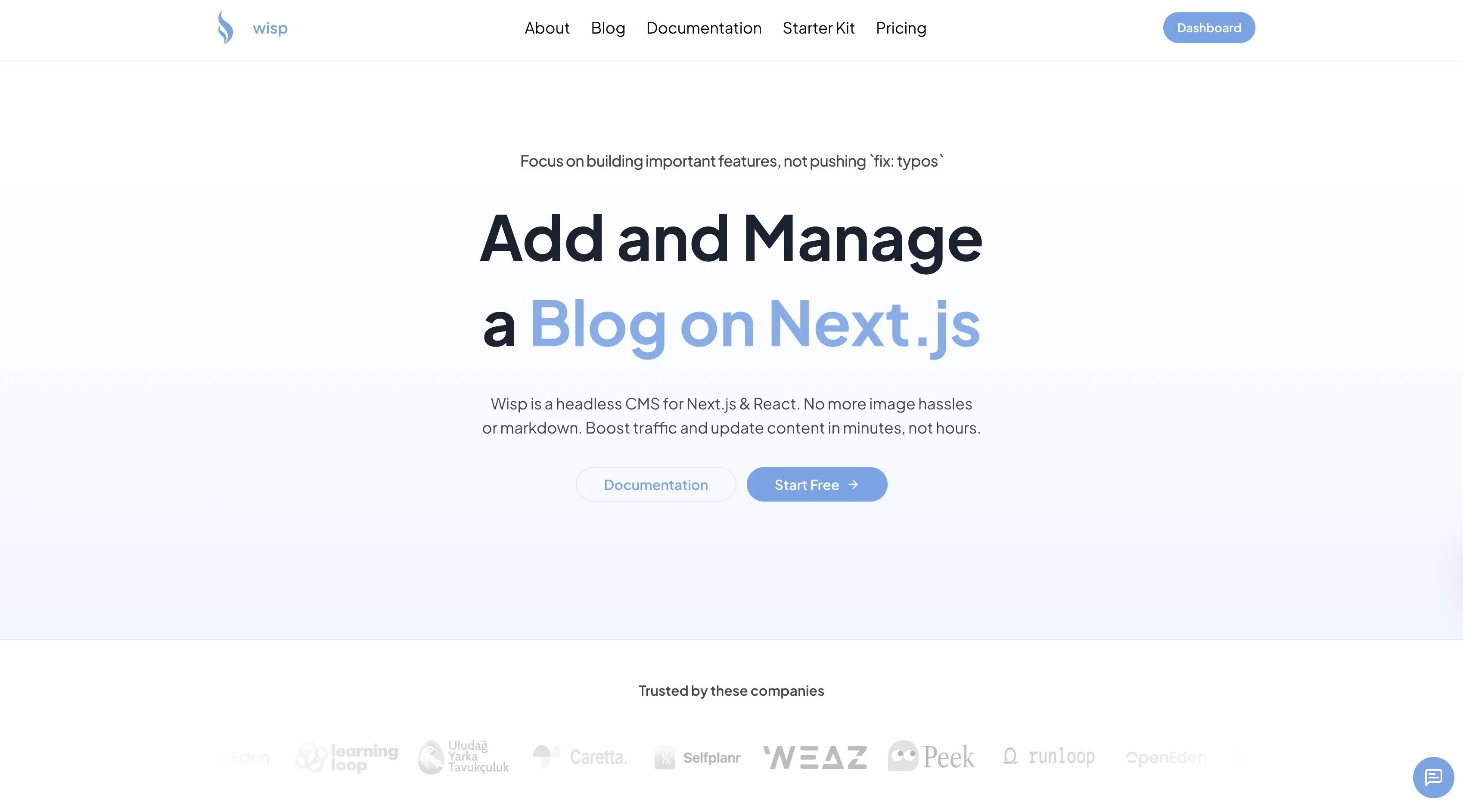
Overview: Wisp is a headless CMS purpose-built for adding a blog to Next.js and React sites. It solves the specific pain point many developers face: managing blog content without constant engineering tickets, allowing teams to ship content faster.
Why it's optimized for AI search:
Native structured data support: Wisp provides built-in SEO implementation guidance for metadata, JSON-LD, and sitemaps, ensuring content is immediately understandable to AI engines.
Total frontend control: As a headless CMS, developers using Wisp's Content API or JS SDK have absolute control over the rendered HTML, allowing for perfect semantic markup and advanced schema implementation.
Performance-first approach: Content and images are delivered via a global CDN, ensuring fast load times—a critical factor for both traditional SEO and AI crawlers.
Key features for teams:
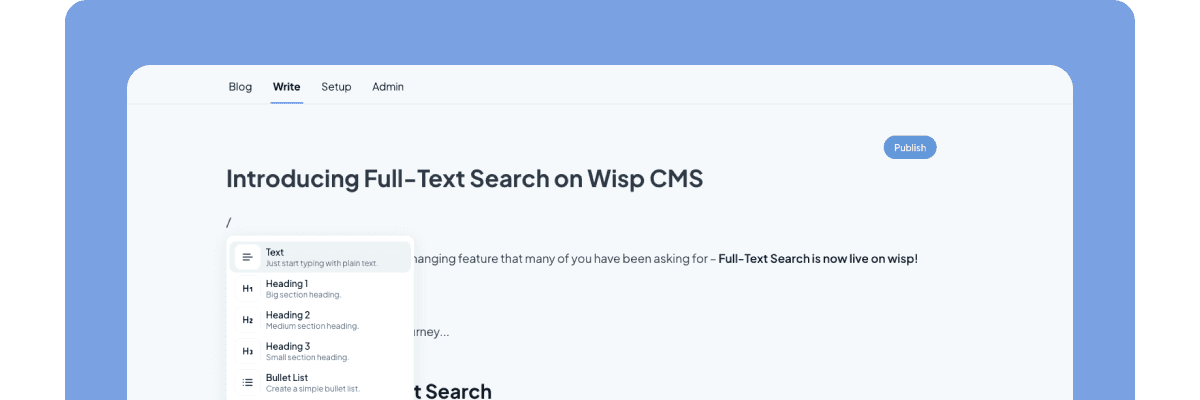
Distraction-free editor: A Medium/Notion-style editor that doesn't require Markdown knowledge, making it easy for non-developers to publish content.
Fast integration: The Next.js Blog Starter Kit allows a fully functional blog to be set up in hours, not days.
Multi-tenancy: Manage multiple blogs for different projects or clients under a single account.
Wisp is ideal for indie hackers, bootstrapped startups, and small teams building on Next.js/React who want to ensure their content is perfectly structured for AI search engines without sacrificing user experience.
2. Contentful
Overview: Contentful is a leading content infrastructure platform that treats content as structured, modular components rather than traditional pages.
Why it's optimized for AI search:
Contentful's core strength is its structured content management approach. By breaking content into reusable fields and models, it creates an inherently machine-readable format that AI can easily parse for context and meaning.
The platform also offers features like AI-generated alt text, which improves accessibility and helps AI systems better understand image content—a crucial factor as AI engines increasingly consider multimedia elements.
Contentful's API-first approach means content is always available in clean JSON format, making it perfect for feeding into AI systems without the bloated HTML that often comes with traditional WordPress setups.
3. Sanity
Overview: Sanity is a flexible content platform known for its real-time collaboration features and highly customizable backend.
Why it's optimized for AI search:
Sanity's powerful query language (GROQ) allows developers to fetch precisely structured data, making it highly efficient for feeding content to AI models. This advanced data fetching and querying system gives developers fine-grained control over the content structure delivered to AI crawlers.
The platform's schema-based approach forces content to be well-structured from the start, eliminating the inconsistencies that often plague WordPress sites and confuse AI systems.
Sanity also makes it easy to implement and manage structured data across your entire site, ensuring AI search engines can accurately understand and categorize your content.
4. Webflow
Overview: Webflow is a visual-first platform that empowers designers to build professional websites without code, while offering a powerful CMS backend.
Why it's optimized for AI search:
Webflow includes built-in AEO (Answer Engine Optimization) tools and provides automatic schema type recommendations, simplifying the process of adding structured data. Its visual interface generates clean, semantic code that is highly crawlable by both traditional and AI search engines.
The platform's native CMS capabilities allow for structured content creation while maintaining visual design flexibility—giving you the best of both worlds for AI visibility and user experience.
As one developer noted, "It is a lot more cumbersome than WordPress but far less hassle in the long run," highlighting Webflow's balance of initial learning curve versus long-term maintainability.
5. Ghost
Overview: Ghost is an open-source publishing platform focused purely on content creation, newsletters, and memberships.
Why it's optimized for AI search:
Ghost is built for speed and simplicity. It outputs clean, semantic HTML by default and has excellent built-in SEO features. Its minimalist approach avoids the plugin bloat that can harm performance and crawlability on WordPress.
The platform's content-first architecture ensures that articles are properly structured with clear headings, metadata, and author information—all crucial signals for AI search engines trying to determine content authority and relevance.
Ghost also includes built-in structured data for articles, ensuring that AI search engines can immediately understand what your content is about without additional configuration.
6. Storyblok
Overview: Storyblok is a headless CMS with a unique visual editor that allows content managers to edit the website in real-time.
Why it's optimized for AI search:
Storyblok's component-based architecture is its key advantage for AI search visibility. Every piece of content is a reusable "blok," forcing a structured approach that makes the content repository inherently AI-ready and easy to parse.
This component-based system ensures consistent structure across your entire site, something AI search engines heavily value when determining content reliability and organization.
The platform also offers robust API capabilities that make it easy to implement advanced structured data and ensure your content is delivered in an optimal format for AI consumption.
7. Strapi
Overview: Strapi is the leading open-source headless CMS, offering developers complete freedom to customize the admin panel and API.
Why it's optimized for AI search:
Strapi provides 100% control over the API output. Developers can create custom endpoints that deliver perfectly formatted JSON structured precisely for AI consumption, without any unnecessary data.
The platform's content-type builder allows for creating highly structured content models that map perfectly to schema.org types—critical for AI search visibility.
Strapi's open-source nature means developers can extend it to integrate with emerging AI technologies and stay ahead of evolving AI search requirements.
Your Implementation Checklist for AI-Ready Content
After choosing an AI-optimized CMS from the list above, follow this GEO implementation checklist to maximize your visibility in AI search:
Establish a Schema Markup Foundation: Ensure that your site has proper schema types (e.g.,
Article,FAQ,Product) to enhance AI citation accuracy.Configure AI Monitoring: Track AI mentions and visibility across platforms like ChatGPT and Google AI to understand where your content is being surfaced.
Implement Visitor Identification: Use scripts to accurately identify and attribute visitors who arrive from an AI search citation.
Integrate with Your CRM: Connect identified leads from AI search into your existing sales and marketing workflows for full-funnel tracking.
Maintain Content Refresh Cycles: Regularly audit and refresh content to maintain its relevance and accuracy, increasing the likelihood of it being used as a trusted source by AI models.
Future-Proof Your Content for the AI Era
As AI search continues its rapid growth, the gap between traditional SEO and GEO (Generative Engine Optimization) will only widen. An AI-first content strategy requires an AI-ready CMS.
The WordPress alternatives we've explored offer superior structured data support, semantic HTML, and API-first architecture—the three critical elements for AI search visibility. Modern, headless platforms provide the control and structure needed to win in the era of generative AI search.
Take time to audit your current tech stack for AI readiness. Consider whether your CMS is helping or hindering your visibility in this new search paradigm. As AI increasingly becomes the front door to the internet for many users, ensuring your content is optimized for AI consumption isn't just a nice-to-have—it's becoming essential for digital visibility.
Ready to build a blog that AI search engines love? Explore Wisp.blog today and see how a headless CMS can transform your content strategy.
Frequently Asked Questions
What is Generative Engine Optimization (GEO)?
Generative Engine Optimization (GEO) is the practice of optimizing your content to be found and cited by AI search engines like ChatGPT. Unlike SEO, GEO focuses on structured data and semantic HTML to make your content a trusted source for AI models, ensuring it appears in AI-generated answers.
Why is WordPress often not ideal for AI search?
WordPress is often not ideal for AI search due to its tendency for bloated code and inconsistent data structures from plugins. AI engines prefer clean, structured data. Modern headless CMSs provide content in a pure format (like JSON) via an API, which is exactly what AI needs to understand it.
How do structured data and semantic HTML improve AI search visibility?
Structured data and semantic HTML improve AI search visibility by giving AI engines clear signals about your content. Structured data (like Schema) defines what your content is, while semantic HTML organizes it logically. This clarity helps AI models trust and cite your content in their answers.
What is a headless CMS and why is it better for AI search?
A headless CMS is better for AI search because it separates content from its presentation. It delivers raw, structured content via an API, which AI crawlers can easily parse for better understanding and citation. This clean data delivery is why platforms like Wisp are so effective for GEO.
Can I improve my existing WordPress site for AI search, or must I switch?
While you can improve your existing WordPress site for AI search, switching to a modern, API-first platform is often more effective. To improve WordPress, use a lightweight theme, minimize plugins, and add schema markup. However, platforms built for structured data offer a significant advantage.
Which WordPress alternative is best for non-technical users?
For non-technical users, the best WordPress alternatives are Webflow and Ghost. They balance ease of use with powerful features for AI search. Webflow has a visual no-code interface that creates clean code, and Ghost offers a simple writing experience with great built-in SEO and structured data.