Chalkie grew from 500K to 1M+ teachers in under five months. 55 blog posts published in seven weeks — roughly 78% of them comparison, alternative, and "best-of" pages — coincided with that run. Here's what we know, what's verifiable, and what's transferable.
Chalkie went from 500,000 teachers to over 1 million in under five months. During that same window, its team published 55 blog posts across roughly seven weeks. The connection is worth examining — but it's not as tidy as "content caused growth."
This is a story about a three-person founding team, a fresh $4 million war chest, and a deliberate bet on a specific type of content — executed at a speed most SaaS teams wouldn't attempt. It's also about product-market fit that predated the first blog post.
Here's how they did it, what's actually verifiable, and what you can take from it
Setting the Stage: $4M, 500K Teachers, and a Clean Slate
On March 19, 2026, Chalkie closed a $4 million funding round led by TriplePoint Ventures. At the time, Chalkie's AI lesson generator already had half a million teachers on its platform, with availability in 100+ countries and 40+ languages. A global footprint that's particularly notable for a product founded just two years prior in 2024.
The founding team is small but credentialed. CEO Phillip Daneshyar leads the company. CTO Mark Hughes previously co-founded Tutorful, a UK tutoring marketplace that reached tens of thousands of users before its acquisition. CPO Peter Sanderson rounds out the trio. Three people, one product, and now real capital to deploy.
One month later, in April 2026, Chalkie was shortlisted for three categories at the ETIH Innovation Awards 2026: Best Solution for UK Institutions, Best Teacher Empowerment Tool, and EdTech Company of the Year (UK). They were finalists, not winners. But shortlisting at ETIH is a signal that the EdTech establishment was paying attention — particularly for a company less than two years old.
By mid-July 2026, Chalkie's user count had crossed 1 million teachers. The climb from 500K to 1M happened in under five months.
The Content Blitz: What 55 Posts in Seven Weeks Looks Like
Between early June and mid-July 2026, Chalkie published 55 posts to its blog. The pace was bursty rather than steady — concentrated publishing waves rather than a daily drip.
The breakdown is what makes it interesting:
~43 of those 55 posts (~78%) were high-intent, bottom-of-funnel pages: comparison posts (head-to-head "X vs Chalkie"), alternative roundups ("X alternatives for teachers"), and "best of" listicles ("7 Best TEKS Aligned Lesson Plan Generators").
The remaining ~12 were how-to guides and supporting resource articles — useful for SEO depth and topical authority, but not the primary engine.
That roughly 80/20 split is a deliberate inversion of how most content teams operate. Most teams publish educational content first and hope readers eventually buy. Chalkie flipped the ratio: majority commercial intent, minority educational support.
Deconstructing the Three High-Intent Buckets
The bottom-of-funnel posts fell into three distinct categories, each targeting a different stage of a buyer's decision-making process.
Comparison Pages: Capturing the "About to Decide" Moment
Comparison pages target users who are already evaluating solutions. As one SaaS operator put it: "Comparing solutions is close to buying." These aren't curious browsers. They're people with credit cards nearby.
Chalkie published head-to-head comparisons including:
Twinkl vs Chalkie: Which Tool Actually Saves Teachers More Time?
Curipod vs Chalkie: Which Interactive Lesson Slides Generator Wins for Teachers
Curipod vs MagicSchool vs Chalkie: The Honest 2026 Comparison for Teachers
MagicSchool AI vs Education CoPilot vs Chalkie for Lesson Planning: An Honest Comparison
Note the framing: "Honest." That word is doing real work.
Teachers on Reddit are vocal about AI tools generating what they call "AI BS" (content that technically fills the brief but requires significant editing before it's usable). One teacher recounted spending "about 40 minutes editing" a set of AI-generated slides.
Trust is hard-earned in this audience. Comparison pages that lead with honesty rather than puffery convert better.
When done well, comparison pages are among the highest-converting assets in a SaaS content library. According to Rework's SaaS growth research, well-crafted comparison pages can achieve conversion rates as high as 23%, which is multiples above a typical landing page.
Alternative Pages: Catching the Switchers
Alternative pages target a slightly earlier moment: the user who has already decided their current tool isn't good enough, and is now shopping around.
Search queries like "Curipod alternatives" or "MagicSchool alternatives" signal active dissatisfaction. Chalkie published 9 alternative roundups including:
10 Best Twinkl Alternatives for Teachers (Free and Paid)
9 Curipod Alternatives for Teachers Who Need Full Lesson Slideshows
8 Khanmigo Alternatives That Actually Save Teachers Time
7 Best Diffit Alternatives for Teachers (Free and Paid)
This matters for EdTech specifically. Teachers don't switch tools easily — there's real institutional inertia when administrators or curriculum leads have signed off on a particular platform. But AI-generated content that routinely produces what teachers call "AI BS" erodes that loyalty fast. When a teacher goes looking for alternatives, Chalkie wants to be the first answer they find.
"Best Of" Listicles: Getting Into the Consideration Set
The third bucket — and numerically the largest at 17+ posts — is broader in intent but still commercially focused. Posts like:
7 Best TEKS Aligned Lesson Plan Generators for Texas Teachers
7 Best Common Core Lesson Plan Generators for Teachers
7 Best AI PowerPoint Generators for Teachers (Free and Paid)
8 Free AI Unit Plan Generators Ranked by Subject Teachers in 2026
These aren't purely educational — they're positioning plays. Appearing on curated lists places Chalkie in front of users who may not have heard of them at all.
There's an observed SEO dynamic behind this: Google tends to favor list-based content in competitive categories because it gives users options rather than forcing a single answer. Publishing "best of" listicles in a fragmented, high-competition space like AI EdTech tools is a way to capture that structural advantage.
Plus: Single-Tool Commercial Reviews
Beyond the three main buckets, roughly 10 more posts are commercial-intent reviews pitching a single tool (usually Chalkie) as "the best X for Y":
Best Lesson Plan Generator for Science Teachers (NGSS Aligned)
Best AI Lesson Planner for High School Teachers Who Teach 5 Classes a Day
The Best Free Lesson Plan Generator for Substitute Teachers in 2026
These read as bottom-of-funnel landing pages disguised as blog posts — targeting specific search queries with strong purchase intent.
The Engine Room: Persona × Intent × Curriculum
The volume of 55 posts in seven weeks is impressive. But the structure underneath it is what makes the strategy replicable and what explains why this wasn't just a random content dump.
Chalkie appears to have operated on a three-axis content grid:
Persona: Who is the teacher? Elementary generalists have fundamentally different needs than high school science teachers or special education specialists. Chalkie's content addresses specific teacher personas — kindergarten teachers, substitute teachers, new teachers (NQTs/ECTs), math teachers, science teachers, Texas TEKS teachers, UK teachers, Australian teachers — rather than a monolithic "educator" audience. The product itself follows the same logic: its AI worksheet generator produces differentiated activity sheets for mixed-ability classrooms in one step, and the Schools Plan extends that to institution-wide deployment with admin controls and compliance guarantees.
Search Intent: For each competitor and each category, Chalkie systematically addressed the comparison query ("X vs Chalkie"), the alternative query ("X alternatives"), and the discovery query ("best tools for Y"). Hitting all three intent types for a single competitor means Chalkie shows up regardless of where a teacher enters the research funnel.
Curriculum Framework: This is the EdTech-specific differentiator that most SaaS writers miss entirely. American teachers don't just teach; they teach to standards. TEKS (Texas Essential Knowledge and Skills), Common Core, and NGSS (Next Generation Science Standards) aren't interchangeable. When Chalkie published content variants for each major curriculum framework, it created highly specific, geographically relevant pages that a general "AI lesson generator" post can never outrank at the local level.
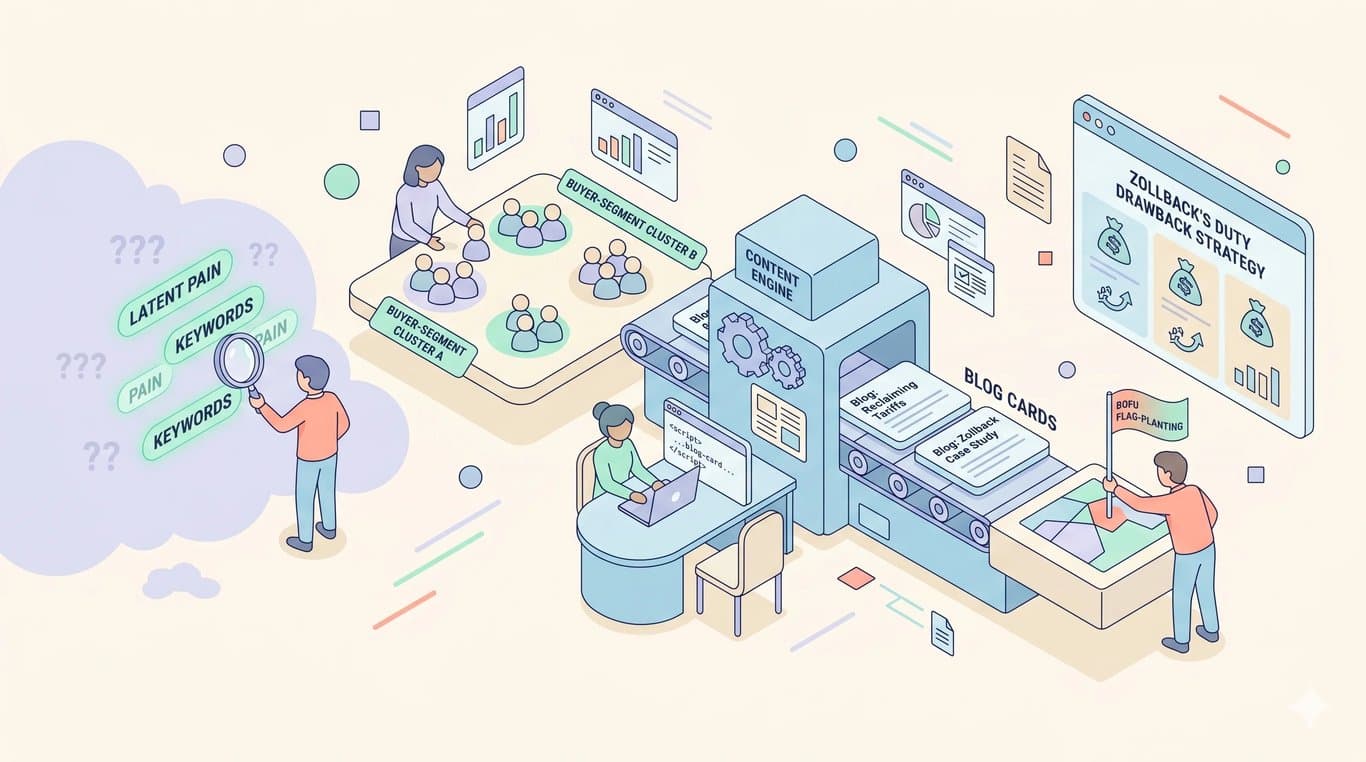
That's the grid. Map every competitor against every intent type against every curriculum framework, and you get a matrix that naturally generates dozens of content slots — each one targeting a distinct, real search query. The 55+ posts aren't 55 random ideas. They're a systematic attempt to occupy every meaningful intersection in that grid.
The Cadence: Bursty, Not Drippy
The 55 posts didn't arrive at a steady 1.3-per-day pace. The publishing was concentrated in waves:
Week 1 (Jun 2–8): 6 posts — the ramp-up
Weeks 2–4 (Jun 9–29): ~35 posts — the main blitz, with spikes of 7+ posts on single days
Weeks 5–7 (Jun 30–Jul 20): ~14 posts — the sustain wave, including more comparison and alternative pieces targeting specific competitors (Curipod, Eduaide, Diffit, Education CoPilot, Gamma)
Publishing multiple related pages in quick succession creates a compounding visibility effect — what some call "surround sound" — where a teacher researching the space encounters Chalkie's brand across multiple different search results in a single session.
Why Content Velocity Matters — Specifically for SaaS
Most SaaS content teams treat blog posts as brand-building assets: slow to produce, intended to demonstrate expertise, measured in traffic over twelve-month windows. That's not wrong, but it's incomplete.
A more useful mental model: each post is a door into your product. It exists at a specific address on the internet. People with a specific problem find it, read it, and either walk through the door or don't. More doors means more entry points. Fifty-five new doors in seven weeks is a different kind of infrastructure investment.
The compounding mechanism is real, and it's particularly powerful when content is published in a compressed window. When multiple Chalkie pages rank for related queries — "best AI lesson plan generator," "Curipod vs Chalkie," "MagicSchool alternatives," "best TEKS aligned tools" — a teacher researching the space encounters Chalkie's brand repeatedly across different pages. That's not one impression; that's five or six. The reinforcement effect is significant.
Directive Consulting's B2B SaaS content research underscores the underlying logic: B2B buyers are non-linear. They move across search results, community forums, peer recommendations, and product review sites before making a decision. A content strategy built around a single piece of cornerstone content is betting everything on one touchpoint. A grid strategy bets on many.
There's also an important distinction between bottom-of-funnel content and educational content in terms of time-to-value. Educational posts — how-to guides, explainers, thought leadership — can take months to accumulate meaningful traffic and even longer to drive signups. Comparison and alternative pages convert at higher rates than awareness content because they reach people who have already decided to buy something. Chalkie's own AI lesson plan generator pages follow this pattern — a teacher searching "best free lesson plan generator" has already decided lesson planning is the problem; they're just choosing the tool.
A Note on the OpenAI Rumor
One detail worth clarifying: in April 2026, Chalkie CEO Phil Daneshyar posted on LinkedIn that OpenAI had begun bidding on Chalkie's branded search terms. This is factually accurate — ETIH reported on it — and established AI players don't typically spend budget targeting a startup's branded keywords unless that startup is gaining meaningful traction. It's a competitive signal.
However, this was not an acquisition. There was no deal, no reported acquisition talks, and no announcement. The rumor appears to have emerged from the search behavior being visible in ad auction data and misinterpreted as commercial intent on OpenAI's part. Chalkie remains an independent company.
What to Take From This
To be clear about what this article is and isn't claiming: the 55-post content blitz coincided with Chalkie's user doubling. The EdTech market was moving, teachers were actively seeking AI tools that didn't produce time-wasting "AI BS," and Chalkie had real product momentum before a single post was published. Content didn't build the rocket. But it may have been the fuel that got it to altitude faster.
The pattern is worth taking seriously, particularly for SaaS teams planning a content investment. Here's what's transferable:
Map your grid before you write a single post. Identify the axes that define your market: competitor names, teacher personas (or buyer types), and any framework-specific variants that create geographic or segment-level differentiation (the equivalent of TEKS or Common Core in your industry). Every intersection on that grid is a potential post. Filling in the grid systematically is a different activity than brainstorming topics.
Lead with commercial intent, not educational content. The instinct to build authority through educational posts first is understandable, but it optimizes for the wrong metric. Comparison and alternative pages convert at higher rates than awareness content because they reach people who have already decided to buy something. Chalkie's own AI lesson plan generator pages follow this pattern – a teacher searching "best free lesson plan generator" has already decided lesson planning is the problem; they're just choosing the tool.
Publish the full set in a compressed window. One comparison page is a page. Thirty comparison pages, published together, is a content moat. The surround-sound effect (where a researcher encounters your brand across multiple search results in a single session) doesn't happen if you publish one post per month. Chalkie's six-week sprint created compounding visibility that a drip approach would have taken a year to build.
Be honest in your comparisons, even when it's uncomfortable. Teachers are a savvy, skeptical audience. One Reddit thread on Chalkie captures the frustration with AI tools that overpromise: teachers recount spending 40 minutes fixing slides that were supposed to save them time, while simultaneously dealing with administrative pressure and unrealistic performance expectations. That skepticism doesn't disappear when they're reading a comparison page. Acknowledging a competitor's genuine strengths (rather than producing a one-sided hit piece) is what turns a marketing asset into a trusted resource. As one SaaS community participant put it, the frustration is specifically with content that's "exaggerated or providing lies." Avoid that, and your comparison page becomes a reference; lean into it, and readers close the tab.
Treat content as infrastructure, not inventory. The mental model shift matters. If each post is a brand asset, you're thinking about polish and voice. If each post is a door, you're thinking about coverage and distribution. Fifty-five doors is a meaningful footprint. Fifty-five polished brand essays, published over two years, probably isn't.
Make Chalkie’s Playbook Your Own
Chalkie's success wasn't an accident; it was the result of a systematic content sprint. You can run the same play. The key is to prioritize high-intent comparison and alternative posts, map competitors against your specific buyer personas, and publish in a compressed timeframe to create a "surround-sound" effect for active buyers.
Executing a high-velocity strategy like this requires a content engine that can keep up. If your current CMS makes publishing slow and clunky, you can’t build momentum. A headless CMS removes the friction between writing and publishing, and Wisp's free plan is a good way to see it in action.
FAQs
What was Chalkie's main content strategy for growth?
Chalkie's main content strategy was to rapidly publish a high volume of bottom-of-funnel content. They focused on comparison and alternative posts targeting users ready to buy, rather than general educational articles. This created a strong commercial-intent footprint quickly.
Why did Chalkie focus so much on comparison and alternative content?
Chalkie focused on comparison and alternative content because it targets high-intent buyers. These readers are actively researching solutions and are much closer to making a purchase decision, leading to higher and faster conversion rates compared to top-of-funnel content.
How much content did Chalkie publish during their content blitz?
During their content blitz, Chalkie published 55 blog posts in about seven weeks. Approximately 70% of these posts were high-intent articles, such as comparisons and "best of" listicles, directly targeting potential customers.
What is the "content grid" mentioned in the article?
The content grid is a systematic way to generate article ideas by mapping key variables against each other. For Chalkie, this meant mapping competitors against buyer personas (e.g., high school teachers) and specific curriculum frameworks (e.g., TEKS) to create dozens of targeted posts.
Was Chalkie's content the only reason for their rapid user growth?
The content blitz was a major factor, but not the only one. Chalkie's user growth was also supported by a strong product, recent funding, and existing market momentum. The content acted as a powerful accelerant, capturing active buyers at a critical time.
How can another SaaS company replicate Chalkie's playbook?
To replicate Chalkie's playbook, a SaaS company should first map its own content grid (competitors vs. buyer personas). Then, prioritize creating bottom-of-funnel content and publish it in a compressed sprint to maximize impact and capture active researchers.
What is the "surround-sound" effect and why does it matter?
The "surround-sound" effect occurs when a potential customer repeatedly encounters your brand across multiple search results while researching a solution. This builds familiarity and trust, making them more likely to choose your product when they are ready to buy.